Enhancing Supply Chain Visibility with Construction Technology to Optimize Project Outcomes
Supply chain visibility in construction means having timely, accurate information about materials and components from purchase through installation so teams can coordinate work, avoid delays, and cut rework. This article shows how digital tools—material-tracking systems, BIM, VDC, IoT and analytics—create dependable data flows and produce measurable results like better schedule performance and less waste. You’ll see what visibility looks like on the job, how digital construction logistics reshape material flow, the roles BIM and VDC play in procurement and sequencing, and which emerging technologies increase resilience. We also map practical tools (RFID, GPS, sensors, robotic layout, 3D scanning) to supply-chain stages, suggest KPIs to track progress, and explain how specialist providers can operationalize these solutions across the Southeastern U.S. — including how teams should begin adopting visibility-driven workflows.
What is Supply Chain Visibility in Construction and Why Does It Matter?
Supply chain visibility in construction is real-time clarity about what materials exist, where they are, and when they’ll be installed — backed by integrated data between procurement, logistics and field teams. Visibility comes from connecting procurement records, model data and field sensors so stakeholders can spot delays, sequence deliveries and align site activity before issues escalate. Its core advantage is reducing uncertainty: when teams see material status, they over-order less, lose fewer shipments and avoid installation conflicts that trigger costly rework. Industry evidence shows projects that improve traceability achieve better schedule adherence and fewer change orders. Grasping how visibility works sets up the practical tools and workflows we cover next.
Clear visibility short-circuits downstream disruptions by enabling earlier interventions and tighter coordination. The next section explains the specific mechanisms that shorten lead times and cut costs.
How Does Supply Chain Visibility Reduce Delays and Costs?
Visibility reduces delays and cost overruns by surfacing exceptions early, enabling tighter sequencing, and improving inventory accuracy before parts reach the point of use. With reliable lead-time data and on-site status, teams can re-sequence work, avoid last-minute expedited shipments, and keep crews productive. Visibility also prevents duplicate orders and excess stock, freeing capital and reducing on-site congestion. Key mechanisms that deliver these outcomes include:
- Early exception detection that alerts procurement and field teams when deliveries slip so contingency plans can start immediately.
- Sequencing adjustments that enable just-in-time deliveries aligned with contractor schedules to avoid unnecessary handling.
- Accurate inventory counts that reduce duplicate purchases and lower the labor needed for reconciliation.
- Integrated, model-based planning that prevents mis-ordered components by matching procurement to as-built geometry.
Those mechanisms convert to measurable savings through fewer change orders, less expedited freight, and reduced corrective labor. Detecting problems earlier naturally leads into the challenges visibility must overcome.
What Are the Common Challenges in Construction Supply Chains?
Construction supply chains are hindered by fragmented stakeholders, siloed systems, manual tracking, variable lead times and inconsistent on-site verification — all of which limit visibility and coordination. Fragmentation happens when owners, GCs, subcontractors and suppliers use different tools or spreadsheets, preventing a unified status view. Paper manifests and ad hoc tagging introduce errors and slow reconciliation. Long-lead items and global sourcing create lead-time variability that complicates sequencing and demands predictive tools. Differences between as-designed and as-built conditions also produce mismatches between ordered parts and installation needs. Identifying these pain points helps teams prioritize the processes and technologies that will yield the fastest visibility improvements.
Solving these issues starts with mapping technologies to supply-chain stages — the focus of the next section on digital construction logistics.
How Does Digital Construction Logistics Improve Material Flow and Coordination?

Digital construction logistics pairs scheduling, real-time tracking, sequencing rules and centralized coordination so materials arrive where and when they’re needed, while minimizing on-site handling and storage. Typical mechanisms include just-in-time delivery tied to model-driven schedules, centralized dispatch that sequences multi-trade deliveries, and automated reconciliation between delivery records and procurement. These practices cut double-handling, reduce work stoppages from missing parts, and optimize crane and laydown usage by syncing material readiness with installation windows. Implementation usually begins by mapping workflows: who confirms deliveries, how sensors report locations, and which system authorizes site releases.
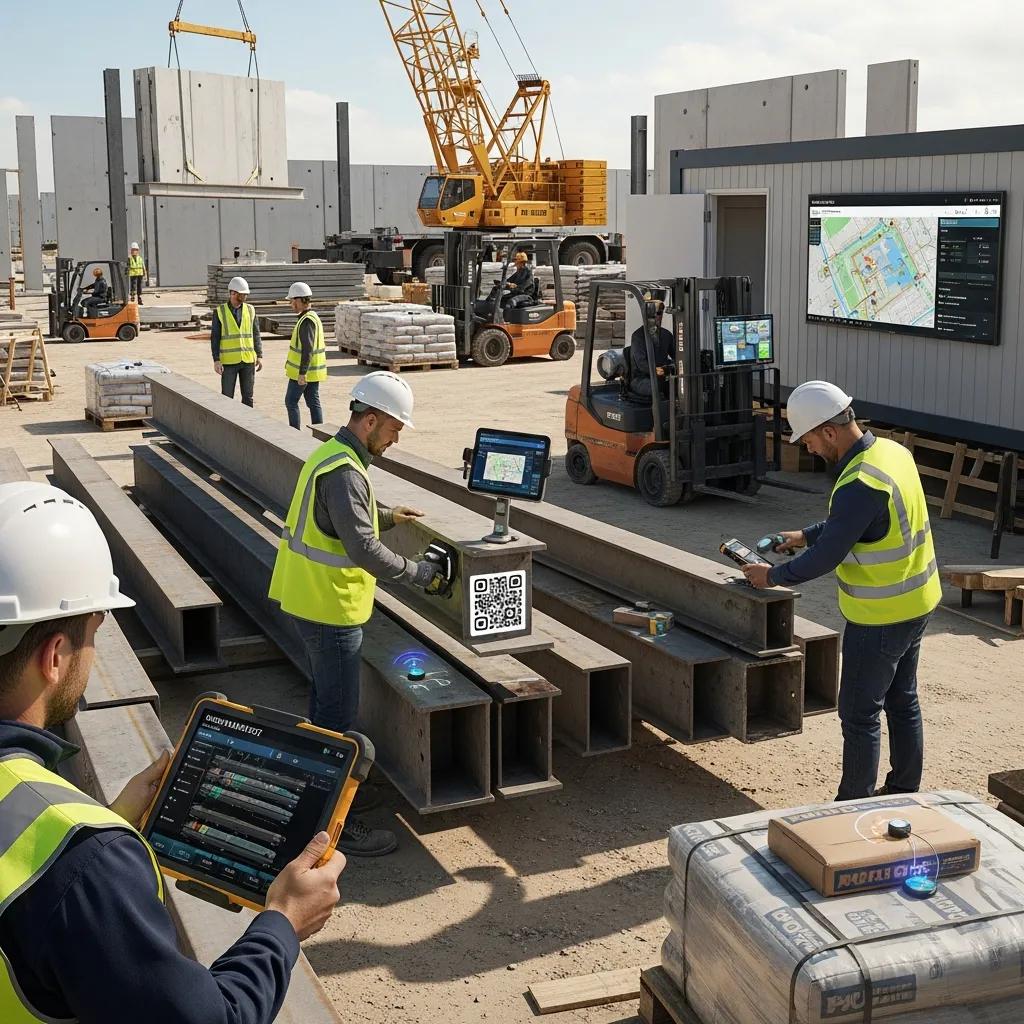
In practice, RFID tags, GPS trackers and site IoT nodes are combined with model data and layout-accuracy services to make sequencing and tracking operational. For example, Robotic Total Station layout and 3D scanning validate that delivered components match planned as-built positions, and VDC workflows fold that validation into procurement and installation schedules. These examples show how precision layout and model integration turn tracking signals into installation decisions.
The table below maps common tracking and logistics technologies to supply-chain stages and operational roles to help guide implementation choices.
Different technologies serve distinct roles across procurement, transit and on-site handling.
| Technology | Supply Chain Stage | Role |
|---|---|---|
| RFID tags | On-site delivery & staging | Provide item-level presence and bin-level counts for fast reconciliation |
| GPS trackers | Long-haul/transit | Reveal carrier location and estimated time of arrival for sequencing |
| IoT sensors | Storage zones & environmental monitoring | Monitor inventory status and conditions (temperature, humidity) for sensitive materials |
| Material Tracking Software | Procurement-to-field integration | Reconciles orders, receipts, and model-based install locations for approvals |
This mapping helps teams choose the right tech for indoor vs. outdoor tracking and for high-value versus bulk items. The summary below connects those roles to practical next steps.
Choosing the right mix of tags, trackers, sensors and software enables predictable deliveries and smoother site operations. The next subsections cover real-time tracking and technology trade-offs that inform those selections.
What Role Does Real-Time Material Tracking Play in Construction Sites?
Real-time material tracking gives immediate visibility into where critical items are on site, when they’re expected to be installed, and whether any handling constraints exist — which cuts search time and prevents missed installation windows. Typical scenarios include quickly locating a missing component that would otherwise halt work, or rerouting a delivery when the laydown area becomes congested. Tracking data supports dynamic schedule adjustments: superintendents can shift crews or reorder tasks when a late delivery won’t affect a critical-path activity. An implementation checklist covers tagging strategy, integration with scheduling tools, reader placement, and clear ownership for exception handling. Real-time visibility shortens response loops and lowers the risk of costly downtime.
Reliable location data also improves productivity measurement and helps teams refine logistics rules over time, which leads into the technology selection trade-offs discussed next.
How Do RFID, GPS, and IoT Technologies Enhance Inventory Management?
RFID, GPS and IoT sensors handle inventory in complementary ways: RFID excels at indoor, item-level counts; GPS provides transit visibility; and IoT sensors monitor storage conditions and zone-level status. RFID speeds reconciliation at receiving and staging without line-of-sight scanning, reducing manual counts and shrinkage. GPS reduces transit uncertainty by showing carrier position and ETA, which informs sequencing. IoT nodes extend visibility to environmental conditions important for sensitive materials or prefabricated assemblies. Selection depends on use case: deploy RFID for high-turnover small components, GPS for vendor shipments, and IoT for storage monitoring. Integration tips include tying tag IDs to procurement SKUs and feeding tracking data into model-based location fields for consistent references.
The right technology mix reduces reconciliation labor and improves inventory accuracy, preparing teams to link model-driven planning with procurement via BIM and VDC.
In What Ways Do BIM and VDC Optimize Supply Chain Management in Construction?
BIM and VDC form the digital backbone for supply-chain decisions by linking quantities, installation locations and sequencing metadata to procurement and logistics workflows. BIM generates accurate takeoffs and ties parts to model geometry, while VDC uses model data to simulate sequencing, prefabrication and site logistics so suppliers and installers can align schedules. Together they reduce procurement errors, inform prefabrication and enable clash detection that prevents mismatches between delivered components and field conditions. These model-driven processes shorten lead times and protect schedule milestones through coordinated planning and digital handoffs.
Operationally, VDC consulting translates model data into staging plans, delivery windows and on-site placement procedures. Conway Coordination and Layout Services (CCLS) provides VDC consulting and BIM modeling & coordination that map model outputs to procurement and logistics rules; teams can request a consultation to explore how those services fit a project’s workflow and sequencing needs. The table below links BIM and VDC functions to procurement and logistics benefits.
The table clarifies how model capabilities translate into measurable logistics improvements.
| Digital Capability | Function | Benefit |
|---|---|---|
| BIM modeling & coordination | Accurate takeoffs and geometry mapping | Reduced mis-ordered materials and clearer procurement specs |
| Clash detection | Automated conflict identification | Fewer field change orders and lower rework costs |
| VDC sequencing | Simulation of construction sequences | Optimized delivery windows and reduced on-site congestion |
| Model-to-fabrication links | Prefab-ready shop drawings | Shorter fabrication lead times and higher install quality |
Using these functions together builds a pipeline from design to procurement to installation that reduces surprises and accelerates handoffs. The next subsections describe BIM planning and VDC benefits in implementation terms.
How Does BIM Enhance Material Planning and Clash Detection?
BIM improves material planning by producing data-rich quantity takeoffs, linking parts to precise model locations, and enabling early clash detection to keep incompatible shipments from leaving the shop. The workflow moves from model creation to automated takeoffs, then to procurement packages and prefabrication drawings so ordered items match the virtual design. Clash detection flags spatial conflicts early, avoiding the shipment of incompatible assemblies and reducing corrective shipments and field labor. This model-driven alignment also clarifies supplier instructions and reduces ambiguity in purchase orders, improving on-time delivery and lowering change-order risk.
Accurate BIM data shortens the feedback loop between design and procurement and sets up how VDC streamlines logistics and sequencing across trades.
What Are the Benefits of VDC for Streamlining Construction Logistics?
VDC streamlines logistics by simulating sequences, validating access and laydown plans, and coordinating multi-trade installations in a virtual environment that mirrors field constraints. Digital mockups reveal pinch points for deliveries, allow planners to schedule crane time effectively, and confirm the feasibility of prefabricated assemblies before fabrication starts. VDC consulting also turns schedule logic into delivery windows and handoff criteria suppliers can meet. The result is fewer installation conflicts, better use of site resources, and less likelihood of last-minute production changes. These operational gains make it easier to layer in predictive technologies for added resilience.
With model-driven logistics in place, teams can add AI forecasting and immutable records to improve prediction accuracy and provenance, explored in the next section.
Which Advanced Technologies Are Driving Supply Chain Resilience in Construction?

Advanced tools — AI/ML, blockchain and digital twins — are strengthening construction supply-chain resilience by improving forecasting, provenance and scenario planning. AI and machine learning analyze historical lead times, seasonality and vendor performance to surface likely delays and suggested mitigations. Blockchain creates tamper-evident provenance for critical components where traceability matters. Digital twins combine live sensor feeds with model data to simulate logistics scenarios and stress-test sequencing before changes hit the site. Together these technologies shift decision-making from reactive to predictive and auditable. Adoption requires data governance and integration effort but delivers greater confidence in supply continuity and faster recovery from disruptions.
The subsections that follow break down AI forecasting use cases and the practical impact of blockchain and digital twins on transparency and predictive logistics.
How Are AI and Machine Learning Used for Supply Chain Forecasting?
AI and machine learning forecast material demand, model lead-time variability and flag supplier anomalies by training on procurement history, transit data and site consumption patterns. Models can predict which orders are at risk of late delivery, estimate realistic arrival windows, and recommend buffer strategies for high-variability items. Inputs include past order dates, supplier reliability scores, transit times and seasonality; limitations include sparse data for one-off items and changes in supplier networks. Practical outputs are prioritized procurement alerts and probabilistic ETAs that inform sequencing, enabling procurement teams to act before delays materialize.
Predictive alerts from AI models improve procurement responsiveness and pair naturally with provenance systems like blockchain and simulation platforms such as digital twins.
What Is the Impact of Blockchain and Digital Twins on Transparency and Predictive Logistics?
Blockchain strengthens provenance by creating immutable records of material origin, certifications and transfer events that build trust across multi-party supply chains — valuable for high-spec or safety-critical components. Digital twins extend visibility by merging live sensor data with the model, allowing teams to run what-if simulations for routing, staging and installation sequencing. Benefits include greater transparency, tamper-resistant records and the ability to rehearse logistics scenarios; drawbacks include integration complexity and the need for consistent data standards. When combined, provenance and simulation improve the quality of inputs feeding forecasts and make predictive logistics more reliable and auditable.
With resilience boosted by these advanced tools, project teams can measure outcomes and quantify benefits — addressed in the next section.
How Does Conway Coordination and Layout Services Support Enhanced Supply Chain Visibility?
Conway Coordination and Layout Services (CCLS) enhances supply-chain visibility through a focused set of services — Robotic Total Station layout, VDC consulting, 3D scanning and point-cloud integration, plus BIM modeling & coordination — that turn model data and field measurements into operational logistics decisions. CCLS applies these capabilities to improve installation accuracy, reconcile as-built conditions with procurement, and streamline sequencing through VDC-driven workflows. The company emphasizes precision via Trimble Robotic Total Station layout, VDC and BIM integration that tie design to procurement, and time-and-cost efficiency through reliable coordination. Teams ready to operationalize visibility strategies can request a consultation to align model outputs, layout verification and tracking data with their project requirements.
By mapping services to logistics outcomes — accurate layout reducing rework, scans validating deliveries, and VDC informing sequencing — CCLS helps project teams build executable workflows. For teams in the Southeastern U.S., this service mix creates a practical path from model-based planning to field execution and invites direct consultation to tailor solutions to project constraints.
What Are the Benefits of Robotic Total Station Layout for Precision Logistics?
Robotic Total Station layout delivers millimeter-level positioning that ensures delivered components align with model coordinates, reducing installation adjustments and the need for corrective shipments. Accurate layout prevents cascading delays where one misaligned element forces downstream rework, and it cuts time spent on field measurement and verification during installation. For prefabricated components, precise layout lowers the risk of fit issues and minimizes site modifications that add cost and slow schedules. Better alignment between delivered components and as-built conditions supports tighter sequencing and less materials handling.
These operational benefits show how precision layout directly enables predictable logistics and smoother handoffs between delivery and installation.
How Do 3D Scanning and VDC Consulting Services Improve Supply Chain Strategy?
3D scanning produces as-built point clouds that validate existing conditions and expose deviations from design that affect procurement and prefabrication accuracy. Integrating scan data into BIM lets teams confirm a fabricated assembly will fit before shipping, reducing surprise returns or on-site modifications. VDC consulting turns those validated models into sequencing rules, staging plans and delivery windows that suppliers and installers can follow. The workflow — scan, register point cloud, update model, confirm procurement — reduces uncertainty and aligns fabrication with actual field conditions, lowering the risk of costly corrective logistics.
Using scans and VDC together closes the loop between field reality and digital planning, improving procurement precision and installation reliability.
What Are the Measurable Benefits of Implementing Technology-Driven Supply Chain Solutions?
Technology-driven supply-chain solutions produce measurable gains in schedule adherence, inventory accuracy, waste reduction and rework avoidance when paired with clear KPIs and governance. Typical KPIs include improvements in on-time deliveries, reductions in material-related change orders, inventory reconciliation time and percent reduction in waste or over-ordered materials. Combining model-driven planning, real-time tracking and accurate layout typically results in fewer expedited shipments, less corrective labor and healthier project cash flow. The table below compares common technologies against the metrics they most directly improve to help teams prioritize investments by expected impact.
This table helps decision-makers match technology choices to the outcomes they need to measure.
| Technology | Metric Improved | Typical Impact |
|---|---|---|
| BIM & VDC | Schedule adherence | 10–25% improvement through better sequencing and clash avoidance |
| RFID & Tracking | Inventory accuracy | 70–95% accuracy gains in staged materials and components |
| IoT Sensors | Condition-related waste | Reduced spoilage or damage by enabling environmental controls |
| Robotic Layout | Rework reduction | Significant reductions in corrective installation labor and return shipments |
These estimates vary with project size and baseline maturity but provide directional expectations. The following subsections explain how technology reduces waste and rework and where case examples show scheduling improvements.
How Does Technology Reduce Construction Waste and Rework?
Technology cuts waste and rework by spotting design conflicts early (clash detection), validating as-built conditions (3D scanning and layout), and keeping accurate inventory counts (RFID and tracking) to prevent over-ordering. Clash detection stops fabrication of parts that won’t fit, reducing scrap and returns. Accurate layout prevents misplacement that would otherwise require demolition or rework. Real-time tracking reduces loss and misplacement that lead to repurchase. KPIs to quantify these effects include volume of material returned, number of fit-related change orders, and percentage reduction in on-site scrap — together they show the environmental and cost benefits of visibility investments.
Less waste and rework directly improves schedule predictability and cost control, leading into project examples that demonstrate these gains.
What Case Studies Demonstrate Improved Project Scheduling and Material Flow?
Teams routinely report better schedule adherence and fewer material-related delays when they combine model-driven planning with real-time tracking and precise layout, though public metrics vary by project. Examples include a prefabrication program where clash detection and model-to-fab links reduced shop rework and shortened lead times, and a jobsite using RFID reconciliation that cut receiving reconciliation time and prevented duplicate orders. When provider engagement includes VDC consulting tied to layout verification, teams can quantify benefits such as percent reductions in change orders and accelerated critical-path milestones. Organizations seeking documented, project-specific results can run pilots with specialist providers to capture baselines and measure improvements.
Capturing those results creates a feedback loop for continuous logistics improvement and shows how dedicated services can scale visibility gains across projects.
Frequently Asked Questions
What technologies are essential for enhancing supply chain visibility in construction?
Essential technologies include Building Information Modeling (BIM), Virtual Design and Construction (VDC), Radio Frequency Identification (RFID), Global Positioning System (GPS) tracking and Internet of Things (IoT) sensors. BIM and VDC form the planning backbone, while RFID and GPS deliver practical tracking and inventory control. IoT sensors monitor storage conditions and inventory status so materials arrive and are stored under appropriate conditions. Together, these tools create a cohesive system that improves visibility and efficiency across the supply chain.
How can construction teams start implementing visibility-driven workflows?
Begin by assessing current processes and identifying visibility gaps. Map supply-chain stages and pinpoint where technology will add the most value. Prioritize training on digital tools and establish clear protocols for data sharing among stakeholders. Start with a pilot to refine workflows and measure gains, and consider engaging specialist consultants to accelerate adoption and align systems with on-site practices.
What are the potential cost savings from improved supply chain visibility?
Improved visibility can yield significant savings by reducing delays, minimizing waste and lowering rework. Teams commonly see fewer expedited shipments, reduced change orders and less corrective labor. While results vary, studies indicate visibility improvements can boost schedule adherence by 10–25% and increase inventory accuracy up to 95%, supporting healthier cash flow and greater project profitability.
How does real-time tracking influence project management in construction?
Real-time tracking gives project managers immediate insight into material locations, expected installation times and potential handling issues. That visibility supports informed decisions like schedule adjustments or resource reallocation to prevent delays. It also improves team communication so everyone understands material status and next steps. By cutting search time and preventing missed installation windows, real-time tracking smooths execution and raises overall efficiency.
What role does data governance play in supply chain technology adoption?
Data governance is essential for successful technology adoption. It ensures data is accurate, consistent and secure across platforms so tools like AI, blockchain and IoT can deliver reliable outputs. Good governance sets standards for collection, sharing and use of data, reduces risk of breaches and builds stakeholder trust. With strong governance in place, teams can make better decisions and realize the full value of their visibility tools.
How can construction companies measure the success of their supply chain visibility initiatives?
Measure success with KPIs such as on-time delivery rate, inventory accuracy, reduction in change orders and waste minimization. Track these metrics over time to evaluate the effect of technologies and workflows. Regular reviews and audits reveal opportunities for improvement. Establishing a feedback loop lets teams refine strategies and steadily improve supply-chain performance.
Conclusion
Adopting construction supply-chain technologies materially improves visibility and project outcomes. By combining BIM, VDC and real-time tracking with precise layout and scanning, teams can tighten logistics, cut waste and keep schedules on track. These insights help construction professionals make the practical decisions that drive efficiency. If you’re ready to improve supply-chain predictability, start by exploring tailored consulting services that fit your project and region.