
VDC Construction Consulting in Richmond, VA: Practical Virtual Design & Construction for Faster, More Accurate Projects
Virtual Design and Construction (VDC) consulting brings digital workflows into the field to lower risk, tighten schedules, and increase installation accuracy on Richmond-area projects. This guide walks through what VDC is, why it matters for local permitting and contractor coordination, and how proven practices—centered on BIM, reality capture, and model-driven layout—turn designs into reliable site results. You’ll find the key technologies, step-by-step implementation guidance, industry use cases, and a clear plan to launch a pilot that delivers measurable ROI: less rework, faster turnover, and cleaner handoffs. The content follows the project path from model creation and clash detection through fabrication handoffs and robotic total-station layout, with lists, comparison tables, and workflows to help teams decide next steps for a Richmond pilot.
What is VDC Construction Consulting and How Does It Benefit Richmond Projects?
VDC construction consulting applies disciplined digital processes—primarily BIM, reality capture, and model-based coordination—to align design, fabrication, and field work and cut uncertainty and rework. The practical chain is straightforward: accurate federated models enable early clash detection and fabrication-ready outputs, which reduce RFIs and limit on-site adjustments during installation. On Richmond projects this typically means smoother permitting reviews, clearer coordination across local trades, and fewer schedule-driven cost premiums. Below we summarize the primary benefits as measurable outcomes, then explain how each one plays out on typical projects.
VDC delivers several high-impact, measurable benefits for construction projects in Richmond:
- Reduced Rework: Regular clash detection and model validation lower on-site corrections and rework percentages.
- Schedule Compression: Prefabrication and precise layout accelerate installations and shorten critical-path activities.
- Cost Avoidance: Early coordination curbs last-minute changes and expensive field fixes.
- Improved Collaboration: Shared federated models and standardized deliverables make communication between designers and trades more efficient.
- Higher Site Accuracy: Model-driven field layout with robotic total stations yields millimeter-level placement precision.
This comparison table links common VDC deliverables to their core benefits and typical impact metrics so teams can estimate ROI before mobilization.
VDC deliverables mapped to likely impacts:
| Deliverable | Primary Benefit | Typical Impact |
|---|---|---|
| Clash Detection Reports | Reduced onsite conflicts | Fewer RFIs and up to 30% lower rework on coordinated systems |
| Fabrication-ready Models | Faster prefabrication | Shorter lead times and reduced field labor hours |
| Model-based Field Layout | Accurate installation | Millimeter accuracy; fewer corrective site surveys |
These deliverables form the practical foundation for ROI: early detection and precise execution convert directly into saved time and cost. With that foundation established, the next section defines VDC and its role across the project lifecycle.
Defining Virtual Design and Construction and Its Role in Construction
Virtual Design and Construction (VDC) is a process that uses coordinated digital models and repeatable workflows to plan, simulate, and manage construction outcomes before crews start work in the field. VDC centers Building Information Modeling (BIM) as the primary data environment, then pairs it with reality capture and logistics planning to create a single source of truth for project stakeholders. Model-driven coordination surfaces spatial conflicts and constructability issues early, allowing teams to resolve them in preconstruction rather than in the field. In practice, VDC is applied during design development, coordination sprints, prefabrication planning, and model-based field layout—bridging design intent to physical execution. That leads naturally to the practical question: exactly how does VDC lower costs and speed schedules on real projects?
How VDC Consulting Reduces Costs and Enhances Project Efficiency
VDC consulting reduces cost and boosts efficiency through focused practices like scheduled clash detection, fabrication-ready modeling, and model-based QA/QC for field installation. Clash detection finds geometric and systems conflicts early so trades can coordinate, reducing mid-construction change orders and labor overruns. Fabrication-ready models enable off-site assembly, cutting on-site labor, weather exposure, and quality risks. Model-based QA/QC and field layout—often executed with robotic total stations—translate model coordinates to the site with millimeter precision, minimizing corrective work and disruptive re-sequencing. The section below explains how a firm like CCLS implements these steps for Richmond projects and what a typical engagement looks like.
How Does CCLS Implement VDC Consulting Services in Richmond, VA?
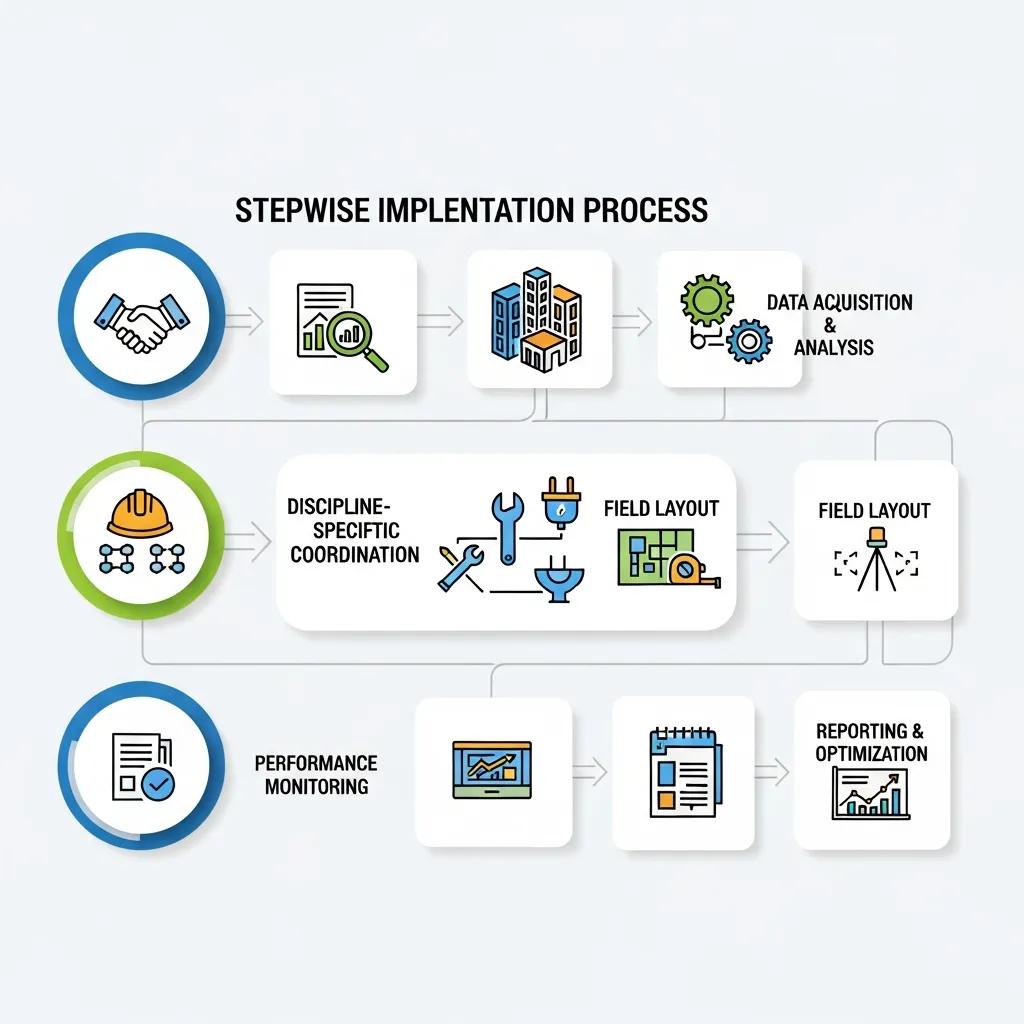
CCLS delivers VDC consulting through a structured, repeatable process that turns digital models into precise field execution. Our high-level sequence is: onboarding and standards setup, federated model creation, scheduled clash detection and triage, prefabrication/shop-model handoffs, and model-based field layout with verification. Each step produces measurable deliverables and relies on tools such as BIM authoring platforms, 3D laser scanning, point-cloud integration, and Trimble Robotic Total Station layout systems. Below is a concise, numbered process designed to help project teams evaluate a consultant quickly.
CCLS follows a clear stepwise implementation for VDC consulting:
- Project Onboarding & Standards Audit: Review existing models, naming conventions, and deliverable expectations.
- Model Federation & Coordination: Build federated models, run clash detection, and generate prioritized clash reports.
- Prefabrication & Shop Model Handoffs: Produce fabrication-ready models and coordinate with trades for off-site builds.
- Field Layout & Verification: Translate model coordinates to site points with robotic total stations and confirm installations.
- Training & Support: Deliver on-site and remote training so owners and contractors sustain model-driven workflows.
This sequence shows how digital models become actionable field work and sets up the tailored strategies CCLS applies for each Richmond engagement.
Tailored VDC Strategy Development and Workflow Optimization
Every Richmond engagement starts with a tailored VDC strategy that aligns project goals, stakeholder roles, and deliverable cadence to the client’s risk profile and schedule. We begin with an audit of existing BIM assets and site conditions, then run a pilot coordination sprint to validate standards, clash thresholds, and reporting formats. Deliverables commonly include coordination models, clash matrices with triage notes, fabrication-ready submodels, and handoff procedures that integrate with procurement and prefabrication timelines. CCLS focuses on change management through short training sessions and playbooks that clarify model ownership, issue-tracking protocols, and coordination meeting cadence. A clear onboarding and handover framework helps teams scale the VDC workflow while minimizing disruption to site operations.
Technology Integration: BIM, 3D Scanning, and Robotic Total Station Usage
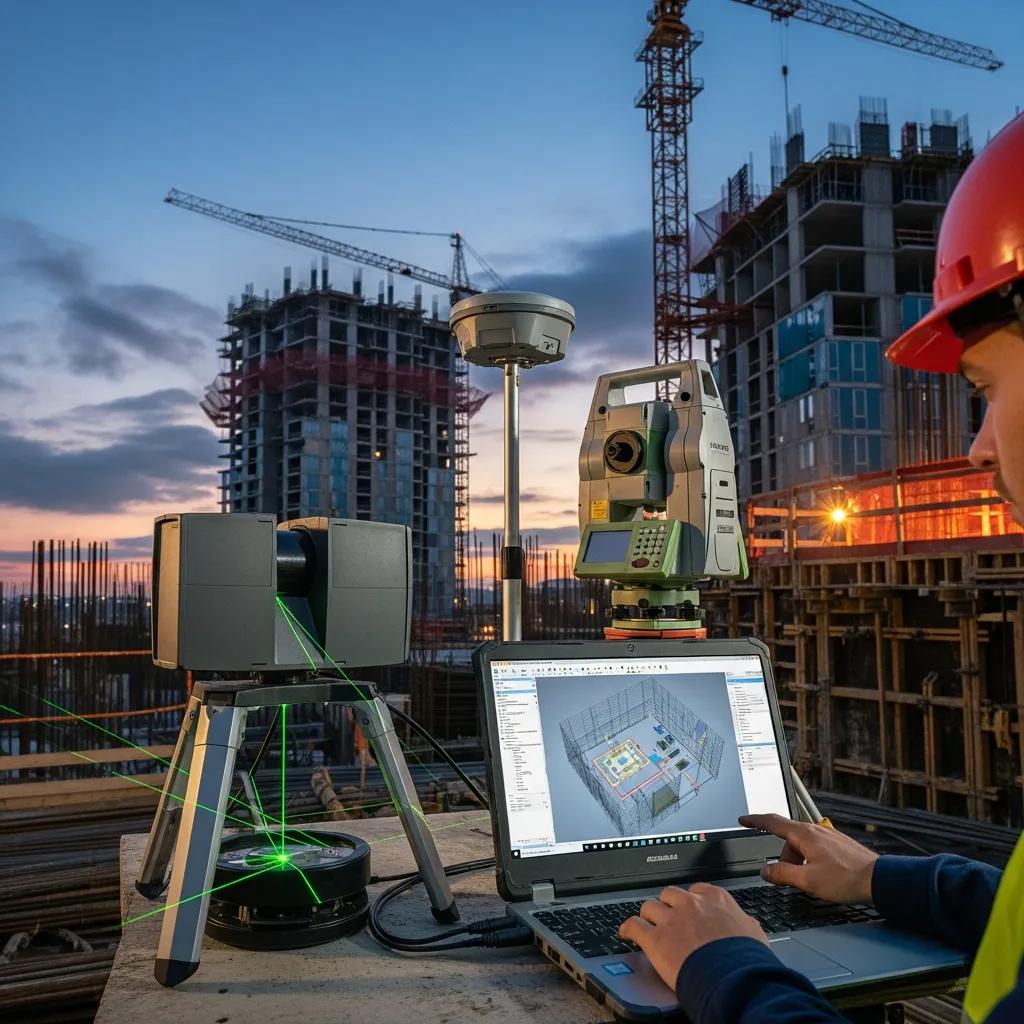
At CCLS we integrate BIM authoring, reality capture, and precision layout tools so a single coordinate system governs both digital and physical workflows. Scan-to-BIM converts 3D laser-scan point clouds into as-built models registered to project coordinates, enabling accurate updates and verification. Clash detection in a federated model highlights conflicts that are resolved and exported as fabrication-ready geometry. Finally, model coordinates are fed to Trimble Robotic Total Stations for model-based field layout with millimeter-level placement accuracy. These integrations close semantic gaps between the model and the field, reducing installation errors and streamlining handoffs.
What Are the Key VDC Technologies and Processes Used in Richmond Construction?
Key VDC technologies pair model authoring, reality capture, and precision layout instruments into a resilient digital construction workflow that reduces errors and speeds delivery. BIM provides authored data, clash detection delivers conflict intelligence, 3D scanning supplies verified as-built references, and robotic total stations translate model coordinates to the site. The table below maps these tools to their attributes and common use cases to help teams select the right combination for a project.
Technology mapping for digital construction tasks:
| Technology | Attribute | Typical Use Case |
|---|---|---|
| BIM (Revit, federated models) | Authoring & data integration | Coordination models and fabrication-ready deliverables |
| 3D Laser Scanning | Reality capture & point cloud | As-built verification and existing conditions modeling |
| Robotic Total Station (Trimble) | Precision field layout | Model-based layout and QA/QC for installed elements |
This mapping clarifies how each tool supports model creation, verification, and field execution, and leads into more detailed process descriptions for clash detection and reality capture.
Building Information Modeling and Clash Detection Techniques
BIM-driven clash detection is a repeatable workflow: build a federated model, run rule-based clash sweeps, and triage results into actionable issues with assigned owners and priorities. A best practice cadence is weekly coordination runs during early design, with more frequent checks during prefabrication planning; this prevents conflict accumulation and allows trades to resolve issues before fabrication. Typical outputs are prioritized clash reports, annotated screenshots, and a resolution timeline that feeds procurement and shop-drawing milestones. Regular coordination meetings and a defined triage protocol keep the model authoritative, reduce RFIs, and align installation with design intent.
3D Scanning and Reality Capture for Accurate Digital Models
3D laser scanning captures detailed point clouds of existing conditions and in-progress work, enabling scan-to-BIM workflows that reconcile field conditions with design models. Point-cloud registration and cleanup create high-quality references that drive model updates and support as-built verification, with accuracy thresholds set where millimeter-level fidelity is required. Integrating point clouds with BIM supports gap analysis, retrofit planning, and verification of prefabricated elements before shipment. Clear tolerances for scan quality and registration turn captured data into usable models that inform fabrication and layout activities.
Which Industries in Richmond Benefit Most from VDC Construction Consulting?
VDC consulting applies across Richmond sectors but delivers the strongest returns in healthcare, industrial, commercial, and historic preservation projects—where coordination complexity or precision requirements are high. Each industry needs tailored VDC tactics: healthcare prioritizes MEP coordination and phased sequencing for infection control, industrial projects focus on heavy-equipment interfaces and tolerance-driven layouts, and commercial fit-outs rely on schedule compression and tenant coordination. The table below summarizes industry-specific VDC applications and the measurable outcomes teams can expect when VDC is applied well.
Industry-specific VDC applications and outcomes:
| Industry | VDC Application | Typical Outcome/Metric |
|---|---|---|
| Healthcare | MEP coordination, phased construction | Reduced downtime during turnover; fewer change orders |
| Industrial | High-precision equipment layout | Millimeter-level tolerances; reduced installation rework |
| Commercial | Tenant fitouts and schedule compression | Faster project turnover; improved tenant satisfaction |
These mappings show where model-driven coordination produces the greatest impact and lead into application examples and case-study templates tailored for Richmond projects.
VDC Applications in Healthcare, Industrial, and Commercial Construction
In healthcare, VDC targets precise MEP coordination, room-level asset tracking, and phased sequencing to support infection-control protocols and limit service interruptions. Industrial facilities use VDC for exact layouts of heavy process equipment, piping interfaces, and to ensure fabrication tolerances match foundations. Commercial projects benefit from accelerated coordination for tenant spaces, enabling parallel fabrication of MEP racks and timely fit-outs. Across sectors, success depends on clear model ownership, defined trade deliverables, and acceptance criteria for prefabricated components—practical levers that reduce operational risk and increase predictability.
Case Studies Highlighting Successful Richmond VDC Projects
Below are short case-study templates and illustrative outcomes Richmond teams can use to set expectations before engaging a VDC consultant. Each template follows Problem → Solution → Outcome and highlights measurable gains—reduced rework, compressed schedules, or verified installation accuracy. Use these templates to build an internal business case and pilot low-risk packages such as an MEP coordination sprint or a single-system prefabrication pilot. The next section answers common questions and outlines starter steps for firms beginning VDC implementation.
What Are Common Questions About VDC Consulting in Richmond, VA?
Teams often ask how VDC differs from BIM and how to start with small pilots that scale. The short answer: BIM is the modelling environment and data structure; VDC is the end-to-end process that uses BIM plus coordination, field verification, and execution practices to produce predictable outcomes. Typical adoption begins with a VDC audit or pilot, standards definition, and targeted training—then scales through documented handover playbooks. The list below gives practical starter actions teams can take to integrate VDC with low risk and fast learning.
Practical starter actions to begin VDC integration:
- Conduct a VDC Audit: Review current models, standards, and coordination gaps.
- Run a Pilot Coordination Sprint: Pick one trade or system for a focused coordination run.
- Establish Standards & Naming Conventions: Create model and deliverable rules to ensure consistency.
- Invest in Targeted Training: Offer short, role-specific sessions for model authors and field engineers.
These steps create a low-risk path to demonstrate value quickly and clarify the difference between VDC and BIM.
How Does VDC Differ from BIM in Construction Projects?
BIM is the technology and data standard used to author, store, and exchange model information; VDC is the holistic process that leverages BIM alongside workflows, coordination, and field execution practices to deliver predictable construction results. BIM supplies the model entities—families, parameters, geometry—while VDC defines the relationships—coordination meetings, clash triage, prefabrication handoffs—that make those entities buildable. In short: BIM enables VDC, and successful VDC needs both solid models and disciplined processes for trade coordination and field validation. That distinction helps teams balance technical investments with process change.
How Can Richmond Firms Start Integrating VDC Consulting Services?
Richmond firms can adopt VDC with a four-step starter plan that balances low initial risk and fast learning: perform an audit, run a focused pilot, formalize standards, and provide training tied to deliverables. Start with a single package—like MEP coordination for a critical zone—to validate outcomes and track metrics such as reduced RFIs or shorter fabrication lead times. Use pilot learnings to refine deliverables, tweak clash thresholds, and scale to additional trades or phases. For teams ready to begin, CCLS offers consultations and on-site or remote support to design pilots and convert early wins into repeatable practices.
CCLS is available to advise Richmond teams on pilot design, standards development, and hands-on implementation; contact Nathan Conway at the phone number below to request a consultation and review sample deliverables such as coordination reports and layout verification artifacts. Our approach emphasizes precision and accuracy—leveraging Trimble Robotic Total Station workflows integrated with BIM—and provides on-site and remote guidance to reduce rework and accelerate schedules. The paragraph below outlines how to structure a pilot and which success metrics to monitor.
CCLS can support pilot projects with a clear scope, schedule, and measurable success metrics including reduced RFIs, percent decrease in rework, and field layout verification rates. Our services include Robotic Total Station layout, 3D scanning, point-cloud integration, and BIM coordination, delivered by a family-owned team familiar with Richmond permitting and local contractor networks. These offerings help clients adopt model-driven construction practices with measurable outcomes and sensible change management steps.
For a consultation or to discuss a pilot, reach out to Conway Coordination and Layout Services (CCLS) by phone at +1 843-283-4618 or by mail at 972 Prospect Rd, Loris, SC 29569; ask for Nathan Conway to discuss Richmond project support and sample coordination deliverables. CCLS stands for Precision and Accuracy through Trimble Robotic Total Station layout and BIM integration, Expert Guidance through implementation and training, and Cost and Time Efficiency via reduced rework and accelerated timelines. Contacting us is the quickest way for Richmond teams to request tailored VDC consulting and start a pilot that demonstrates clear value.
Frequently Asked Questions
What types of projects are best suited for VDC consulting in Richmond?
VDC is most valuable on projects with complex coordination or tight tolerances: hospitals and healthcare facilities, industrial plants with heavy equipment, commercial tenant fit-outs, and preservation/retrofit work. In healthcare, VDC supports MEP coordination and phased sequencing to keep systems online. Industrial work relies on precise equipment layouts; commercial projects use VDC to compress schedules and improve tenant handoffs. Assess the coordination complexity and tolerance needs to decide if VDC will deliver strong returns.
How does VDC consulting impact project timelines?
VDC shortens timelines by catching conflicts early and enabling off-site prefabrication. Early clash detection prevents late-change delays, and fabrication-ready models let trades build off-site while site work continues, reducing on-site labor and weather risk. The result is a compressed critical path and fewer schedule-driven premiums—meaning projects finish faster and with fewer surprises.
What training is necessary for teams adopting VDC practices?
Effective adoption requires targeted, role-specific training: model authors need standards and naming-convention guidance; project managers need coordination and triage workflows; field engineers need model-based layout and verification training. Short, focused sessions and practical playbooks—followed by on-call support—are usually enough to build confidence and maintain momentum as processes evolve.
What are the common challenges faced when implementing VDC?
Common hurdles include resistance to change, inconsistent model practices, and gaps between digital workflows and field routines. Overcoming these challenges requires clear standards, hands-on training, and incremental pilots that prove value. Early wins—reduced RFIs, faster shop drawing cycles, or verified layouts—help build buy-in across teams.
How can VDC consulting improve collaboration among project stakeholders?
VDC creates a shared digital environment where architects, engineers, and contractors work from the same federated models and issue logs. That transparency reduces misunderstandings, focuses coordination meetings, and clarifies accountability. Standardized deliverables and a consistent meeting cadence keep teams aligned and decisions documented—improving both workflow efficiency and project outcomes.
What metrics should be tracked to measure the success of VDC implementation?
Track metrics that show tangible impact: reduction in RFIs, percent decrease in rework, accuracy rates from field layout verifications, lead-time reductions for prefabricated assemblies, and stakeholder satisfaction. Establish baseline measurements before a pilot so you can quantify improvements and make data-driven scaling decisions.
Conclusion
Adopting VDC consulting in Richmond, VA, delivers clear benefits: less rework, better collaboration, and accelerated schedules. By combining BIM, reality capture, and precision layout—backed by disciplined workflows—teams achieve higher accuracy and predictable project delivery. Consider starting with a focused pilot to validate outcomes for your projects. Contact CCLS to design a pilot tailored to your needs and begin moving toward more reliable, efficient construction execution.