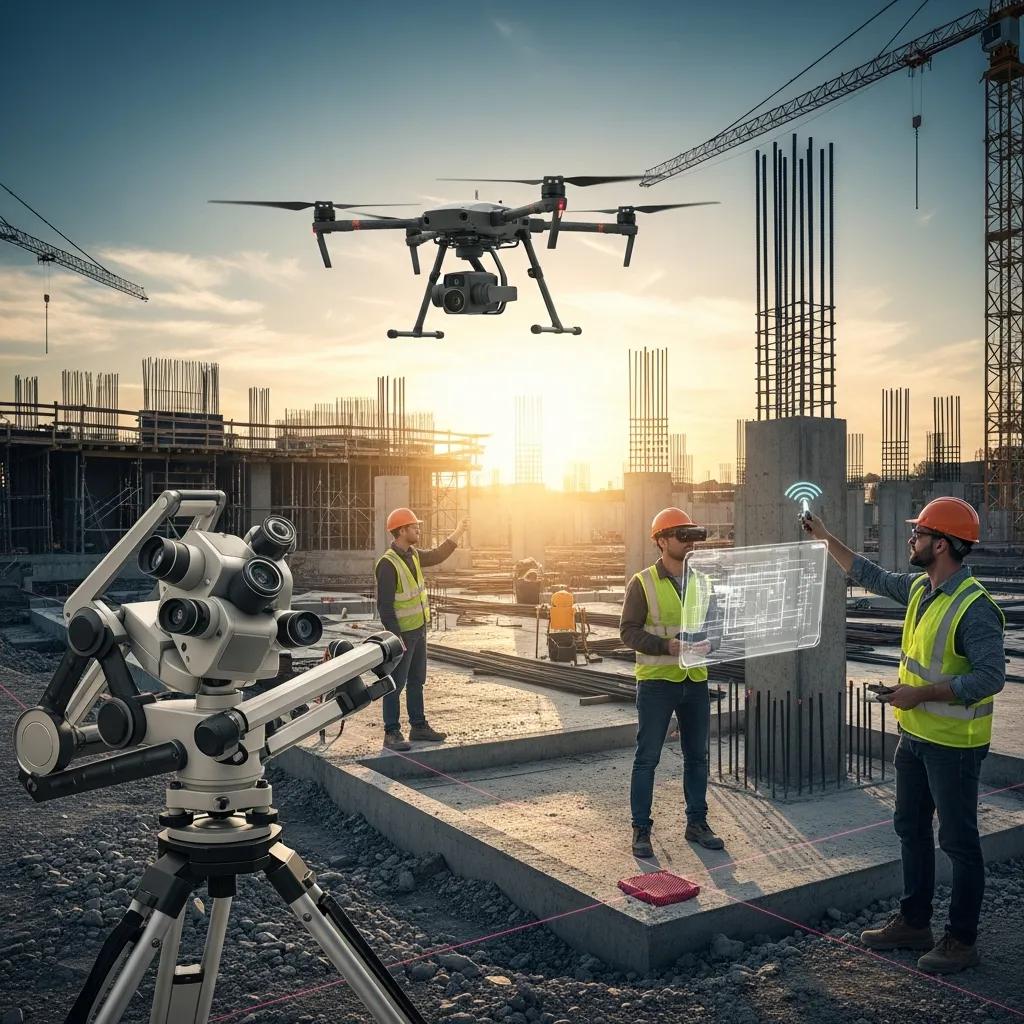
Key Emerging Technologies Shaping the Construction Industry — Trends & Innovations for 2025
Construction is at an inflection point: digital platforms, robotics, and high-fidelity reality capture are coming together to tackle persistent issues like schedule risk, quality gaps, and fractured collaboration. This article outlines the leading construction technologies for 2025, explains why they matter, and shows how teams turn them into measurable results—less rework, faster turnover, and safer jobsites. You’ll find clear definitions, how each technology works in practice, and real examples for VDC/BIM integration, robotic layout, 3D scanning and digital twins, plus the combined effects of AI, AR/VR, and IoT on delivery. The focus is practical: model-driven workflows that connect design to field execution, instruments that push layout accuracy to millimeter tolerances, and data streams that improve decisions. Each section includes actionable lists, comparison tables, and short case notes so project teams can evaluate adoption strategies and vendors. Mentions of Conway Coordination and Layout Services (CCLS) appear only when they help illustrate real-world application—this is a topic-first guide to support better decision-making on your projects.
What Are the Top Construction Technology Trends in 2025?
In 2025, construction tech clusters around digitization, automation, and enhanced insight. VDC and BIM keep driving model-led execution; robotics and automated layout boost field precision; 3D scanning and digital twins close the loop between as-built conditions and design intent; and AI, AR/VR, and IoT turn data into planning, safety, and monitoring tools. Each trend responds to common pressures—labor shortages, schedule demands, and sustainability targets—and delivers tangible benefits such as fewer RFIs, shortened delivery windows, and lower lifecycle costs. Industry studies show projects using integrated digital workflows report measurable drops in rework and schedule variance, which explains why these technologies are converging on today’s jobsites. Recognizing these trends helps teams prioritize investments that yield the strongest returns in coordination and field execution.
Top construction technology trends for 2025 with concise definitions and primary benefits:
- VDC / BIM: Model-driven coordination across disciplines to reduce clashes and rework.
- Robotics & Automated Layout: Mechanized field tools that speed layout and improve placement accuracy.
- 3D Scanning & Point Cloud Workflows: Reality capture producing as-built datasets for verification and modeling.
- Digital Twin: Operational replicas that combine BIM and sensor data to support commissioning and FM.
- AI & Predictive Analytics: Data-driven forecasting that optimizes schedules, procurement, and risk mitigation.
- AR/VR Visualization: Immersive review and training tools that improve comprehension and safety.
- IoT & Connected Jobsite: Sensor networks for equipment monitoring, environmental tracking, and material control.
- Drones & Photogrammetry: Aerial capture that speeds surveying and progress documentation.
These trends set up deeper operational shifts in coordination and layout—next we look at how digital transformation drives efficiency on projects.
How Is Digital Transformation Driving Construction Efficiency?
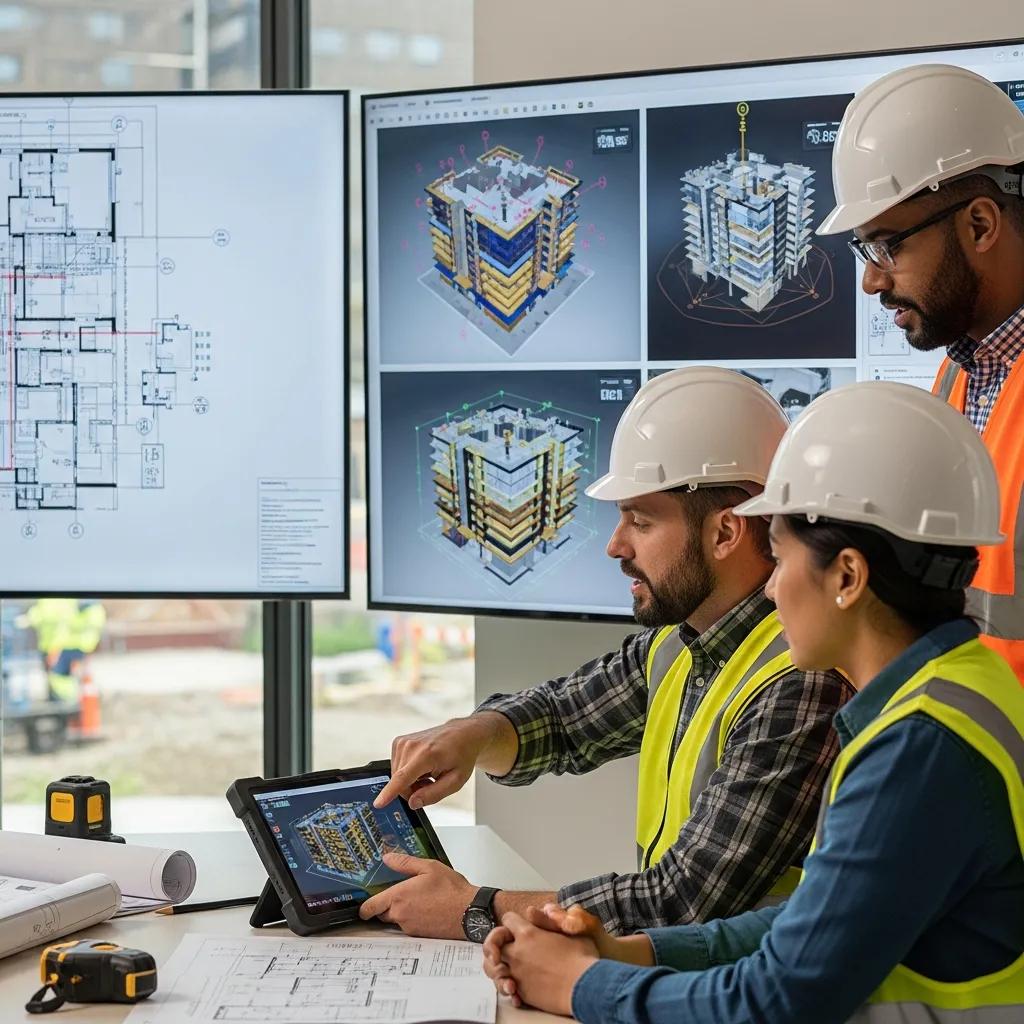
Digital transformation in construction means linking design models, project data, and field work into one collaborative workflow that cuts manual handoffs and information loss. Tools like cloud model repositories, automated clash detection, and mobile model viewers let teams resolve issues in the office before they become costly field problems. The payoffs are measurable: fewer RFIs, lower change-order rates, and better schedule adherence when everyone uses consistent, model-driven processes. For example, a mid-size hospital project used integrated 4D sequencing to reduce schedule variance by smoothing handoffs between specialty trades and the GC—reducing site congestion and shortening critical-path activities. Understanding these mechanisms points to the specific tools and management practices that improve project-level performance.
Which Technologies Are Revolutionizing Project Management?
Project management tools now mix predictive analytics, model-based scheduling (4D/5D), and collaborative platforms that centralize data for clearer decisions. AI-driven schedulers analyze historical performance and real-time progress to flag high-risk activities before delays compound, while 4D sequencing ties model geometry to time to reveal phasing conflicts. Cloud collaboration platforms become a single source of truth for drawings, models, RFIs, and submittals—speeding approvals and clarifying accountability across trades. The typical outcome: earlier detection of sequencing issues and more accurate forecasts for resource needs, which reduces float erosion and unplanned overtime. Together these capabilities form the operational backbone of modern VDC and coordination strategies and directly inform layout and field verification workflows.
How Does Virtual Design and Construction Enhance Modern Building Projects?
Virtual Design and Construction (VDC) is the disciplined use of BIM, coordination processes, and simulation tools to manage delivery from design through turnover. VDC translates multi-discipline models into coordinated construction plans, using clash detection and sequencing to cut field conflicts and optimize work packages. The result: fewer surprises, more predictable schedules, and tighter budget control through early identification of constructability issues. A typical VDC roadmap—assessment, model federation, clash cycles, and model-to-field integration—aligns stakeholders around shared data and creates the conditions for reliable model-driven workflows that reduce rework across the project lifecycle.
VDC components compared by what they deliver and why they matter:
| Component | Role in VDC | Value Delivered |
|---|---|---|
| Federated BIM Model | Combines architectural, structural, and MEP models | Enables cross-discipline clash detection and coordinated planning |
| Clash Detection | Automated conflict identification | Reduces on-site rework and change orders |
| 4D/5D Scheduling | Links model geometry to time and cost | Improves sequencing, cost forecasting, and procurement timing |
| Mobile Model Access | Field access to latest models | Ensures accurate layout and verification at point-of-work |
This comparison shows how each VDC element contributes to coordinated execution and smoother turnover—next we cover what VDC consulting actually delivers.
- VDC consulting defines strategy, model governance, and on-site integration to standardize processes across teams.
- Consultants set up clash-detection workflows and resolve coordination issues before field work begins.
- Consultants train project staff on model-based methods and support deployment of field tech for model-to-field layout.
- Consultants track KPIs—like RFI volume and change-order exposure—to quantify VDC’s project impact.
VDC consulting produces measurable results: streamlined coordination, fewer RFIs, and reduced schedule risk that lower total project costs. For teams exploring adoption, pairing a VDC strategy with robust field tools helps ensure model fidelity reaches the jobsite.
Conway Coordination and Layout Services (CCLS) provides VDC consulting that includes custom strategy development, technology implementation and training for BIM and clash detection, plus on-site or remote VDC support. CCLS focuses on efficient, model-driven workflows and helps teams move from isolated models to coordinated execution while preserving field usability and accountability.
What Are the Benefits of VDC Consulting Services?
VDC consulting aligns design intent with construction execution to deliver fewer field clashes, smoother sequencing, and higher productivity. Consultants standardize model exchange and coordinate clash cycles so integration issues get resolved early. They also run training and change management programs so field teams adopt model-driven processes and mobile tools. Measured KPIs often include reductions in RFIs, lower rework rates, and shorter commissioning windows. Those operational gains translate directly into cost savings and a cleaner turnover process—setting the stage for BIM’s role in coordination and facilities management.
How Does BIM Integration Improve Construction Coordination?
BIM integration moves beyond geometry into 4D (time), 5D (cost), and into lifecycle dimensions that support sustainability and operations. Integrated BIM enables MEP clash detection, prefabrication planning, and automated takeoffs that feed procurement and schedule decisions. When BIM ties to field layout systems, model elements become control points that guide robotic and manual layout—improving placement accuracy. Handover packages generated from integrated BIM accelerate commissioning and simplify facilities management by delivering structured asset data that operations teams can use immediately.
In What Ways Are Robotics and Automation Transforming Construction Layout?
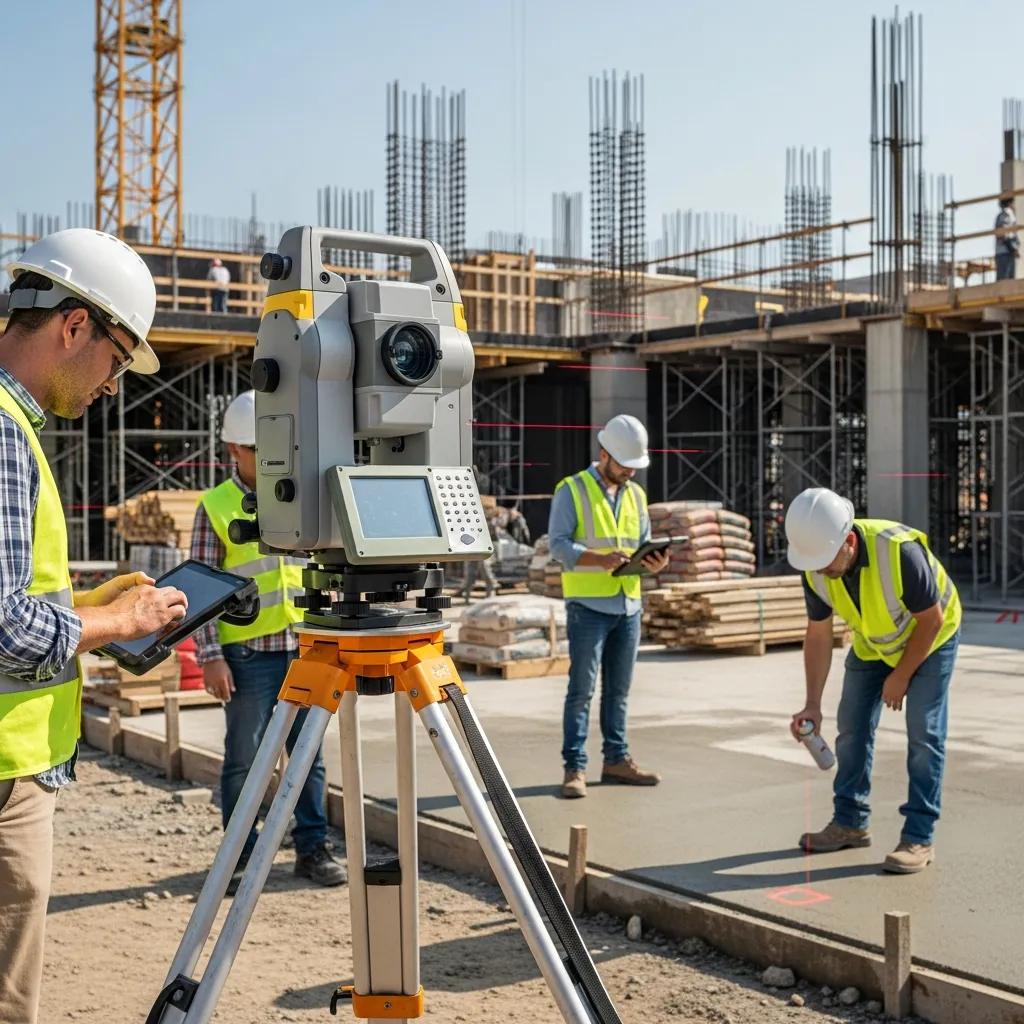
Robotics and automation take repetitive, high-precision layout tasks—traditionally vulnerable to human error—and make them repeatable using machine control, robotic total stations, and automated layout systems. These tools increase accuracy, speed layout cycles, and reduce personnel exposure in congested or hazardous zones. Automated systems can ingest model-based control files and place layout points with consistent precision, shrinking layout time and cutting rework. The sections that follow explain how instruments like robotic total stations integrate with BIM/VDC workflows and the safety and efficiency gains typical on modern jobsites.
Comparison of layout approaches on accuracy, speed, and error outcomes:
| Layout Method | Typical Accuracy | Relative Speed | Error Rate |
|---|---|---|---|
| Manual Layout | ± 10–25 mm | Slow | Higher (human measurement variability) |
| Robotic Total Station | Millimeter-level | Moderate to fast | Low (automated measurement) |
| Automated Layout Systems | Sub-millimeter to millimeter | Fast | Very low (machine-driven repeatability) |
The table highlights why teams adopt robotic and automated workflows to reduce disputes and rework. Next, we look at how the Trimble Robotic Total Station fits into a model-driven layout process.
CCLS deploys robotic layout services—including Trimble Robotic Total Station workflows—to link BIM coordinates directly to field control. Their project examples show model-driven layout reducing layout cycles and tightening installation tolerances, demonstrating clear benefits from precision instrumentation.
How Does the Trimble Robotic Total Station Ensure Precision?
The Trimble Robotic Total Station (RTS) automates measurement, remote tracking, and model-based coordinate placement to deliver millimeter-level accuracy. It integrates with BIM/VDC platforms by importing model coordinates and control files so crews can execute layout from federated models without manual coordinate translation. The RTS reduces human positioning error through automated targeting and measurement, which lowers rework and speeds marking tasks. In a common workflow, a federated BIM supplies control points to the RTS, the instrument locates each point, and crews verify placement with as-built capture—closing the loop between design intent and field reality.
What Are the Safety and Efficiency Gains from Automated Layout Systems?
Automated layout systems cut repetitive manual measurements in hazardous or crowded areas, lowering worker exposure to falls or moving equipment. Efficiency gains come from faster, repeatable layout cycles that compress fit-out and installation schedules. Reduced errors mean fewer corrective actions, less downtime, and lower labor costs. Predictable layout throughput also enables more reliable handoffs between trades, which helps procurement and reduces on-site coordination delays. These operational improvements make a compelling case for adding automation to layout workflows.
How Are 3D Scanning and Digital Twins Shaping Construction Accuracy?
3D scanning captures high-detail reality data—point clouds and meshes—that teams convert into as-built documentation and digital twins for verification and lifecycle use. The workflow (scan → registration → model conversion) turns site geometry into datasets used for clash detection, prefabrication, and commissioning. Digital twins layer that as-built model with sensor and operational data to support monitoring and predictive maintenance. Together, these tools reduce surprises at turnover and create a single source of verification for owners and contractors—improving short-term quality control and long-term asset management.
Reality-capture outputs compared by downstream application and value:
| Reality Capture | Primary Output | Downstream Use |
|---|---|---|
| Laser Scan | Dense point cloud | As-built modeling, clash verification |
| Photogrammetry | Orthophotos and meshes | Volumetrics, progress monitoring |
| Point Cloud to BIM | Modeled elements | Prefab, coordination, digital twin creation |
Choosing the right capture method depends on project goals—accurate as-built BIM, digital twins, or progress tracking—and that choice drives downstream value for coordination and turnover.
CCLS provides 3D scanning and point-cloud-to-BIM services that turn reality captures into coordinate-accurate models for coordination and verification. Clients use these deliverables for exacting layout checks, prefab input, and handover packages that align as-built conditions with design intent.
What Is the Role of 3D Scanning in As-Built Documentation?
3D scanning produces dense point clouds and orthophotos that document existing conditions with high spatial fidelity, allowing teams to measure and model real geometry without invasive surveys. Those deliverables feed conversion to as-built BIM elements—structural members, MEP runs, and architectural components—so renovation and tie-in work can be planned with confidence. Laser scanning typically delivers millimeter to sub-centimeter accuracy, which eliminates many surprises during retrofit work. Using scanned deliverables during coordination reduces change orders and speeds the design-to-construction handoff.
How Do Digital Twins Bridge Physical and Digital Construction Worlds?
Digital twins are living models created from BIM and reality capture that incorporate sensor and operational data to simulate and monitor an asset through commissioning and operations. They start as accurate as-built models and gain value when connected to IoT and maintenance systems—enabling predictive maintenance, energy optimization, and lifecycle analytics. During commissioning, a digital twin validates systems against design baselines and accelerates turnover. Over time, digital twins support facilities teams with searchable, model-based documentation and simulation tools that extend the value of construction-phase investments.
What Impact Do AI, AR/VR, and IoT Have on Construction Innovation?
AI, AR/VR, and IoT work together to turn raw data into prescriptive insights, immersive understanding, and continuous monitoring. AI mines project data to predict delays, prioritize clashes, and recommend resource shifts; AR overlays model data on the physical site to speed verification and layout; VR enables immersive design reviews and safety training that align stakeholders early. IoT sensors stream machine hours, environmental data, and material locations into analytics platforms for faster, evidence-based decisions. Together these technologies increase planning accuracy, raise safety awareness, and unlock new efficiency gains across construction and operations.
Concrete use-cases and ROI-focused applications include:
- AI for predictive scheduling: Uses historical performance and current progress to forecast delays and propose mitigations.
- AR for field verification: Device overlays show model alignments to speed layout checks and reduce measurement errors.
- VR for design coordination and safety training: Immersive walkthroughs catch coordination issues earlier and prepare crews for complex sequences.
- IoT for connected jobsite management: Sensors report equipment hours, temperature, and material movement that feed cost and schedule models.
These practical examples show how integrated technologies reduce uncertainty and improve on-site decision-making—next we examine AI and AR/VR in more detail.
How Does Artificial Intelligence Optimize Construction Planning?
AI optimizes planning by combining historical project data, live progress metrics, and model inputs to surface scheduling risks, optimize resource allocation, and rank clashes by impact. Predictive analytics can flag activities likely to delay the critical path and recommend alternative sequences. AI also speeds quantity takeoffs from BIM and clusters clashes by risk to focus coordination efforts. Required inputs include structured model elements, progress reports, and quality historical datasets; when integrated into VDC workflows, AI delivers measurable improvements in on-time performance and cost predictability.
In What Ways Do AR and VR Enhance Project Visualization and Safety?
AR and VR improve spatial understanding by placing model information where work happens or by immersing teams in a simulated build. AR gives crews accurate overlays for layout verification and installation guidance—reducing measurement errors and RFIs. VR lets multidisciplinary teams run immersive coordination sessions and safety training that expose conflicts or unsafe sequences before crews arrive on site. These tools reduce misunderstandings, shorten review cycles, and contribute to fewer reworks and safer work environments.
Conway Coordination and Layout Services (CCLS) supports these integrated workflows with VDC consulting, BIM integration, Trimble Robotic Total Station layout, and 3D scanning to produce dependable point-cloud-to-BIM deliverables. With a regional focus in the Southeastern U.S., CCLS emphasizes precision and streamlined workflows to help teams adopt model-driven practices while protecting schedule and quality goals.
Project teams seeking hands-on help with model-to-field integration, layout robotics, or reality-capture conversions can request consulting and execution support from CCLS. A tailored consultation helps evaluate a project-specific implementation plan and validate outcomes for coordination, layout accuracy, and turnover readiness.
Frequently Asked Questions
What are the key challenges in adopting emerging construction technologies?
Adoption challenges include cultural resistance to change, up-front capital requirements, and the need for targeted training. Integrating new systems with legacy tools can be complex, risking short-term disruption. Data interoperability and governance are common hurdles as well. To ease adoption, prioritize change management, phase rollouts, and invest in hands-on training so teams gain confidence and workflows stabilize.
How can construction companies measure the ROI of new technologies?
Measure ROI by tracking KPIs such as reductions in rework, improved schedule adherence, lower change-order costs, and time savings in delivery. Before-and-after comparisons help, as do process metrics—RFI volume, layout cycles, and commissioning time. Use centralized data tools to aggregate performance and calculate tangible savings tied to technology adoption.
What role does training play in the successful implementation of construction technologies?
Training is essential. Practical, role-based training reduces resistance, accelerates adoption, and minimizes errors during rollout. Ongoing support and refresher sessions help embed new workflows. Effective training combines classroom, hands-on field exercises, and documentation tailored to the project’s tech stack.
How do regulatory standards impact the adoption of new construction technologies?
Regulatory standards influence technology selection and how it’s deployed—especially around safety, environmental performance, and code compliance. Staying current on relevant regulations and engaging authorities early in the adoption process helps avoid delays. Documenting compliance workflows and maintaining traceable records also smooth approvals and inspections.
What are the long-term benefits of integrating AI and IoT in construction?
Long-term benefits include greater operational efficiency, improved safety, and smarter resource use. AI turns data into forecasts and prescriptive actions; IoT supplies continuous operational insight. Together they reduce downtime, extend asset life through predictive maintenance, and support more sustainable, cost-effective operations over the asset lifecycle.
How can construction firms ensure data security when using advanced technologies?
Protect data with encryption, role-based access controls, and regular security audits. Establish clear data governance policies that define collection, storage, and sharing rules. Train staff on security best practices and work with vendors who have proven security certifications and safeguards in place.
Conclusion
Adopting emerging technologies—VDC, robotics, 3D scanning, AI, AR/VR, and IoT—improves accuracy, shortens schedules, and reduces risk compared with traditional methods. These tools let teams close the gap between design intent and field reality, producing safer jobsites and cleaner turnovers. If your project needs practical help integrating model-to-field workflows, precision layout, or reality-capture conversions, our team can translate these innovations into measurable project outcomes. Reach out to start a project-specific conversation.