
BIM Clash Detection & Resolution Services in Durham, NC — Expert Coordination That Keeps Projects Moving
BIM clash detection and resolution identify and manage geometric and sequencing conflicts inside coordinated digital models so teams avoid costly rework, schedule delays, and installation headaches on site. Below we break down how automated interference checks, federated model workflows, and tolerance-based filters expose hard, soft, and sequencing clashes — and how disciplined resolution reduces change orders and improves constructability on Durham projects. You’ll get a clear look at the detection mechanics, practical clash classifications, an end-to-end coordination cadence, and how tools like Navisworks, Revit, 3D scanning, and robotic layout move the model into the field. We also tie those technical steps to deliverables — clash reports, BCF issue logs, and verified as-built models — so project teams can adopt a repeatable process that lowers risk. After a plain-language primer on why clash detection matters locally, we cover proactive resolution benefits, CCLS’s federated process and toolset, precision technologies we use, and the business outcomes Durham owners and contractors should expect.
What is BIM Clash Detection and Why Does It Matter in Durham, NC?
BIM clash detection is the automated review of aggregated discipline models to find spatial and sequencing conflicts that would interfere with installation or operation, producing a prioritized list of coordination issues. The process federates Revit/CAD models (and sometimes point clouds), runs rule-based interference checks and tolerance filters, and exports a curated issue log designers and trades can act on to reduce on-site surprises. In Durham — where healthcare additions, commercial renovations, and institutional builds often face tight access, phased work, and overlapping MEP runs — late discovery is costly. Finding clashes in the model preserves schedule and budget by converting potential change orders into coordinated model edits during preconstruction.
CCLS applies these same coordination practices on Durham projects — contact us to align scope and cadence with your delivery model. Next, we explain the 3D mechanics of how clashes are found.
How Does BIM Clash Detection Identify Conflicts in 3D Building Models?
Clash detection compares geometry and object metadata across discipline models to locate physical intersections and clearance violations. Core mechanics include geometric collision tests, tolerance offsets that model required clearances, and rule-based filters that exclude false positives like annotations or temporary items. For example, a duct routed through a structural beam will be flagged: the system assigns a clash type and severity and links it to the responsible discipline via model metadata. Analysts then group related clashes, apply zone or system filters, and prioritize items so coordination meetings focus on the highest-impact work first. Well-designed filters and rule sets cut noise and drive purposeful resolution — which brings us to how clashes are classified.
What Are the Types of BIM Clashes: Hard, Soft, and Workflow Explained?
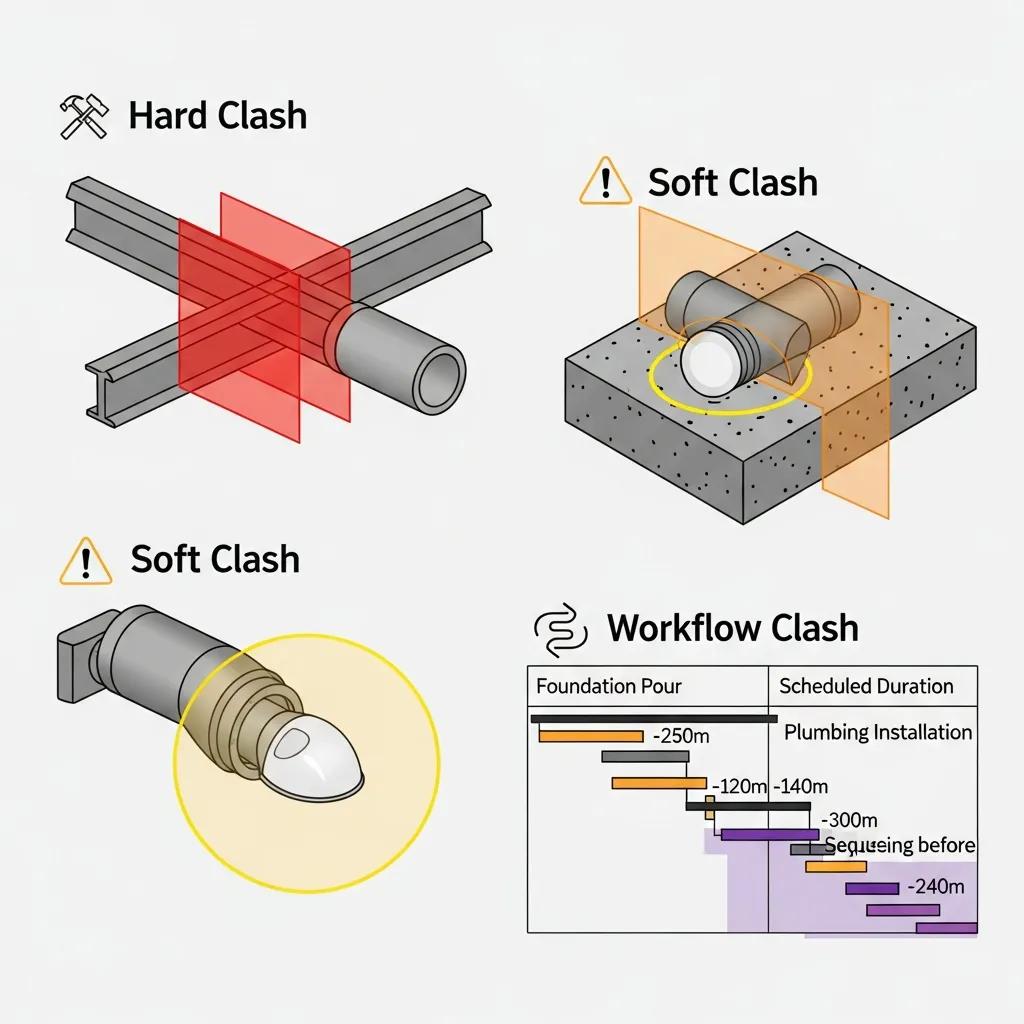
Clashes are usually grouped as hard, soft, or workflow so teams know whether an item needs redesign, a small tweak, or schedule/logistics action. A hard clash is a true physical intersection — for example, a pipe occupying the same space as a structural member — and typically requires relocation or redesign. A soft clash indicates clearance or tolerance concerns, such as restricted maintenance access, and is often resolved with minor coordination or spec changes. Workflow clashes expose sequencing problems, like equipment modeled before its supports; these require schedule and logistics fixes. Separating clashes this way helps teams choose corrective actions and log issues in BCF or coordination platforms so detection moves cleanly into documented resolution.
Why is Proactive Clash Resolution Essential for Durham Construction Projects?

Proactive clash resolution cuts downstream costs by addressing spatial, tolerance, and sequencing conflicts during design and preconstruction rather than in the field. Running iterative clash cycles turns latent design problems into model-level fixes and clarified responsibilities, which reduces RFIs and minimizes change orders that would otherwise cascade into schedule slips. On Durham sites — where constrained access and phased work increase risk — a proactive cadence preserves constructability and protects handover quality. Below we outline the core advantages teams capture through early coordination.
Construction teams typically realize three primary benefits from proactive resolution:
- Fewer rework events and change orders, protecting budget and procurement plans.
- Schedule protection through early sequencing corrections, avoiding on-site stoppages.
- Clearer communication and fewer RFIs thanks to shared issue logs and visual viewpoints.
These outcomes improve overall project predictability and lead into the cost and schedule impacts described next.
How Does Early Clash Detection Reduce Costly Rework and Project Delays?
Finding clashes early turns expensive field fixes into model-level decisions, lowering labor and material change-order costs and protecting milestone dates. Industry studies show addressing clashes during design and preconstruction can cut rework by up to 30% because fewer issues reach the site where fixes are costly and disruptive. For example, resolving MEP–structural conflicts in the model on a Durham renovation can prevent a multi-week shutdown of mechanical work and avoid expedited fabrication charges. Regular coordination runs often pay back quickly by trimming contingency spend and preventing sequential delays — which is why teams see measurable savings when clash detection is standard in VDC workflows.
In What Ways Does Clash Resolution Enhance Collaboration and Project Efficiency?
Clash resolution formalizes collaboration through scheduled coordination meetings, shared federated models, and tracked issue logs that clarify responsibility and deadlines. A typical workflow includes a pre-meeting triage, a multidisciplinary coordination session to assign fixes, and tracked revisions via BCF or a model-based issue tracker to close items — enforcing accountability. Deliverables like prioritized clash reports, saved viewpoints, and updated federated models create a feedback loop that reduces RFIs and improves shop drawing accuracy. Clear ownership and concise deliverables shorten decision cycles and feed verified models into prefabrication and field layout — supporting the model-to-field transfer outlined in the process section.
To operationalize these collaboration practices, teams need a repeatable process. The next section outlines an end-to-end clash detection and resolution flow used by coordination specialists.
What is the Comprehensive BIM Clash Detection Process Used by CCLS?
Our repeatable clash detection process moves through model aggregation, clash setup and detection, reporting and prioritization, coordinated resolution, and verification of as-built conditions. First, models and point clouds are ingested, checked for naming, LOD, and coordinate consistency, then federated into a single review model. Second, clash tests are configured with discipline-specific rules, tolerances, and zone filters and executed to generate an initial issue set. Third, the team triages clashes, groups related items, and publishes prioritized reports and viewpoints for coordination meetings; model updates are then tracked and validated in subsequent runs. Finally, verification uses site scans or field layout checks to confirm resolved conditions before closeout.
Below is a compact comparison of the core process steps, the tools typically responsible, and expected outputs and timeframes as implemented in coordinated VDC workflows.
| Phase | Primary Tools | Typical Output / Timeframe |
|---|---|---|
| Model Aggregation | Revit, Navisworks, IFC conversion | Federated model, QA checklist — 1–5 days |
| Detection & Rules | Navisworks Clash Detective, custom filters | Prioritized clash list, viewpoints — 1–3 days per run |
| Reporting & Coordination | BCF/issue logs, coordination meetings | Issue assignments and updated models — 1 week cadence |
| Verification | 3D scanning, field checks, layout verification | As-built overlays, closed issue log — final verification run |
This simple table clarifies responsibilities and outputs so teams can plan coordination iterations. Next we step into the technical aggregation details.
How Are Multidisciplinary Models Aggregated and Federated for Analysis?
Aggregation starts with collecting Revit models, CAD exports, IFCs, and point clouds, standardizing coordinate systems, and running QA checks for naming, levels, and LOD before federation. Typical conversion steps include exporting to Navisworks format, removing non-essential geometry, and aligning origin points so elements from different disciplines overlay correctly. Common pitfalls — mismatched units, inconsistent level naming, and uncoordinated phase filters — create false clashes if not fixed. A disciplined pre-check reduces noise in the clash run and makes the detection step more efficient, feeding into advanced analysis and reporting.
What Tools and Techniques Are Used for Advanced Clash Detection Analysis?
Advanced analysis leverages Navisworks Clash Detective features like grouped clash tests, tolerance configurations, and saved test sets, plus filters for zones, systems, or work packages to prioritize work. Techniques such as batch reporting, clash grouping by connectivity, and schedule-linked (4D) checks help identify sequencing issues and reduce duplicate items. Integration with BCF or an issue tracker streamlines assignment and closure so clashes progress from detection to verified resolution with a clear audit trail. These methods connect technical detection to managed resolution; the following section explains how 3D scanning and layout systems bring model accuracy into the field.
How Does CCLS Leverage Technology Like Navisworks and 3D Scanning for Precision?
Precision in clash detection and verification depends on federated review platforms, accurate as-built capture, and precise field layout tools to translate model geometry into installed conditions. Navisworks is the coordination backbone for clash tests and visualization, while point-cloud capture and registration validate installed conditions against the model. Robotic total stations provide the accuracy needed to transfer verified model coordinates to the field for layout and installation, creating a closed loop from model to built asset. Combining these technologies delivers millimeter-level verification where required and reduces the risk of installation errors; below we map tools to outcomes and summarize each role.
The following table maps core tools to their use cases and expected outcomes so you can see how each contributes to detection and verification accuracy.
| Tool | Use Case | Outcome / Accuracy |
|---|---|---|
| Navisworks | Model federation, clash testing | Comprehensive clash lists, visual viewpoints |
| 3D Laser Scanning | As-built capture and verification | Point clouds for deviation mapping (~mm-level) |
| Trimble Robotic Total Station | Model-to-field layout | Precise anchor and fixture placement for installation |
| Revit | Discipline modeling and revisions | Source models with parametric metadata for coordination |
This mapping connects technology to measurable outcomes. In short:
- Navisworks aggregates discipline models, runs Clash Detective tests, and exports actionable reports and saved viewpoints.
- 3D laser scanning produces point clouds used to create deviation maps and validate as-built conditions.
- Trimble robotic total stations transfer model coordinates to the field for accurate layout and installation.
These tool roles explain how the coordination pipeline turns model information into verified construction actions. The next subsection highlights Navisworks’ specific role.
What Role Does Navisworks Play in BIM Clash Detection Services in Durham?
Navisworks is our federation and analysis platform: discipline models are merged there, clash tests are defined, and results are reviewed visually with stakeholders. Clash Detective supports multiple test sets, tolerance settings, and saved viewpoints that document each issue for downstream resolution; exported reports and viewpoints become the communication artifacts used in coordination meetings. Navisworks also supports grouping and batch reporting to streamline repetitive clashes and exports to common trackers so responsibility can be assigned and closed. Those outputs feed verification steps that use field scans and layout systems, described next.
How Is 3D Scanning Integrated for As-Built Clash Verification?
3D scanning captures the installed condition as a dense point cloud, registered to the model coordinate system and compared against design geometry to highlight deviations and unresolved clashes. The scan-to-BIM workflow includes scan acquisition, registration, noise filtering, and creation of deviation maps or annotated overlays that show where installed elements differ from the model beyond tolerance thresholds. Deliverables typically include color-coded deviation visuals, annotated viewpoints, and an updated as-built model or corrected geometry that resolves outstanding issues. Integrating scanned verification into coordination ensures clashes reported in Navisworks are validated on site before closeout and supports precise field layout using robotic instruments.
What Are the Benefits of Choosing CCLS for BIM Clash Detection & Resolution in Durham, NC?
Working with a coordinated provider yields measurable results: fewer field changes, better schedule certainty, and a cleaner handover with verified as-built assets that support operations and maintenance. CCLS combines VDC consulting, model coordination, 3D scanning, and robotic total station layout into an integrated workflow from clash detection through field verification — reducing rework and improving constructability on Durham projects. Clients receive prioritized clash reports, BCF-tracked issues, and verified model deliverables that slot into procurement and fabrication schedules. The table below summarizes typical benefits, metrics, and estimated impacts to help owners and contractors evaluate ROI from coordination services.
| Benefit | Metric / Example | Estimated Impact |
|---|---|---|
| Rework Reduction | Percent fewer field change orders | Up to 20–30% fewer rework events |
| Schedule Savings | Reduced installation delays | Weeks saved on critical-path tasks |
| Quality of Handover | Verified as-built models | Fewer O&M issues post-handover |
This benefits mapping shows measurable improvements and leads into how our local expertise addresses Durham’s specific challenges.
How Does CCLS’s Local Expertise Address Durham’s Unique Construction Challenges?
CCLS brings local knowledge that aligns coordination cadences with common Durham constraints like phased campus work, renovation complexities, and tight site logistics. That proximity supports on-site scanning and fast model verification cycles, and our integrated VDC approach tailors clash rules and meeting cadences to regional delivery methods. Familiarity with local contractor practices and permitting sequences reduces coordination friction and speeds resolution. Clients get predictable deliverables and practical field verification that respect Durham-specific sequencing and access limitations.
What Client Success Stories Demonstrate CCLS’s Impact on Project Coordination?
Anonymous project summaries show coordinated workflows translate to real time and cost savings: one institutional renovation reduced mechanical rework and avoided an expedited change order by resolving clashes in the model before fabrication, producing measurable schedule relief and cost avoidance. Another redevelopment project used point-cloud validation and robotic layout to ensure prefabricated systems fit on first install, cutting site labor hours and improving milestone adherence. These examples illustrate how disciplined detection, prioritized reporting, and field verification combine to deliver predictable coordination outcomes for Durham stakeholders.
As a family-owned, client-focused firm, CCLS provides a single coordination partner across clash detection, scanning, modeling, and field layout — contact us to discuss how this integrated approach can be applied to your Durham project.
Frequently Asked Questions
What is the difference between hard, soft, and workflow clashes in BIM?
Hard clashes are direct physical intersections between elements — for example, a pipe overlapping a beam — and typically require relocation or redesign. Soft clashes are clearance issues, like limited access for maintenance, that can often be handled with small coordination changes. Workflow clashes are sequencing problems, such as installing equipment before its supports exist, and require schedule or logistics adjustments. Knowing these differences helps teams pick the right resolution path during coordination.
How can BIM clash detection improve project communication among stakeholders?
BIM clash detection centralizes issue tracking and visualizations so all stakeholders see the same information. Shared issue logs and prioritized clash reports keep teams aligned on responsibilities and deadlines, reducing misunderstandings and RFIs. Regular coordination meetings backed by clear deliverables create a single source of truth that smooths decision-making throughout the project.
What role does technology play in the effectiveness of BIM clash detection?
Technology is fundamental: it enables accurate analysis and clear visual communication across complex models. Navisworks lets teams federate discipline models and run comprehensive clash tests; 3D scanning delivers accurate as-built data for verification; robotic layout tools transfer verified coordinates to the field. Together, these tools streamline detection, improve accuracy, and speed resolution — improving project outcomes.
How does proactive clash resolution impact project budgets?
Proactive clash resolution lowers budget risk by reducing costly rework and change orders. Identifying conflicts during design and preconstruction avoids expensive field corrections. Industry data suggests early clash detection can cut rework costs by up to 30%, helping preserve contingency and making project outcomes more predictable.
What are the common challenges faced during BIM clash detection in Durham?
Durham projects commonly face tight site logistics, phased construction schedules, and the added complexity of renovations — all of which increase the likelihood of clashes if not addressed early. Local contractor practices and permitting sequences can also affect coordination. Understanding these regional challenges lets teams tailor clash detection strategies for smoother execution.
How can clients measure the success of BIM clash detection services?
Success is measurable through reduced field change orders, improved schedule adherence, and cleaner handover documentation. For example, a 20–30% drop in rework events indicates effective coordination. Tracking time saved on critical-path tasks and the accuracy of as-built models also shows the process’s impact on efficiency and cost control.
Conclusion
Implementing BIM clash detection and resolution in Durham makes projects more predictable by cutting rework and protecting schedules. Using the right tools and a proactive coordination cadence helps teams navigate site constraints and improves collaboration across stakeholders. The measurable benefits — fewer change orders, stronger schedule confidence, and verified handovers — demonstrate the value of an integrated approach. Contact CCLS to learn how our local, end-to-end services can strengthen your next Durham project.