
Blockchain in Construction: Improving Efficiency, Transparency, and Project Outcomes
Blockchain is a distributed ledger that records transactions in immutable, time-stamped blocks, creating verifiable records shared across project teams. In construction, that capability addresses long-standing problems—slow payments, fractured supply chains, and disputes over BIM accuracy—by improving collaboration, clarity, and accountability for owners, contractors, and suppliers. This article lays out how blockchain, smart contracts, and integration with BIM/VDC workflows can speed payments, secure material provenance, and build auditable digital processes that reduce rework and project risk in 2024. You’ll get clear explanations of core concepts, technical integration patterns, supply-chain examples, measurable benefits, and practical adoption steps—plus how Conway Coordination and Layout Services (CCLS) can support pilots where BIM and VDC verification are required. Topics include: what blockchain is and why it matters; smart contracts for automated construction payments; on-chain supply-chain traceability and material provenance; BIM/VDC integration patterns; emerging uses like tokenization; and common adoption barriers with pragmatic mitigations. Along the way we reference practical search terms—blockchain construction, smart contracts building, blockchain BIM, construction supply chain traceability—so technical teams can follow implementation guidance.
What is Blockchain Technology and Why Does it Matter in Construction?
At its core, blockchain is a tamper-evident ledger: cryptographic hashes link blocks of records so parties on a permissioned network share a single, verifiable truth. Nodes hold copies of hashed records and consensus rules and digital signatures prevent unilateral edits, creating a reliable audit trail. For construction teams, that means contracts, BIM revisions, material certificates, and milestone signoffs can be recorded in a way that resists tampering and supports multi-party collaboration—owners, general contractors, subcontractors, and suppliers all benefit. Grasping these principles is the foundation for practical uses like automated payments, provenance tracking, and stronger BIM data integrity, which we unpack next in the data security and transparency section.
How Does Blockchain Ensure Data Security and Transparency in Construction?
Blockchain protects data through cryptographic hashing, digital signatures, and consensus protocols that produce tamper-evident records and verifiable provenance. When a BIM revision or material certificate is hashed and written to a permissioned ledger, any later change produces a different hash and a detectable discrepancy—so auditors can trace who changed what and when. Permissioned ledgers with role-based access let teams balance transparency with confidentiality for commercially sensitive information, and trusted oracles bring vetted external inputs into contract logic. That technical foundation gives projects immutable BIM revision logs and clear audit trails that simplify dispute resolution and regulatory review—setting the stage for smart contracts to act on those verified signals.
How Do Smart Contracts Revolutionize Construction Project Management?
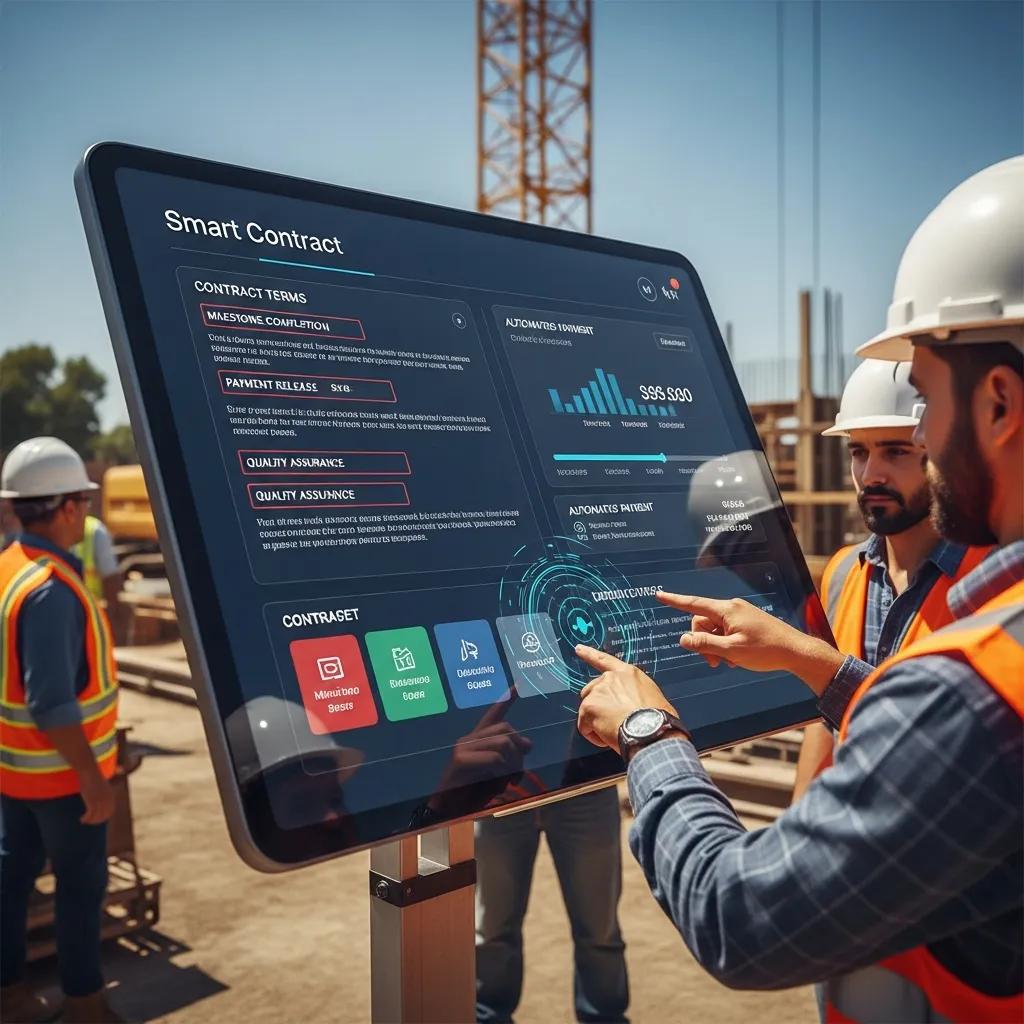
Smart contracts are self-executing code that runs when predefined conditions are satisfied, automating outcomes such as payments, notices, and status changes. On construction projects, smart contracts can encode milestone definitions, acceptance criteria, and payment rules so verified completion triggers escrow releases and stakeholder notifications without manual paperwork. That automation lowers administrative burden, accelerates cash flow, and leaves an on-chain record of enforcement and compliance that complements traditional contracts and procurement. The next section outlines concrete payment and dispute-resolution benefits, and how encoded compliance cuts down on manual checks across projects.
What Are the Benefits of Automated Payments and Dispute Resolution with Smart Contracts?
Smart-contract driven payments link verified milestone completion to escrow or direct release, shrinking cashflow cycles and easing financing pressure on subcontractors. These automated flows also reduce admin time by minimizing invoice disputes and reconciliation work, while embedded dispute procedures provide predictable remediation paths and transparent evidence for adjudication. The table below maps common milestones to the trigger conditions and on-chain outcomes you’d expect when payment automation is in place.
Introduction to milestone automation table: This table shows how typical project milestones map to trigger conditions and the automated on-chain outcomes enabled by smart contracts.
| Milestone | Trigger Condition | On-Chain Outcome |
|---|---|---|
| Structural Frame Completion | Verified 4D schedule + site scan match | Escrow release for frame pay item; timestamped proof |
| MEP Rough-In Signoff | BIM clash-free report + inspection hash | Partial payment and automated notification to owner |
| Final Commissioning | Acceptance criteria + point-cloud validation | Final payment release and immutable completion record |
Clear trigger conditions and verifiable inputs make on-chain payments dependable and reduce subjective approval steps that cause disputes. With payment automation explained, the next section shows how smart contracts also encode compliance and quality checks.
Common smart-contract use cases in building projects:
- Automated milestone payment releases: Shortens the gap between acceptance and payment.
- On-chain dispute escalation: Supplies predefined evidence and arbitration paths.
- Compliance enforcement: Encodes inspection and certification gates to control downstream actions.
These capabilities cut paperwork and speed approvals on regulated projects.
How Do Smart Contracts Improve Compliance and Contract Automation?
Smart contracts can encode regulatory checks, safety inspections, and material-certification gates so work only proceeds after required verifications are present. For example, a rule might require a safety-inspection hash and supplier-certificate hash before the next phase begins, producing an immutable compliance audit trail accessible to authorized owners and regulators. Compared with paper approvals, this approach shortens review cycles and creates searchable records that simplify audits and claims analysis. Next, we examine how blockchain improves supply-chain traceability and material provenance to further reduce project risk.
In What Ways Does Blockchain Enhance Construction Supply Chain Traceability?
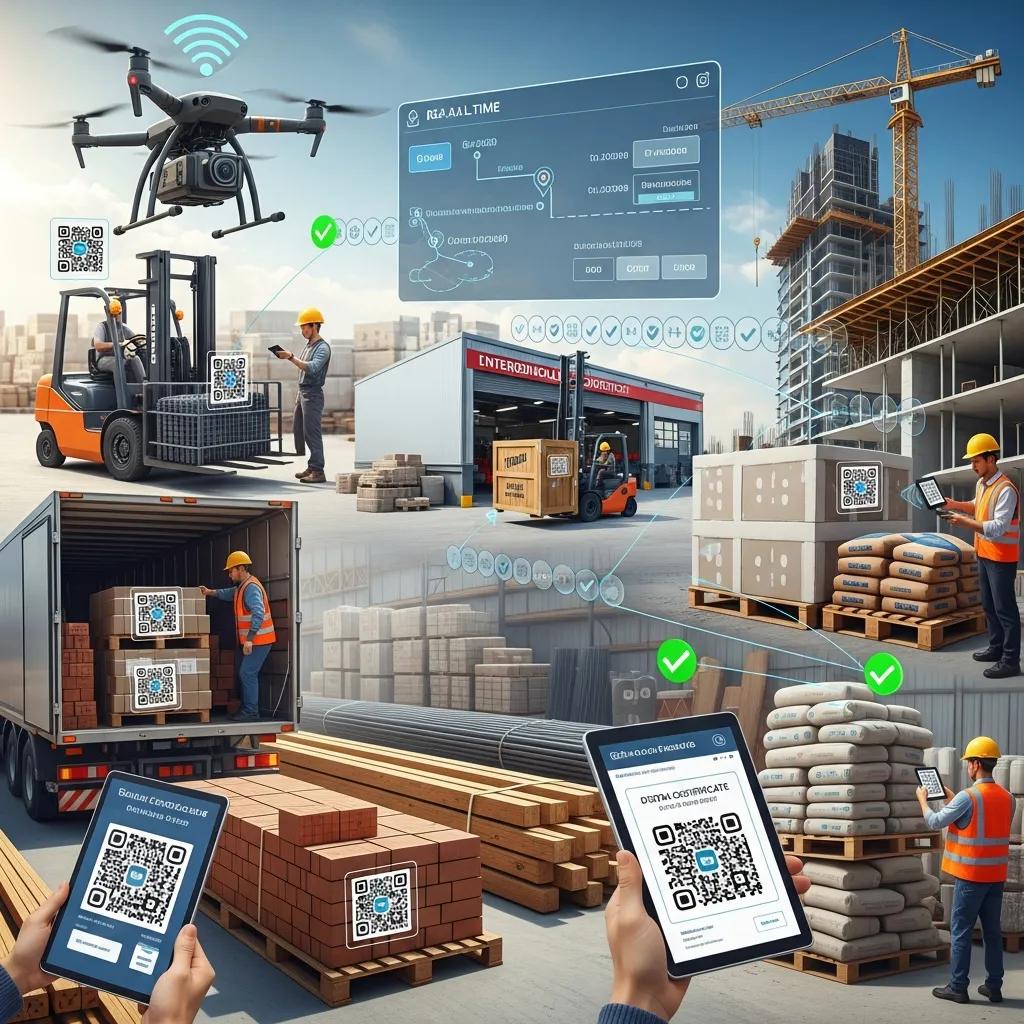
Blockchain improves supply-chain traceability by recording supplier attestations, batch IDs, and certificate hashes on a shared ledger so stakeholders can verify provenance without relying on paper documentation. Typical implementations link IoT sensors, QR/NFC tags, or supplier-submitted certificates to on-chain records, creating a traceable chain of custody from manufacture to installation. That accountability speeds recall responses, supports ethical sourcing, and strengthens quality control by making provenance auditable and verifiable for project teams. The following subsections walk through verification steps and how traceability supports sustainability and QA.
How Is Material Provenance Verified Using Blockchain in Construction?
Provenance verification ties batch IDs, supplier certificates, and cryptographic hashes to create on-chain records that map physical deliveries to digital certificates. A common workflow hashes a mill test report or lab certificate, records that hash with the batch ID on-chain, and links the record to a QR/NFC tag applied at fabrication—on-site crews can scan the tag and confirm the certificate hash against the ledger. This reduces fraud risk (false certifications) and simplifies chain-of-custody audits by providing an immutable verification path from supplier to installed component. The table below shows typical materials and the provenance attributes mapped to on-chain verification values.
Intro to material provenance table: This table maps material types to provenance or certification attributes and the on-chain verification value used to confirm authenticity.
| Material | Provenance/Certification Attribute | On-Chain Verification Value |
|---|---|---|
| Structural Steel | Mill test report batch number | Certificate hash + batch ID |
| Precast Concrete | Mix design & curing report | Laboratory certificate hash |
| MEP Components | Manufacturer serial + compliance label | Serial hash linked to supplier attestation |
Mapping materials this way makes verification straightforward and supports faster, evidence-backed responses when quality issues occur. With provenance covered, we next examine traceability’s impact on ethical sourcing and quality control.
Typical provenance verification steps:
- Record supplier certificate and batch ID on the ledger.
- Link the physical tag (QR/NFC) to the on-chain record.
- Verify on-site by scanning the tag and checking the ledger.
These steps create a practical chain of verification that supports sustainability claims and simplifies recalls or remediation.
How Does Blockchain Support Ethical Sourcing and Quality Control?
Blockchain supports ethical sourcing by capturing attestations from certified suppliers and logging chain-of-custody events that show responsible sourcing and material certifications. When sustainability credentials are hashed and recorded at source, downstream stakeholders can verify origin claims without relying on easily forged paper certificates. This reduces certification fraud, speeds procurement vetting, and gives owners transparent metrics when pursuing sustainable procurement goals. Securing provenance and ethical claims on-chain reduces rework and reputational risk—and it enables automated milestone validation when integrated with BIM and VDC workflows.
How Can Blockchain Integrate with BIM and VDC to Transform Digital Construction Workflows?
Integration typically hashes BIM model revisions, stores those hashes on a permissioned ledger, and uses them as authoritative references for multi‑party collaboration and milestone verification. The workflow: author a BIM revision, generate a cryptographic hash, write that hash to the ledger with metadata (author, timestamp), and let permissioned stakeholders validate model integrity before approving site actions. This pattern preserves BIM data integrity across distributed teams and links digital model revisions to contractual triggers for payments or inspections. Below we explain how BIM integrity is preserved and how CCLS can partner on pilot projects requiring VDC and BIM verification.
How Does Blockchain Enhance BIM Data Integrity and Collaboration?
Writing BIM revision hashes to a ledger preserves model provenance and creates an immutable audit trail that shows who changed what and when—preventing unauthorized edits from reaching the field. Permissioned ledgers and access controls let teams restrict who can commit revision hashes or view sensitive metadata, balancing confidentiality with shared validation. Point clouds and 3D scans can act as independent validators: a scan’s hash linked to a BIM revision provides strong evidence that modeled elements match as-built conditions. Conway Coordination and Layout Services (CCLS) offers VDC consulting, BIM modeling and coordination, and high-precision verification using 3D scanning and Trimble Robotic Total Station workflows to support blockchain pilot integrations where model fidelity and layout precision matter.
Recommended BIM–blockchain integration steps:
- Author the BIM revision and create a cryptographic hash for the model file.
- Record the hash and metadata on a permissioned ledger with role-based access.
- Use independent 3D scans to validate on-chain model-to-site consistency.
These steps lead directly to using VDC milestones as triggers for smart contracts and automated payments.
What Role Does Blockchain Play in Automating VDC Project Milestones and Payments?
Blockchain connects VDC milestone outputs—such as 4D schedule confirmations or 5D quantity takeoffs—to smart contracts that trigger payments when verification signals meet encoded acceptance criteria. For example, a 4D schedule checkpoint plus a point-cloud match can generate a validation hash that releases a milestone payment, reducing subjectivity in acceptance. Integrating robotic layout verification and 3D scanning ensures on-site measurements are objective and reliable as oracle inputs to contract logic. The table below maps VDC milestone types to verification inputs and smart-contract triggers to clarify how automation reduces disputes by tying payments to verifiable events.
| VDC Milestone Type | Verification Input | Smart Contract Trigger |
|---|---|---|
| 4D Sequence Completion | Schedule + site scan match | Release progress payment |
| Quantity Verification | 5D takeoff vs delivered material | Adjust invoice and release funds |
| As-Built Acceptance | Point cloud vs BIM tolerances | Final acceptance and retention release |
Converting measurable VDC outputs into automated contract triggers improves transparency and shortens payment cycles. Next, we summarize emerging use cases and measurable benefits across projects.
What Are the Emerging Use Cases and Benefits of Blockchain in Construction?
Use cases are expanding beyond payments to include supply-chain provenance, BIM-data integrity, tokenization for financing, and lifecycle asset tracking for operations and maintenance. Each area delivers measurable benefits—faster payment velocity, fewer disputes, better traceability for recalls, and improved investor liquidity through new financing models. The following sections quantify cost and cashflow impacts and introduce tokenization as a financing innovation that can change how projects raise and distribute funds.
How Does Blockchain Reduce Costs, Accelerate Payments, and Mitigate Risks?
By automating verification and payment workflows, blockchain lowers time spent on invoicing, reconciliation, and dispute handling. Faster payments improve subcontractor cash flow and reduce reliance on expensive interim financing, while on-chain provenance and BIM integrity reduce rework and fraud losses by supplying verifiable evidence of material authenticity and model conformity. The table below compares representative use cases with direct, measurable benefits to illustrate expected impacts from pilot deployments.
Intro to use-case benefits table: This table compares blockchain use cases to the measurable benefits organizations commonly track when running pilots.
| Use-Case | Measurable Benefit | Typical Impact |
|---|---|---|
| Smart Contracts (Payments) | Payment velocity increase | Faster payouts; fewer disputes |
| Supply Chain Traceability | Reduced recall time | Lower rework and liability costs |
| BIM-integrity | Fewer as-built disputes | Reduced rework and schedule risk |
This comparison highlights where pilots often show the strongest ROI and supports prioritizing payments and provenance in early deployments. With cost and risk benefits established, below we explain real estate tokenization and its implications for construction investment.
Key measurable benefits include:
- Faster payments and improved cash flow: Reduces financing pressure on trades.
- Shorter dispute resolution times: Lowers legal and administrative costs.
- Reduced fraud and rework through provenance checks: Protects margins and schedules.
What Is Real Estate Tokenization and Its Impact on Construction Investment?
Tokenization converts property or project assets into digital tokens representing fractional ownership, improving liquidity and widening investor access to construction returns. Tokenized structures can shorten fundraising timelines and let smaller investors participate, but regulatory and compliance frameworks must be addressed before issuance. Practically, tokenized funding can be tied to milestone-driven smart contracts so investor payouts align with verifiable project progress, creating transparent distributions. As market infrastructure evolves in 2024, tokenization offers a complementary financing route projects can pilot alongside traditional debt and equity.
What Challenges Exist in Adopting Blockchain in Construction and How Can They Be Overcome?
Common barriers include technical scalability and interoperability concerns, organizational skill gaps, regulatory uncertainty, and upfront integration costs that can dissuade early adopters. Effective mitigations include choosing permissioned ledger architectures for controlled performance, using middleware and oracles for system integration, running staged pilots to demonstrate ROI, and investing in focused training to build internal capability. Partnership models that combine VDC/BIM domain expertise with blockchain integrators provide a practical path to scope pilots and validate benefits before scaling. The next section outlines specific technical and organizational barriers and a stepwise partnership model for pilots.
What Are the Main Adoption Barriers Like Scalability and Education?
Scalability concerns come from throughput and latency when recording frequent events—so many pilots use hybrid architectures that store large files off-chain while recording hashes and metadata on-chain. Interoperability gaps between ERP, BIM, and logistics systems require middleware or standardized APIs to ensure reliable data flows and reduce vendor lock-in. Education and trust barriers persist across stakeholders, so training programs, clear governance, and demonstrable pilot results are critical to build confidence. Addressing these issues through technical design and change management lays the groundwork for pilots that can scale.
Practical mitigations for adoption barriers:
- Permissioned ledgers: Limit participation and improve performance.
- Middleware & oracles: Bridge BIM, ERP, and logistics systems reliably.
- Staged pilots + training: Build trust with measurable outcomes.
These strategies form the foundation of a partnership model for firms seeking implementation support.
How Can Construction Firms Partner with Experts Like CCLS for Blockchain Integration?
Assessment → Pilot design → VDC/BIM integration → Verification → Scale. Start with a technical and operational assessment to identify high-value use cases, then design a focused pilot that ties blockchain triggers to VDC outputs. Integrate BIM and verification tooling, validate outcomes with independent scans and layout checks, and scale successful pilots across projects. For consultation, contact Conway Coordination and Layout Services (CCLS) to scope pilots and implement VDC-based verification workflows led by experienced BIM modeling and coordination teams. A practical next step is to request a focused assessment that defines KPIs, verification inputs (point clouds, scan hashes), and a pilot timeline so stakeholders can measure payment velocity, dispute reduction, and provenance improvements.
Introductory list of partnership steps:
- Assessment: Identify use cases, stakeholders, and success metrics.
- Pilot design: Define triggers, verification inputs, and smart-contract logic.
- Integration: Connect BIM/VDC tools, scanning workflows, and ledger APIs.
- Verification & scale: Validate with site scans and expand on success.
These steps provide a low‑risk adoption path and position CCLS as a practical VDC/BIM implementation partner for moving pilots into production.
Summary insight: Pairing layout and VDC expertise with focused blockchain pilots delivers the fastest path to measurable benefits and stakeholder confidence.
For consultation, contact Conway Coordination and Layout Services (CCLS) to discuss how VDC consulting, BIM modeling, and coordination can support blockchain-enabled pilots. Nathan Conway leads the firm’s project introductions and pilot planning.
Frequently Asked Questions
What are the potential risks associated with blockchain adoption in construction?
Blockchain brings benefits but also risks: data-privacy exposure if not properly permissioned; implementation complexity when teams lack technical expertise; and shifting regulations that can affect permitted uses. Mitigation starts with thorough assessments, permissioned architectures, and experienced partners to ensure compliance and practical integration.
How can construction firms ensure the successful integration of blockchain technology?
Success begins with a clear process: assess current workflows, choose specific use cases where blockchain adds measurable value, engage stakeholders early, and invest in targeted training. Partnering with experts who understand both construction (BIM/VDC) and blockchain accelerates adoption and reduces implementation risk.
What role do regulatory frameworks play in blockchain adoption in construction?
Regulation sets the legal boundary for blockchain use—covering data privacy, contract enforceability, and financial transactions. Because regulation is evolving, firms should stay informed and work with legal counsel to design compliant solutions that meet both project and jurisdictional requirements.
How does blockchain impact project collaboration among stakeholders?
Blockchain creates a shared, verifiable source of truth that reduces misunderstandings and disputes. When combined with smart contracts, it automates approvals and payments based on predefined conditions—fostering trust by making records immutable and auditable across the project lifecycle.
What are the key performance indicators (KPIs) for measuring blockchain success in construction?
Useful KPIs include payment velocity (speed of payouts), dispute resolution time, and administrative cost savings. Other indicators are the accuracy of provenance records and the efficiency of compliance checks. Tracking these metrics helps teams quantify pilot outcomes and make data-driven scale decisions.
How can blockchain technology support sustainability initiatives in construction?
Blockchain enhances sustainability by making material provenance transparent and auditable. Recording sourcing credentials on-chain helps verify ethical supply chains, reduces opportunities for fraud, and supports carbon-tracking or other environmental reporting—helping owners meet sustainability goals and regulatory commitments.
Conclusion
Applied thoughtfully, blockchain can materially improve construction project efficiency and transparency—addressing payment delays, strengthening data integrity, and reducing disputes. Smart contracts and supply-chain traceability deliver measurable improvements in cash flow and risk management. If you’re interested in piloting these ideas, Conway Coordination and Layout Services (CCLS) can help design and verify VDC/BIM-integrated pilots that demonstrate value quickly. Start a conversation with our team to explore a tailored approach for your projects.