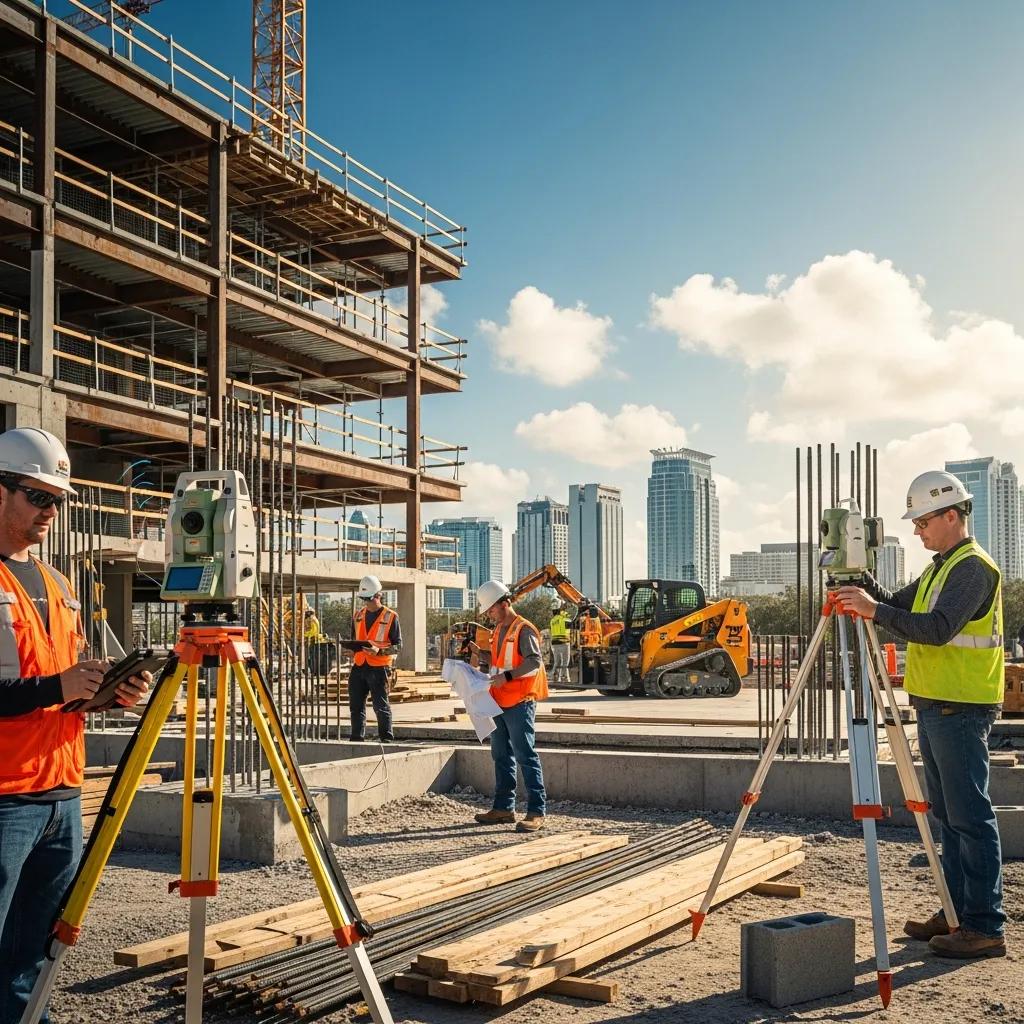
Improving Construction Project Efficiency in Orlando, FL — Practical Technologies and Proven Workflows
Construction efficiency in Orlando means finishing work on time, on budget, and with minimal rework — the things that protect margins and keep clients satisfied. This guide breaks down the biggest drivers of inefficiency on local projects — rework, coordination gaps, and inaccurate field layout — and shows how proven technologies like Robotic Total Station layout, Virtual Design and Construction (VDC), BIM coordination, and 3D scanning lower risk and improve schedule compliance. You’ll see how millimeter‑level layout, model‑driven coordination, and data‑led planning cut RFIs, reduce rework, and tighten sequencing on Florida jobs. The guide connects typical regional challenges to concrete tools and workflows, compares them to conventional methods, and explains how integrated services are deployed on site. Read on to understand which interventions deliver the largest schedule and cost improvements and how to prioritize them during preconstruction and early field work.
What Are the Key Challenges Affecting Construction Project Efficiency in Orlando?
Orlando projects combine common industry pain points with regional pressures that increase schedule risk and rework. Rework can quickly consume budgeted labor and materials, and on active sites it cascades into overtime, duplicated handling, and lost productivity. Local permitting timelines, complex trade coordination among multiple subcontractors, and weather‑driven sequencing disruptions add friction and tighten margins on commercial and institutional projects. Below are the primary challenges and why they matter for teams working in central Florida.
- Rework and field corrections: Issues found after installation require demolition and replacement, increasing material waste and labor hours.
- Poor trade coordination: MEP clashes and sequencing gaps force trades to wait or redo completed work, delaying critical activities.
- Inaccurate field layout: Conventional layout methods allow tolerance drift that becomes costly to correct during finishing stages.
- Permitting and external delays: Administrative holds and inspection timing can disrupt planned sequences and resource allocation.
These factors interact: layout errors create clashes, clashes multiply rework, and permitting delays shave schedule float — making every rework event more expensive. Mapping that causal chain helps teams select targeted interventions that prevent downstream impacts and keep projects on schedule.
How Does Rework Impact Project Budgets and Timelines?
Rework raises direct costs through extra labor and replacement materials and creates indirect costs from schedule disruption and reduced productivity. Fixing a misplaced anchor bolt, resolving an MEP clash, or correcting an incorrect embed often requires demolition, re‑ordering or re‑fabrication, and re‑sequencing trades — all of which lengthen the critical path. The knock‑on effects increase site congestion, raise safety exposure during remedial work, and frequently trigger overtime or expedited shipping to recover schedule, amplifying budget risk. Early detection through model coordination and precision layout limits rework by catching conflicts before installation, preserving float and protecting contingency.
Understanding how detection leads to correction clarifies why investing in prevention — better layout, clash detection, and field validation — yields outsized returns on both schedule and cost. Avoiding a single major rework event can prevent multiple downstream delays that would otherwise cascade across subcontractors and inspections, safeguarding contractual milestones and owner expectations.
What Common Causes Lead to Delays and Inefficiencies in Florida Construction?
Delays and inefficiencies come from both technical gaps and external pressures that are especially relevant in Florida. Incomplete design details create coordination gaps because models lack the specificity installers need, prompting RFIs and late changes. MEP routing conflicts, improper clearances, and prefabrication mismatches are frequent sources of on‑site rework. Conventional surveying and layout methods generate cumulative tolerance drift that affects finishes and connections. External issues — permitting timelines, long material lead times, and weather interruptions — compress schedule buffers and increase the cost of corrective actions.
Mitigations should match the cause: robust BIM coordination closes design gaps, precision layout eliminates tolerance accumulation, prefabrication shifts work off site, and data‑driven planning accounts for inspection and permit windows. Prioritizing these steps in preconstruction reduces the chance that site‑level problems force costly schedule recovery later.
How Does Robotic Total Station Layout Enhance Precision and Reduce Errors?

Robotic Total Station layout uses an automated, model‑linked instrument to place points with millimeter‑level accuracy, improving installation fidelity and cutting layout‑related rework. The instrument locks to a prism or reflector and ties directly to BIM coordinates, enabling single‑operator workflows that transfer digital design data to the field with high repeatability. That reduces field adjustments, improves fit‑up for structural and MEP elements, and speeds verification of critical points like anchors and embeds. Below are the operational benefits that explain why teams deploy robotic layout for tight‑tolerance work.
- Millimeter accuracy: Precision required for anchor bolts, prefabricated assemblies, and tight MEP clearances.
- Single‑operator efficiency: Fewer personnel and less time spent moving instruments and re‑checking points.
- Direct model integration: BIM coordinates go straight to the site, cutting transcription errors.
Those advantages translate to measurable productivity gains and lower schedule risk: fewer corrective tasks during installation mean crews work planned sequences instead of reacting to layout mistakes.
What Are the Benefits of Millimeter-Level Accuracy in Orlando Construction Projects?
Millimeter‑level accuracy produces clear downstream value for work with tight tolerances — MEP rough‑ins, structural anchor placement, and prefabricated modules. When layout points match design coordinates, prefabricated components fit without field rework, reducing delays to adjacent trades. Correct anchors and embeds cut punch‑list items and shorten commissioning windows because systems align as modeled. Higher installation fidelity also lowers site disruption from multiple trades re‑entering an area to fix earlier errors.
Getting critical geometry right at the start supports faster turnover, better client satisfaction, and fewer schedule extensions caused by corrective tasks that consume critical‑path resources.
How Does Robotic Total Station Technology Compare to Traditional Layout Methods?
Robotic Total Station technology surpasses tape‑and‑transit or manual staking in accuracy, speed, and digital interoperability, making it ideal for complex commercial work. Traditional methods often require several crew members, manual coordinate conversions, and repetitive checks — increasing transcription errors and tolerance drift. Robotic systems accept digital model inputs, perform remote measurements, and let a single operator re‑establish points quickly, reducing setup time and misinterpretation of design data.
Beyond accuracy, a key advantage is integration: robotic layout workflows feed verification data back to models and coordination teams, closing the design‑to‑field loop. That feedback reduces installer ambiguity and gives project managers timely assurance that installed elements match design intent, smoothing acceptance and sequencing for downstream trades.
Teams that compare these approaches frequently adopt integrated services that combine precise layout with reality capture and VDC to lock down as‑built conditions before finishing trades mobilize — a workflow that naturally pairs layout, scanning, and coordination.
Conway Coordination and Layout Services (CCLS) provides the technical services that support these precision workflows. CCLS combines Robotic Total Station Layout with VDC construction and consulting, 3D scanning, point‑cloud rendering and model integration, plus BIM modeling and coordination. As a regional, family‑owned firm, CCLS emphasizes Precision You Can Trust, Seamless Coordination, and Proven Expertise — values that directly address layout accuracy and coordination gaps. For teams that need to validate layout against models and reduce rework, a consultation with CCLS will show how these tools integrate into your schedule and coordination cycles.
| Service | Typical Accuracy | Primary Use-Cases |
|---|---|---|
| Robotic Total Station Layout | Millimeter-level | Anchor bolt placement, structural layout, modular setouts |
| 3D Scanning (Point Cloud) | Sub-centimeter | As-built verification, pre-installation validation, renovations |
| BIM Modeling & Coordination | N/A (process) | Clash detection, model-based sequencing, prefabrication checks |
The table shows how each service targets different causes of rework and supports tighter schedule control by turning design intent into verifiable field conditions. Teams that combine these services get cross‑validated data that reduces surprises during installation.
What Role Does Virtual Design and Construction Play in Streamlining Workflows?

Virtual Design and Construction (VDC) turns design models into executable construction workflows by linking BIM outputs to scheduling, procurement, and field validation. VDC is a consulting‑led practice that maps digital deliverables to on‑site activities, defines coordination cadences, and prescribes verification steps aligned with construction sequencing. The outcome: fewer RFIs, shorter coordination cycles, and clearer handoffs between design, fabrication, and field teams. Below are the core ways VDC reduces inefficiency.
- Model‑to‑sequence integration: Connects 3D models to 4D schedules so sequences are visualized and validated.
- Coordination workflows: Establishes regular model reviews and defined clash‑resolution timelines.
- Field validation: Uses reality capture to compare installed conditions with the model for timely sign‑off.
When VDC consulting starts early, it creates consistent digital workflows so model updates, prefabrication decisions, and procurement schedules share the same source of truth — reducing downstream rework and improving schedule adherence.
How Does VDC Consulting Optimize Digital Workflows for Florida Contractors?
VDC consulting begins with a digital maturity assessment and moves to a focused integration plan that ties models to field workflows and measurable outcomes. Deliverables commonly include a digital workflow map, coordination schedule, model integration templates, clash‑resolution protocols, and field verification plans using point clouds or layout reports for sign‑off. These outputs reduce RFIs by clarifying assumptions and speed coordination by assigning responsibility and deadlines for clash resolution. Training and handoff materials for field crews make the process sustainable, and routine validation keeps models aligned with as‑built conditions.
Turning model outputs into executable tasks and decision gates shortens iteration loops between design and trades and lowers the chance that unresolved model issues become costly field problems.
What Are the Advantages of Integrating VDC with BIM Coordination?
Pairing VDC strategy with BIM coordination multiplies their impact: VDC provides the operational framework while BIM supplies the technical models for clash detection and prefabrication. VDC leverages BIM to build 4D sequences, set prefabrication scope, and assign coordination responsibilities. BIM tools then run clash cycles, generate reports, and support resolution with annotated model updates. This combination reduces uncertainty about routing, clearances, and sequencing and enables earlier off‑site fabrication decisions that lower on‑site labor exposure and schedule variability.
Operationalizing BIM deliverables through VDC ensures model intelligence actively informs procurement, scheduling, and quality control rather than remaining passive documentation.
How Can Building Information Modeling Coordination Prevent Construction Conflicts?
BIM coordination prevents field conflicts by enabling systematic clash detection and multi‑disciplinary model reviews before installation. Coordination cycles identify geometric and spatial conflicts among architectural, structural, and MEP models and produce prioritized clash reports with actionable next steps. Many coordination questions are resolved in the model environment during scheduled meetings, which reduces RFIs. Regular model validation and integration with layout and scanning feedback close the loop, ensuring installations reflect the coordinated model.
Practical BIM use‑cases that prevent field conflicts and save schedule time include:
- MEP routing coordination: Verifies clearances and access for mechanical, electrical, and plumbing systems.
- Structural/architectural interface checks: Ensures penetrations and supports align with structural members.
- Prefabrication verification: Confirms factory‑built modules will fit and connect as modeled.
When BIM coordination is a recurring, scheduled activity rather than a one‑time check, on‑site corrective work drops and schedule predictability improves.
What Are the Applications of BIM for Clash Detection in Orlando Projects?
BIM clash detection applies to MEP routing, prefabrication validation, structural‑architectural interfaces, and renovation work that needs as‑built reconciliation — all common on Orlando commercial and institutional sites. For tight ceilings, clash detection prevents ducts and conduits from conflicting with structure or other systems. Prefabrication checks verify module dimensions and connection points before factory assembly, reducing returns or rework in the field. In renovation or preservation projects, point‑cloud‑to‑model comparisons surface deviations early so teams can plan corrective work before major trades mobilize.
Applying these checks early in preconstruction prevents surprises and supports smoother sequencing during busy installation phases.
How Does BIM Reduce Rework and Improve Schedule Adherence?
BIM reduces rework by finding design and coordination issues before fabrication or installation and improves schedule adherence by enabling 4D sequencing and informed procurement. Early clash detection eliminates many installation conflicts that would otherwise require teardown and rework. Coordinated models support prefabrication and off‑site assembly to compress on‑site labor hours. Integrating BIM with scheduling tools visualizes critical‑path activities and helps planners allocate resources proactively, reducing the chance a single trade’s delay cascades into others. Model‑based inspections and verification help ensure installed systems match coordinated designs, shortening punch‑list and commissioning windows.
Using BIM as a continuous coordination tool shifts effort from reactive correction to proactive prevention, stabilizing schedules and reducing contingency drawdown.
What Strategies Help Achieve Schedule Adherence and Cost Savings in Orlando Construction?
A mix of data‑driven planning, precise field layout, prefabrication, and integrated VDC/BIM workflows produces the most reliable improvements to schedule and cost control. Data‑driven planning relies on model metrics, reality‑capture status, and progress reporting to detect drift and trigger corrective actions early. Precision layout and routine field verification remove a common source of rework by ensuring installations match design coordinates, while prefabrication moves work into controlled environments and reduces on‑site uncertainty. Below are high‑impact strategies project teams should prioritize to protect schedule and cost outcomes.
- Data‑driven planning and KPIs: Track schedule variance, percent complete, and rework rate to prompt adjustments.
- Integrating VDC/BIM with 4D scheduling: Sync models with time to visualize sequence risks.
- Precision field layout and reality capture: Verify as‑built geometry before finishing trades proceed.
- Prefabrication and modularization: Reduce on‑site labor exposure and speed installation cycles.
Combining these approaches reduces the cumulative risk that small issues grow into schedule drivers and helps managers make informed trade‑offs between recovery actions and planned float.
How Does Data-Driven Planning Support On-Time Project Completion?
Data‑driven planning aggregates model metrics, site verification data, and progress inputs into dashboards and decision triggers that support on‑time completion. The simple framework — collect, analyze, act — uses data sources such as BIM model status, clash counts, scanning deviation reports, and schedule progress to populate KPIs like schedule variance and rework percentage. When deviations appear, corrective actions (re‑sequencing, resource shifts, or targeted prefabrication) are executed and re‑measured to verify effectiveness. This near‑real‑time feedback loop shortens response time to emerging risks and prevents small delays from becoming major schedule impacts.
Institutionalizing data‑driven triggers and ownership turns observations into predictable interventions that protect critical path milestones and reduce cost volatility.
What Case Studies Demonstrate Proven Efficiency Results in Florida?
Florida case summaries typically follow a challenge → action → result pattern: coordination failures or layout inaccuracies are the challenge, model‑driven coordination and precise layout are the actions, and reduced rework plus earlier turnover are the results. For example, teams often resolve MEP routing conflicts through iterative clash cycles and validate installations with point‑cloud scans before finishes — preventing costly rework and shortening commissioning. Outcomes vary by project, but the consistent theme is clear: coordinated digital processes and precision field workflows produce fewer RFIs, less on‑site remediation, and more predictable completion windows.
If schedule or cost exposure is a concern, request a consultation to evaluate which mix of strategies best fits your project and to review portfolio examples tailored to your sector.
Why Choose Conway Coordination and Layout Services for Construction Efficiency in Orlando?
Conway Coordination and Layout Services (CCLS) is a regional partner that blends precision layout with digital coordination to reduce rework and keep schedules on track. Our service suite aligns with the technologies discussed above: Robotic Total Station Layout, VDC construction and consulting, 3D scanning, point‑cloud rendering and model integration, and BIM modeling and coordination. As a local, family‑owned firm, we stand behind three commitments — Precision You Can Trust, Seamless Coordination, and Proven Expertise — that show our technical focus on accuracy, integrated workflows, and reliable delivery. This section explains what to expect from our offering and how to request a consultation to fit these capabilities into your project.
- Robotic Total Station Layout: Model‑driven layout to reduce anchor and embed errors.
- VDC and VDC Consulting Services: Workflow design, model integration, and schedule alignment.
- 3D Scanning & Point Cloud Integration: As‑built verification and model reconciliation.
- BIM Modeling & Coordination: Clash detection and model‑based coordination for trades.
These services plug into existing delivery chains: layout verifies critical geometry on site, scanning confirms as‑built conditions, and BIM/VDC convert model intelligence into executable sequences. For teams looking to reduce rework and protect schedule milestones, scheduling a consultation with CCLS is the recommended next step.
What Unique Expertise and Technologies Does CCLS Offer?
CCLS combines the equipment, software, and workflows common to modern coordination‑driven projects: Trimble‑enabled Robotic Total Station layout for high‑accuracy placement, 3D scanning and point‑cloud rendering for as‑built capture, and BIM modeling and coordination to resolve clashes before they affect the field. We lean on a family‑owned operating model and two decades of hands‑on experience to deliver practical, technically focused services. Together, these capabilities bridge digital models and field execution by delivering verifiable geometry and coordinated models that trades can install with minimal on‑site adjustment.
This mix of equipment, model services, and coordination workflows positions CCLS to support projects that prioritize precision, prefabrication readiness, and reduced rework in complex installation environments.
How Does CCLS Ensure Precision and Client Success in Local Projects?
We ensure precision and client success by combining model‑integrated layout, reality‑capture verification, and ongoing BIM coordination so design intent and installed reality stay aligned. Our workflows integrate Robotic Total Station outputs with point‑cloud validation and coordination cycles so discrepancies are caught and remediated before finishing trades mobilize. Emphasizing Seamless Coordination and Precision You Can Trust reflects our habit of tying technology to installation and acceptance decision gates. Clients can request a consultation to review project needs and determine the right mix of layout, scanning, and coordination services to mitigate primary schedule and rework risks.
This project‑centric approach helps ensure technology investments translate into measurable rework reductions and improved schedule predictability for Orlando projects and similar regional deliveries.
| Strategy | Metric Impacted | Expected Improvement / Example |
|---|---|---|
| Data-driven planning | Schedule variance | Reduces unforeseen delays through early corrective actions |
| Clash detection (BIM) | Rework % | Lowers field corrections by resolving conflicts before installation |
| Precision layout | Installation accuracy | Decreases fit‑up issues and punch‑list items |
| Prefabrication | On-site labor hours | Shrinks labor exposure and installation variability |
Frequently Asked Questions
What technologies can help reduce rework in construction projects?
Tools like Building Information Modeling (BIM), Robotic Total Station layout, and 3D scanning are proven to cut rework. BIM enables detailed clash detection and trade coordination before installation. Robotic Total Stations deliver millimeter‑level layout accuracy so installations match design intent. 3D scanning captures as‑built conditions for rapid verification against models, preventing costly corrections later in the schedule.
How can contractors in Orlando benefit from prefabrication?
Prefabrication reduces on‑site labor hours and lowers the risk of installation errors by moving work into controlled environments. Components built off site fit together more predictably, reducing field adjustments and speeding installation. That translates into faster project turnover and lower overall cost exposure — a strong value proposition for contractors focused on efficiency.
What role does data-driven planning play in construction efficiency?
Data‑driven planning uses real‑time metrics to inform decisions and trigger corrective actions before issues escalate. By analyzing progress, resource allocation, and known risks, teams can improve scheduling, allocate resources more effectively, and mitigate problems earlier. Implemented well, this approach keeps projects on track and limits budget variability.
How does effective trade coordination impact project outcomes?
Good trade coordination minimizes conflicts and downtime between subcontractors. Aligning schedules and responsibilities prevents rework and idle time. Regular coordination meetings, combined with BIM clash detection, identify issues early and enable timely resolution — boosting productivity and helping projects finish on time.
What are the benefits of using Virtual Design and Construction (VDC)?
VDC improves visualization, collaboration, and workflow clarity by connecting 3D models to scheduling and procurement. That visibility helps teams spot issues before they occur, reduce RFIs, and streamline handoffs. VDC also improves stakeholder alignment so decisions are made earlier and with better information.
How can construction teams in Orlando ensure compliance with local regulations?
Teams ensure compliance by staying current on local building codes, permitting processes, and inspection requirements and by engaging authorities early. Using BIM to visualize compliance aspects can help confirm code adherence before permits are pulled. Regular training and communication about local regulations also keep teams aligned throughout the project lifecycle.
Conclusion
Improving construction project efficiency in Orlando is achievable by combining precision layout, VDC, and BIM coordination with data‑driven planning and prefabrication. These approaches reduce rework, tighten schedules, and improve collaboration across teams — all of which protect margins and client satisfaction. If you want a tailored plan for your project, request a consultation and we’ll review the best combination of services to reduce risk and accelerate delivery.