
Pharmaceutical Facility Layout & Coordination Services in Augusta, GA — Precise Planning for Compliance and Faster Validation
Building or renovating pharmaceutical spaces in Augusta, GA demands millimeter-level layout accuracy, coordinated digital workflows, and strict regulatory alignment to protect product quality and keep validation on schedule. This guide shows how construction layout, BIM/VDC coordination, robotic total station workflows, and reality capture work together to cut rework, support cGMP and ISO cleanroom requirements, and lower schedule risk. You’ll learn which tolerances matter, how layout choices control contamination and staff flow, and what verification outputs regulators expect. We map cGMP, USP 797/800, and ISO drivers to concrete field tasks and verification deliverables, then explain the specialized services and local considerations for Augusta projects. Finally, practical next steps help owners and general contractors scope a layout program, commission digital verification, and move to execution with a clear audit trail. Operational terms — cleanroom layout, BIM coordination, VDC sequencing, robotic total station — are used with real-world examples so teams can prioritize verification work that reduces cost and validation delays.
Why Is Precision Critical in Pharmaceutical Facility Construction?
Precision is the baseline for compliant processes, contamination control, and predictable schedules. Accurate layout makes sure utilities, pressure boundaries, and equipment anchors match design intent and the acceptance criteria regulators expect. When tolerances are met, airflow patterns, material flows, and validated process sequences commission with fewer deviations — shortening operational qualification and approval cycles. Precise layout also preserves required room adjacencies and segregation schemes from ISO and USP guidance, avoiding costly rebuilds or temporary fixes that can delay batch release. The points below highlight where precision reduces risk and where preconstruction attention delivers the most value.
Key considerations that drive precision requirements:
- Regulatory‑critical interfaces — airlocks, gowning rooms, and pass‑throughs — must align to prevent cross‑contamination and maintain pressure cascades.
- MEP penetrations and anchor bolt locations typically require millimeter accuracy to avoid rework, equipment misalignment, and validation delays.
- Coordinated sequencing and verified as‑built records streamline validation and limit audit findings or post‑construction corrective actions.
These priorities point directly to the verification workflows and technical services teams use to convert design intent into validated field conditions — the focus of the next section.
What Are the Key Regulatory Standards: cGMP, USP 797, and ISO Compliance?
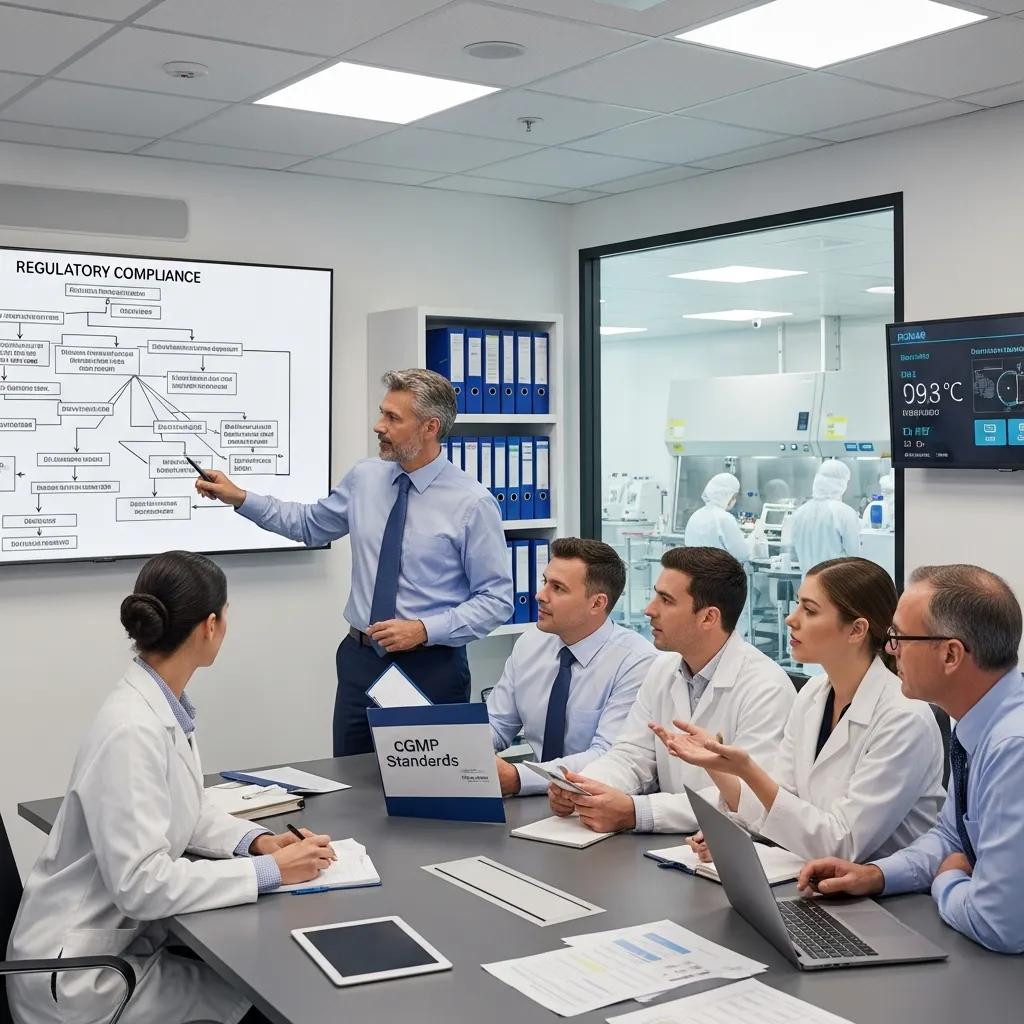
cGMP, USP 797/800, and ISO cleanroom classifications set the containment, flow, and documentation expectations layout must enable to protect patients and products. cGMP requires controlled environments and traceable processes, so layout must support validated flows, segregated utilities, and accessible sampling and monitoring points. USP 797 and USP 800 govern sterile compounding and hazardous drug handling; their requirements drive segregation of compounding suites, buffer/ante‑areas, and dedicated exhaust or containment details in the layout. ISO classes (ISO 5–8) map to room adjacency and airflow needs — layout must create the physical relationships and pressure differentials required to meet particulate and microbial targets. Early translation of these standards into layout tasks is essential for architects, MEP designers, and verification teams to coordinate effectively.
This regulatory mapping establishes the foundation for a verification program that documents readiness for commissioning and validation.
How Does Accurate Layout Prevent Costly Errors and Delays?
Accurate layout removes common construction conflicts — misplaced anchor bolts, wrong slab penetrations, and MEP clashes — that otherwise lead to demolition, rework, or equipment reorders and slow validation. For example, a 12–25 mm anchor bolt offset can trigger crane adjustments, baseplate refabrication, or shop redraws that push critical path activities. Digital verification workflows catch offsets during pre‑installation checks and tie field layout to the federated BIM model, shortening the traditional RFI and rework loop. In practice, verified anchor and embed workflows have cut downstream rework and validation hold points by measurable days on time‑sensitive projects.
Common error types and mitigations:
- Anchor bolt misplacement: Pre‑install verification and robotic total station checks reduce replacement cycles and delays.
- MEP clashes: BIM clash detection with VDC sequencing minimizes on‑site reroutes and fit‑ups.
- Penetration offsets: 3D scanning of slabs before cutting prevents wrong‑location penetrations and air‑barrier breaches.
Preventing these issues requires early coordination, precise field layout, and consistent digital records so corrective actions are minimized and validation readiness is preserved.
What Specialized Services Does CCLS Offer for Pharmaceutical Facilities?
Our pharmaceutical services translate design intent into verifiable field conditions using a mix of digital coordination and precision layout tools. Core components include BIM/VDC coordination for clash detection and sequencing; Robotic Total Station (RTS) layout for millimeter‑level anchor and penetration verification; 3D laser scanning for accurate as‑built baselines; and cleanroom layout coordination that integrates HVAC zoning, pressure cascades, and personnel/material flows. These services reduce RFIs, accelerate prefabrication, and produce audit‑ready documentation that supports validation. We select the right tools by phase and risk profile — new builds typically begin with RTS and VDC sequencing, while renovations emphasize scan‑to‑BIM workflows to resolve unknowns early.
Introductory comparison table of services and typical benefits:
| Service | Typical Application in Pharma | Primary Benefit / Metric |
|---|---|---|
| BIM / VDC | MEP clash detection, sequencing, prefabrication planning | Fewer RFIs, reduced onsite rework, faster installs |
| Robotic Total Station (RTS) | Anchor bolt positioning, penetration layout, hanger placement | Millimeter‑level accuracy, fewer corrective actions |
| 3D Laser Scanning | As‑built validation for renovations, retrofit modeling | Shorter preconstruction, fewer unknowns |
| Cleanroom Coordination | Flow planning, pressure cascade integration, HEPA routing | Compliance‑ready adjacencies, minimized contamination risk |
This comparison clarifies when each technology adds value and how they combine to protect schedule and regulatory outcomes.
Services list and call to action:
- BIM/VDC coordination to resolve clashes and define prefabrication sequencing.
- Robotic total station workflows to verify anchor bolts and critical penetrations with high confidence.
- 3D scanning to produce registered point clouds that drive retrofit modeling and reduce field surprises.
- Cleanroom layout coordination to align personnel/material flows, gowning areas, and HVAC zoning.
Request a consultation to scope these services, define deliverables, and schedule a site assessment to establish a verification baseline. We’ll outline the right mix of BIM, RTS, and scanning to meet your compliance and schedule goals.
Summary: The correct blend of digital coordination and field verification reduces uncertainty, shortens validation timelines, and lets teams focus on predictable execution.
How Does Cleanroom Design and Layout Coordination Ensure Contamination Control?
Cleanroom layout manages contamination by shaping space, airflow, and human movement so particulate and microbial risks are controlled through separation, pressure cascades, and defined interfaces. Placement of gowning rooms, airlocks, and pass‑throughs determines how personnel and materials move between sterile and non‑sterile zones — directly influencing contamination risk. HVAC integration is part of the layout: diffuser locations, return paths, and HEPA routing require the same attention as equipment anchors to keep airflow predictable in operation. Early collaboration between architects, MEP engineers, and layout teams reduces design concessions later and creates validation‑ready documentation.
Checklist for owners and GCs to verify contamination controls:
- Confirm dedicated personnel and material flow paths that prevent cross‑traffic.
- Validate the pressure cascade strategy and ensure layout supports physical separation.
- Coordinate HVAC penetrations and HEPA routing to avoid conflicts with sterile envelopes.
Treating layout as a contamination‑control tool helps teams design adjacencies that meet ISO requirements and reduces corrective work during commissioning.
How Do BIM and VDC Enhance Pharmaceutical Construction Coordination?
BIM and VDC create a federated model where design intent, MEP routing, and installation sequencing are validated digitally before field work begins. Clash detection highlights spatial conflicts between ducts, piping, and structure so assemblies can be prefabricated and installed faster. VDC sequencing supports phased installs — essential in cleanroom projects where temporary containment and staged commissioning are common — letting teams simulate handovers and mitigate risk. The outcome is fewer RFIs, reduced field labor, and more predictable validation schedules because as‑built conditions align more closely with the coordinated model.
Benefits of BIM/VDC coordination include:
- Improved clash detection: Identify and resolve interferences before installation.
- Prefabrication support: Enable shop fabrication to cut field hours and variability.
- Sequencing clarity: Define handover points that align with validation milestones.
These digital practices produce repeatable, auditable outputs regulators expect and materially reduce schedule risk by aligning field execution to the coordinated model.
How Does Robotic Total Station Technology Improve Pharma Facility Precision?
Robotic Total Station (RTS) systems deliver millimeter‑level layout accuracy and a verifiable digital record that ties field measurements to the BIM model. RTS automates stake‑out, reduces transcription errors, and produces timestamped reports that feed a digital QA/QC loop for validation readiness. Typical uses include anchor bolt verification, slab penetration layout, and hanger placement where tolerances are tight and rework costs are high. RTS workflows can include acceptance thresholds, automated checks, and exportable datasets that integrate with model deliverables to form a clear audit trail.
Key RTS applications and benefits:
- Anchor bolt verification with documented positional accuracy.
- MEP hanger and penetration layout to preserve routing and clearances.
- Repeatable verification checks that generate audit‑ready digital records.
These capabilities make RTS a core tool on projects where validation timelines and regulatory scrutiny demand unambiguous field documentation.
Introductory tolerance table for RTS applications:
| Task | Typical Required Tolerance | RTS Capability / Value |
|---|---|---|
| Anchor bolt location | ±2–10 mm | RTS routinely achieves sub‑5 mm accuracy; reduces baseplate rework |
| MEP hanger layout | ±5–15 mm | Ensures routing clearances and modular support placement |
| Slab penetration placement | ±3–10 mm | Prevents wrong‑location cutouts and air barrier breaches |
What Are the Applications of Robotic Total Station in Anchor Bolt and MEP Layout?
RTS workflows begin with model import and control‑network setup, proceed through stake‑out and immediate verification, and finish with a digital report that ties field coordinates to the design model. For anchor bolts, teams typically verify points before concrete placement and perform post‑cure checks to confirm anchors remain within tolerance. For MEP hangers and penetrations, RTS supplies fast, repeatable offsets that feed installers’ shop layouts and remove guesswork in tight cleanroom envelopes. On confidential projects, RTS anchor verification has eliminated multiple baseplate adjustments and accelerated equipment set‑in while preserving the documented evidence required for validation.
Workflow steps for anchor bolt verification:
- Import anchor layout from BIM and establish control points.
- Stake‑out bolt locations and record measured coordinates.
- Produce a verification report linking measured positions to design tolerances.
Integrating RTS outputs back into the coordinated model keeps a continuous digital record that supports commissioning and audit readiness.
How Does 3D Scanning Support Accurate As-Built Documentation and Renovations?
3D laser scanning captures a dense point cloud of existing conditions to serve as the authoritative baseline for renovations, additions, or validation checks that require exact spatial context. Point‑cloud to BIM workflows convert scans into modeled geometry that reveals clashes, hidden services, and structural constraints before demolition or tie‑ins occur, reducing the surprises that inflate retrofit budgets. Typical deliverables include registered point clouds, measured clearances, and clash‑enabled models that support off‑site prefabrication and minimize on‑site fitting. Scanned as‑builts also provide a permanent record for validation comparisons against the design model.
Benefits of scanning in retrofit and validation contexts:
- Reduces preconstruction surprises by exposing hidden services.
- Shortens coordination cycles by enabling off‑site modeling and prefabrication.
- Creates an auditable as‑built record that supports regulatory review.
Using reality capture early turns uncertainty into model‑driven decisions that protect schedule and compliance.
How Does CCLS Ensure Compliance with Pharmaceutical Industry Standards?
We map regulatory standards to specific layout and verification tasks, producing measurable outcomes — fewer rework events, validated flow diagrams, and documented verification artifacts that support audits. Our approach ties each compliance requirement to a field activity: pressure cascade needs translate to HVAC diffuser and chase layouts; USP segregation rules drive buffer room adjacency and gowning sequences. Digital records from BIM, RTS, and 3D scans form the audit trail inspectors and validation engineers expect. Clear verification steps reduce ambiguity that often leads to observations or hold points. The table below shows common standards, associated tasks, and how we add value.
Regulatory mapping table:
| Regulatory Standard | Layout / Coordination Task | CCLS Role / Value |
|---|---|---|
| cGMP | Define validated flows, locate sampling points, ensure accessible utilities | Translate design into verifiable field layout and supply verification records |
| USP 797 / USP 800 | Segregate compounding areas, specify containment and exhaust routing | Coordinate cleanroom adjacencies and document compliance checks |
| ISO Cleanroom Classes | Adjacency planning, pressure cascade implementation, HEPA placement | Integrate layout with HVAC design and verify as‑built conditions |
What Role Does Layout Play in Meeting cGMP and USP 800 Requirements?
Layout is how cGMP and USP 800 requirements become physical: separation of high‑risk operations, containment of hazardous activities, and accessible routing for utilities and monitoring equipment must be embedded in the plan. We document and verify these elements by confirming adjacencies support required flows, placing sampling and monitoring points in accessible locations, and showing containment boundaries and HVAC penetrations maintain integrity. A concise compliance checklist used during layout verification captures pressure differentials, evidence of physical segregation, and traceable verification records for commissioning and audits.
Short compliance checklist:
- Confirm physical separation and direct flows between high‑risk and support areas.
- Verify HVAC penetration seals and HEPA routing align with cleanroom envelopes.
- Produce documented verification showing measured conditions meet acceptance criteria.
Strong layout practice prevents ad‑hoc workarounds and preserves the integrity of validation evidence.
How Are ISO Cleanroom Classifications Integrated into Facility Design?
ISO classes (ISO 5–8) set particulate targets that drive room adjacency, HVAC zoning, and the layout of gowning and pass‑through areas; layout must create the envelope and access patterns that make those particle counts achievable. Integration starts by mapping process areas to an ISO class and continues with adjacency planning so higher‑class rooms are protected by ante‑areas and pressure cascades. HVAC and utility segregation — separate return paths or dedicated exhaust, for example — are planned with layout so mechanical systems can meet certification metrics during testing. Using a simple mapping helps designers and owners align room function with the right layout choices early.
ISO class mapping example:
| ISO Class | Typical Uses | Layout Considerations |
|---|---|---|
| ISO 5 | Critical aseptic processing | Strict ante‑area sequencing, minimal through‑traffic |
| ISO 7 | Preparation / staging | Gowning adjacency, material flow controls |
| ISO 8 | Support spaces | Buffer zones, secondary staging areas |
Applying ISO mapping during early layout decisions reduces late redesign and supports predictable certification outcomes.
What Is CCLS’s Local Expertise in Augusta, GA for Pharmaceutical Projects?

CCLS combines regional knowledge with industry‑grade tools — Trimble RTS, VDC, BIM, and 3D scanning — to provide precise verification and coordination for Augusta‑area pharmaceutical projects. Local experience matters for logistics, phased renovations, and subcontractor coordination: it shortens mobilization, aligns schedules with permitting rhythms, and improves trade sequencing. While client confidentiality limits project names, our portfolio includes high‑precision anchor bolt verification and scan‑to‑BIM retrofit work in the region, showing practical application of RTS and reality capture. Proximity lets us respond quickly when schedule‑critical verification is needed.
Benefits for local clients include:
- Faster site response and lower mobilization delays.
- Established workflows with regional trades that speed sequencing.
- Local insight that produces realistic schedule and staging plans.
Our regional capability complements our technical services and makes execution more predictable for owners and general contractors in Augusta.
Which Augusta-Based Projects Demonstrate CCLS’s Pharmaceutical Facility Experience?
Public project details are limited, but regional examples reflect the services we deliver: high‑accuracy anchor bolt verification for manufacturing equipment, tight‑envelope MEP coordination for sterile suites, and as‑built scanning for lab renovation tie‑ins. A referenced engagement — anchor bolt verification at a confidential facility — highlights our ability to work under strict tolerances and confidentiality. These anonymized examples consistently show fewer corrective actions, clearer installation sequences, and deliverables that support validation goals.
Project types and scope examples:
- Manufacturing cleanroom anchor bolt and embed verification.
- Sterile compounding suite MEP coordination and sequencing.
- Renovation as‑built scanning to produce validated retrofit models.
These repeatable approaches scale to Augusta projects where confidentiality and precision are essential.
How Does Local Knowledge Benefit Project Scheduling and Coordination?
Local knowledge shortens schedules by leveraging vendor relationships, understanding permitting timelines, and reducing verification crew mobilization overhead. We plan RTS and scanning crews around slab pours and equipment deliveries to avoid unnecessary site visits, lowering cost and schedule risk — especially for phased projects where verification ties closely to validation milestones. A practical advantage is the ability to quickly respond to a verification exception and produce corrected records without long lead times.
Practical advantages include:
- Reduced mobilization time from local crew availability.
- Improved sequencing coordination with regional subcontractors and suppliers.
- Faster resolution of verification exceptions because of proximity.
These scheduling efficiencies translate into fewer commissioning disruptions and clearer paths to regulatory acceptance.
How Can You Start Your Pharmaceutical Facility Project with CCLS?
Begin with a verification‑first approach: reach out to scope risk, schedule an assessment to establish baseline control points, then execute a prioritized verification plan that dovetails with construction and commissioning. The three‑step path below outlines a practical way to mobilize verification services and align them with validation objectives.
- Contact: Start a conversation to outline project scope, critical spaces, and regulatory drivers.
- Assessment: Arrange a site or design review to define control points, tolerances, and deliverables.
- Execution: Deploy BIM/VDC, RTS, and scanning workflows to produce verification artifacts and support commissioning.
Get Started / Consultation
Request a consultation to scope services, define deliverables, and schedule a site assessment that creates your verification baseline.
Next steps and what to expect: during the consultation we’ll identify critical control points, recommend a phased verification plan aligned with your construction schedule, and deliver a list of early artifacts — BIM coordination reports, RTS verification logs, and point‑cloud baselines for renovations. Typical early deliverables include a control network plan, a prioritized stake‑out schedule for anchor bolts and penetrations, and a point‑cloud baseline for retrofit work. Defining these items up front reduces late discoveries and creates a defensible audit trail that supports faster validation.
What Consultation Services Are Available for Pharmaceutical Layout and Coordination?
Our consultations cover site and feasibility assessments to identify critical control points; BIM/VDC planning for clash detection and sequencing; RTS layout planning for anchor and critical point verification; and 3D scanning for as‑built baselines. Each consult includes tangible deliverables: assessment memos, coordination models with clash logs, verification plans with tolerances, and registered point clouds linked to the model. New builds typically start with BIM/VDC and RTS sequencing; renovations prioritize 3D scanning and point‑cloud validation to reveal hidden conditions early.
Deliverables and timeline estimates:
- Site assessment and risk memo: 1–2 weeks.
- BIM clash review and coordination plan: 2–4 weeks depending on model maturity.
- RTS layout plan and verification schedule: coordinated with slab pours and equipment deliveries.
- 3D scanning baseline: rapid capture with model translation in 1–2 weeks.
This modular approach lets owners engage only the services needed to mitigate their specific project risks.
How Does CCLS Support Project Success from Planning to Execution?
We follow a phased model — Plan → Verify → Coordinate → Validate — with clear deliverables and client touchpoints at each stage to keep projects aligned with regulatory and schedule goals. In Plan, we define control points, tolerances, and verification methods. In Verify, RTS and scanning crews produce documented evidence tied to the coordinated model. Coordinate uses BIM/VDC outputs to resolve clashes and sequence prefabrication. Validate compiles verification artifacts into a logbook ready for commissioning and regulatory review. Quality controls include checklists, timestamped verification logs, and model updates that keep a single source of truth.
Phase deliverables outline:
- Plan: Control network, tolerance matrix, verification schedule.
- Verify: RTS reports, scan deliverables, measured as‑built comparisons.
- Coordinate: Clash reports, sequencing drawings, prefabrication guides.
- Validate: Compiled verification logbook for commissioning and audits.
This end‑to‑end model turns layout and verification into a predictable, auditable process that reduces surprises and supports timely regulatory acceptance.
Frequently Asked Questions
What are the benefits of using 3D laser scanning in pharmaceutical facility projects?
3D laser scanning yields an accurate representation of existing conditions as a detailed point cloud — a reliable baseline for renovations or new construction. Scanning reveals potential clashes and hidden services before work starts, reducing costly surprises. The scan data can be converted to a BIM model to improve coordination and prefabrication. As‑built documentation from scanning also supports regulatory compliance by providing a permanent record of installed conditions for validation.
How does CCLS ensure that its services align with local regulations in Augusta, GA?
We leverage local knowledge to navigate Augusta’s regulatory and permitting landscape, mapping standards like cGMP, USP, and ISO to practical layout and verification tasks. Our assessments produce documentation that meets local expectations, and our relationships with regional authorities and trades help streamline timelines and reduce regulatory risk.
What role does digital verification play in pharmaceutical facility construction?
Digital verification ensures layout and installation meet precise specifications and regulatory standards. Tools like BIM and robotic total stations allow real‑time checks against the design model, catching discrepancies before they lead to rework. This proactive approach enhances accuracy and creates a verifiable audit trail essential for regulatory compliance, ultimately shortening validation time and cost.
How can project owners benefit from CCLS's consultation services?
Owners gain tailored assessments that identify critical control points and early risks. Our consultations include deliverables such as risk memos, verification plans, and clash detection reports to help owners make informed decisions. Engaging CCLS aligns projects with regulatory requirements and optimizes efficiency, producing smoother execution and faster validation.
What technologies does CCLS use to enhance precision in pharmaceutical facility layouts?
We use Robotic Total Stations (RTS), 3D laser scanning, and Building Information Modeling (BIM). RTS provides millimeter‑level accuracy for critical layout tasks; scanning captures existing conditions for retrofit modeling; and BIM enables clash detection and coordinated sequencing. Together, these tools minimize errors, reduce rework, and support stringent regulatory standards.
What are the common challenges faced during pharmaceutical facility renovations?
Renovations often struggle with unknown existing conditions, updated regulatory requirements, and minimizing disruption to operations. Hidden services or structural constraints can create unexpected complications, while strict cGMP and ISO rules add planning complexity. Coordinating trades to match the validated design is another common challenge. Technologies like 3D scanning and BIM reduce these risks by supplying accurate data and improving communication across teams.
Conclusion
Precision in pharmaceutical facility layout and coordination is essential to meet regulatory expectations, reduce errors, and speed validation. Applying advanced tools — BIM, robotic total stations, and 3D scanning — produces measurable gains in accuracy and schedule predictability. Partnering with CCLS delivers tailored verification strategies that align with your compliance needs and operational goals. Contact us to discuss how our local experience and technical workflows can support your next pharmaceutical project.