
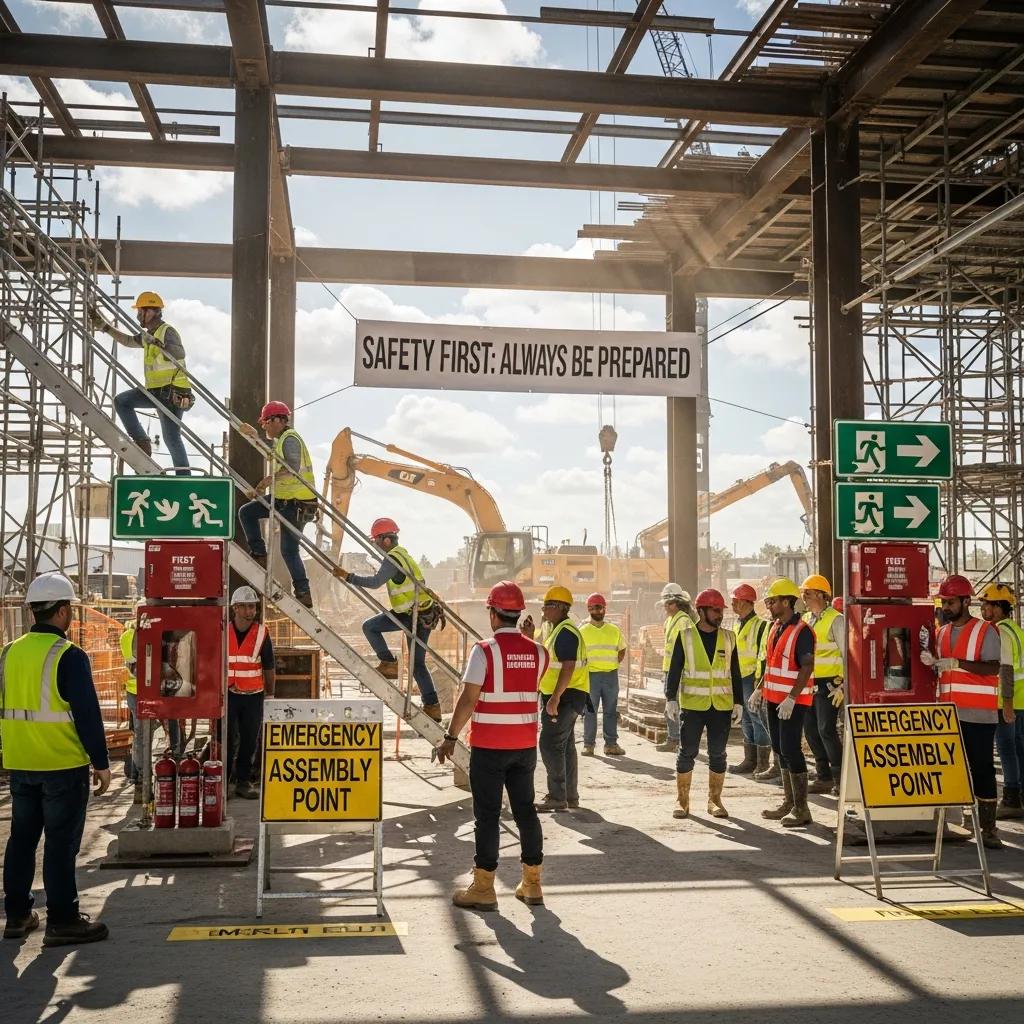
Essential Emergency Preparedness for Construction Sites: Comprehensive Construction Emergency Response and Safety Planning
Construction emergency preparedness is the organized set of policies, procedures, and resources that enable a site to prevent, respond to, and recover from incidents while protecting workers and assets. Effective preparedness works by identifying hazards, assigning roles, and creating clear evacuation and medical-response procedures so teams can act quickly and safely during an incident. This article explains how to build a construction emergency action plan, design site evacuation routes, meet OSHA first-aid requirements, perform hazard identification and risk assessment, and implement resilient emergency communication systems. It also examines how Virtual Design and Construction (VDC), BIM, 3D scanning, and precision layout tools reduce onsite uncertainty and improve emergency readiness. You will learn practical steps, checklists, and decision-making templates to document responsibilities, run effective drills, and integrate technology for hazard simulation and route verification. The next section defines the key components of a construction emergency response plan and shows how those elements form the foundation for every subsequent preparedness activity.
What Are the Key Components of a Construction Emergency Response Plan?
A construction emergency response plan (EAP) is a written framework that defines how incidents are reported, how personnel evacuate and are accounted for, and how on-site medical and external emergency resources are engaged. The mechanism that makes an EAP effective is clear task assignment combined with defined procedures and communication protocols that reduce confusion and speed response times. The benefit of a well-structured EAP is measurable: faster incident containment, higher accountability for personnel, and a defensible record of compliance with OSHA expectations. Below is a concise list of core EAP components intended for featured-snippet style clarity and quick operational use.
Construction emergency response plans should include these core components:
- Reporting & Notification: Clear steps for reporting incidents and alerting site personnel and emergency services.
- Evacuation Procedures: Defined evacuation routes, assembly points, and accountability processes.
- Medical Response: On-site first-aid arrangements, trained responders, and AED locations where applicable.
- Roles & Responsibilities: Designated incident commander, evacuation marshals, and first-aid personnel with documented duties.
- Communication Protocols: Primary and backup alert systems, confirmation procedures, and external contact lists.
- Training & Drills: Scheduled orientation and periodic drills with after-action reviews and corrective actions.
These components establish the EAP’s functional scope and lead naturally into defining specific site roles and regulatory touchpoints for compliance.
Introductory EAP component comparison table — purpose and recommended elements:
| Component | Required Elements | Recommended Enhancements |
|---|---|---|
| Reporting & Notification | Reporting chain and emergency contacts | Redundant alerting channels and escalation matrix |
| Evacuation Procedures | Evacuation routes and assembly points | Temporary-route marking plans and accessibility checks |
| Medical Response | First-aid provisions and trained personnel | AEDs, burn kits, and designated trauma responders |
| Roles & Responsibilities | Incident commander and accountability method | Role matrix with alternates and cross-training |
This comparison helps teams prioritize plan elements during development and documentation.
How Does an Emergency Action Plan Define Procedures and Roles on Site?
An EAP defines procedures by mapping each response task to a named role, specifying who performs the action, how it’s performed, and under what conditions authority changes hands. The mechanism is a role matrix that lists primary and backup personnel for incident commander, evacuation marshals, first-aid responders, and site safety officers, ensuring continuity if key staff are unavailable. Clear role definitions reduce decision latency and prevent duplicated efforts during an incident, which improves safety and accountability. Below is a simple role-versus-responsibility example to illustrate how documentation supports execution.
- Incident Commander: Directs response activities and communicates with emergency services.
- Evacuation Marshal: Leads evacuation on assigned zone and ensures route clearance.
- First-Aid Responder: Provides initial medical care and documents injuries.
- Site Safety Officer: Monitors hazards and recommends mitigation or work stoppage.
Documenting these roles and training alternates helps teams execute the EAP reliably and transitions into how OSHA regulations apply to those responsibilities.
Which OSHA Regulations Govern Construction Emergency Preparedness?
OSHA sets expectations for written plans, training, and first-aid arrangements under standards such as 29 CFR 1926.35 and related construction safety regulations, requiring employers to have procedures for medical emergencies and employee reporting. The mechanism is employer responsibility for planning, training, and maintaining records to demonstrate compliance, including providing prompt access to medical care and training first-aid providers as needed. Meeting OSHA requirements reduces liability and aligns on-site practices with recognized safety norms, while also forming the baseline for site-specific enhancements. Key regulatory touchpoints include written emergency action plans, methods for accounting for personnel during evacuations, and requirements to ensure competent first-aid responders or access to emergency medical services.
| OSHA Topic | Requirement | Practical Implementation |
|---|---|---|
| Written EAP | Documented emergency procedures | Site-specific EAP posted and distributed |
| First Aid | Access to medical care and trained personnel | Designated responders and first-aid kits on site |
| Training | Employee training on EAP and drills | Orientation and documented drill records |
These regulatory points clarify employer obligations and guide plan development and training schedules.
How to Develop and Implement Effective Site Evacuation Plans for Construction?
A site evacuation plan prescribes mapped routes, assembly points, and accountability systems sized to site personnel and the project’s phasing; it works by removing ambiguity so people can move safely when alerted. The mechanism uses site assessment, route mapping, marking, and drills to validate that routes stay unobstructed under active construction conditions, producing the benefit of faster, safer evacuations and clearer post-incident accounting. The steps below provide a structured how-to process for developing and testing a site-specific evacuation plan.
Follow these steps to develop and implement an evacuation plan:
- Assess the Site: Identify hazards, population counts, and dynamic constraints by zone.
- Map Evacuation Routes: Create primary and secondary routes with capacity assessments.
- Designate Assembly Points: Place visible, accessible assembly areas outside hazard zones.
- Mark & Maintain Routes: Install temporary signage and enforce route clearance during work shifts.
- Train & Drill: Run orientation and periodic drills with verification and after-action reviews.
These steps form a cycle: assessment informs mapping, mapping supports marking, and drills validate the design while revealing required refinements.
What Are Best Practices for Evacuation Routes and Assembly Points?
Evacuation route design should prioritize redundancy, capacity, and accessibility while anticipating changing site footprints during phased construction. Mechanisms include selecting multiple routes per zone, specifying minimum clear widths, and using high-visibility temporary signage to maintain path clarity; the benefit is resilience—if one path is blocked, another supports safe egress. When placing assembly points, choose locations that are visible, a safe standoff distance from hazards, and sheltered if weather or post-incident triage is required. Regular verification during phased work ensures routes remain viable, which leads into the cadence for drills and evaluations to confirm readiness.
- Route Selection Criteria: Multiple egress options, unobstructed width, and accessible gradients.
- Assembly Point Considerations: Visibility, safe distance from hazard zones, and capacity for headcounts.
- Temporary Marking: Durable, high-contrast markers and lighting for low-visibility shifts.
Applying these criteria and marking strategies helps teams maintain effective evacuation capability as site conditions evolve.
How Often Should Evacuation Drills Be Conducted and Evaluated?
Drill frequency should align with project risk, complexity, and changes to site logistics: a practical schedule includes orientation on hire, monthly walk-throughs, quarterly full drills, and immediate drills after significant scope or layout changes. The mechanism is regular practice combined with data-driven after-action reviews that measure evacuation time, accountability accuracy, and notification latency; the benefit is continuous improvement that reduces response times and uncovers latent flaws. Evaluation metrics should be documented, corrective actions assigned, and outcomes fed back into route design and training curricula to close the loop on readiness.
- Orientation: Onboarding briefings and route familiarization for new personnel.
- Routine Drills: Quarterly full-scale or phased drills with timing and role verification.
- Post-Change Drills: Drills triggered by layout, personnel, or scope changes.
Structured evaluation ensures drills translate into operational improvements and better emergency outcomes.
After validating routes through drills, teams can reduce on-site risk further by improving first-aid readiness and reducing incident likelihood through coordination and precise layout.
What Are OSHA First Aid Requirements and Best Practices for Construction Sites?
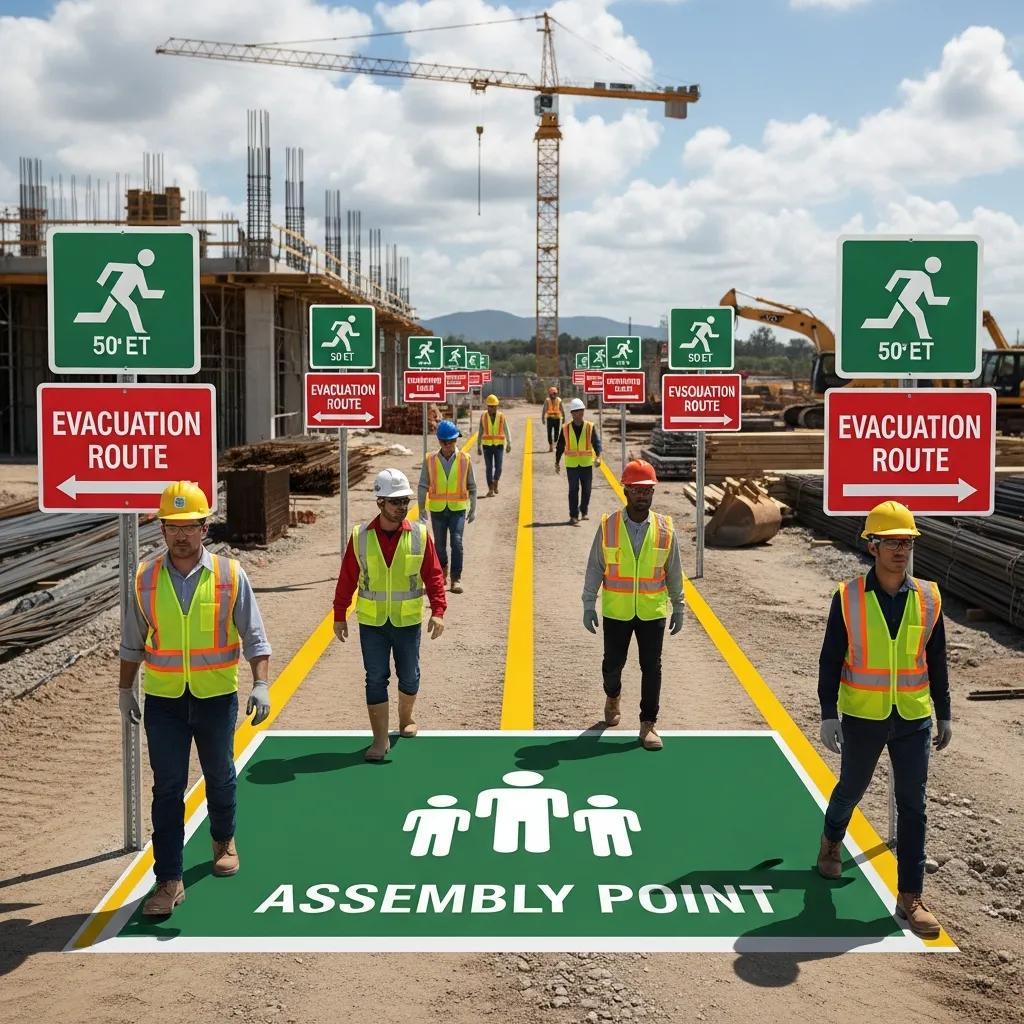
OSHA requires employers to ensure prompt access to medical personnel and first-aid supplies, and to provide employee training where appropriate, forming the baseline of on-site medical preparedness. The mechanism for meeting these expectations is provisioning kits, training designated responders, and maintaining documentation of inspections and certifications; the benefit is timely care that limits injury severity and supports regulatory compliance. Below is a practical checklist and a comparative table that shows OSHA-referenced minimums versus recommended best-practice items to improve outcomes on high-risk sites.
Recommended first-aid and medical readiness checklist:
- On-site first-aid kits: Adequate number and placement for site size.
- Trained responders: Designated personnel trained in first aid and CPR.
- Inspection cadence: Regular kit inspections and replacement of expired items.
- AED availability: Where practical, placement with trained AED users.
Ensuring these items are consistently managed reduces time to care and supports recovery while tying directly into training and drill outcomes.
The table below compares OSHA-required items against recommended enhancements for construction sites.
| Item Category | OSHA Guidance / Required | Recommended Best Practice |
|---|---|---|
| First-Aid Kits | Accessible kits with basic supplies | Multiple kits, burn care, eye wash station |
| Trained Personnel | Access to medical care or trained first-aiders | On-site certified responders and CPR/AED training |
| Recordkeeping | Document incidents and first-aid administered | Maintenance logs for kits and training records |
| AEDs | Not universally required | Deploy AEDs on larger or high-risk sites |
Comparing required items with enhanced recommendations helps project teams prioritize investments that improve survival and reduce complication rates.
What Should a Construction Site First Aid Kit Contain According to OSHA?
OSHA indicates that first-aid supplies must be available and suitable for the kinds of injuries likely on the job; practical minimums include bandages, antiseptics, dressings, and tools such as scissors. The mechanism of effectiveness is rapid, accessible materials plus trained personnel to use them, which reduces the progression of injuries and the need for advanced care. Recommended enhancements—such as burn dressings, eye irrigation solutions, and splints—address construction-specific risks and reduce recovery time. A weekly inspection cadence and clear kit location signage ensure that supplies are ready when needed and that staff can access them quickly.
- Minimum Kit Items: Bandages, sterile gauze, adhesive tape, antiseptic wipes, and gloves.
- Recommended Additions: Burn kits, eye wash, triangular bandages, and compact splints.
- Maintenance: Weekly checks and replacement of expired items; clear signage for kit locations.
Maintaining enhanced kits and training responders supports quicker interventions and informs the selection of drills for realistic medical scenarios.
Who Should Be Trained in First Aid and Medical Response on Site?
Designated first-aid responders, supervisors, and selected crew leads should receive first-aid and CPR training appropriate to site hazards, creating a distributed capability for immediate care while professional medical help is en route. The mechanism is role-based training with refreshers and competency checks, which ensures that responders maintain practical skills and that coverage ratios match workforce size and shift patterns. Recommended training cadence includes initial certification and annual refreshers, with documentation retained to demonstrate preparedness and to guide staffing for drills and response plans.
- Primary Responders: At least one trained responder per shift and per work zone.
- Site Leaders: Supervisors trained to coordinate response and record events.
- Alternates: Backup personnel trained to replace primary responders during absences.
Role-based training reduces response delay and supports the accountability processes in the EAP.
Integrating precise site layouts and coordination reduces incident rates, which in turn lowers demand on first-aid resources.
How Does Hazard Identification and Risk Assessment Enhance Construction Safety?
Hazard identification and risk assessment systematically uncover potential events that could cause harm and assign risk levels so mitigation is prioritized and tracked. The mechanism combines preconstruction reviews, job safety analyses (JSA), and ongoing field observations to identify hazards such as falls, struck-by incidents, electrical exposure, and excavation collapse; the benefit is prevention—mitigations reduce incident frequency and severity. Effective assessments feed into the EAP and evacuation planning by identifying high-risk zones, informing route selection, and defining where additional controls or first-aid resources are necessary.
Common hazard categories and associated mitigation examples follow from this assessment process.
| Hazard Category | Typical Cause | Typical Mitigation |
|---|---|---|
| Falls | Unprotected edges | Guardrails, harnesses, controlled access |
| Struck-By | Moving equipment | Exclusion zones and high-visibility PPE |
| Electrical | Contact with live conductors | Lockout/tagout and qualified personnel |
| Excavation | Trench collapse | Shoring, sloping, and protective systems |
This mapping links observed hazards to prioritized mitigations that reduce the likelihood of emergencies and influence site logistics decisions.
What Types of Hazards Are Common on Construction Sites?
Construction sites routinely face hazards including falls from height, struck-by incidents due to moving equipment or falling objects, electrical exposures, and excavation collapses; these hazards arise from the physical nature of construction, dynamic site changes, and interaction among trades. The mechanism for control is layered mitigation—engineering controls first, then administrative controls and PPE—leading to reduced incident likelihood. Quick mitigation examples include temporary edge protection for heights, exclusion zones around cranes, lockout/tagout for electrical work, and shoring for excavations, each of which should be documented in the project hazard register.
Understanding these hazard types informs risk assessment methodology selection and the prioritization of emergency planning activities.
Which Risk Assessment Methodologies Are Most Effective for Prevention?
Effective methodologies include Job Safety Analysis (JSA) for task-level risks, Hazard Identification and Risk Assessment (HIRA) for project-level profiling, and Bowtie analysis for complex hazard-pathway modeling; each provides a different lens for prevention. The mechanism involves selecting an approach based on project scale: JSAs work well for routine tasks, HIRA for multi-trade projects, and Bowtie for critical systems where causal chains must be controlled; the benefit is a tailored mitigation strategy that aligns resources to the highest risks. A comparative approach often yields the best results, combining JSA detail with HIRA prioritization and Bowtie for high-consequence hazards.
- JSA: Task-level controls and worker engagement.
- HIRA: High-level prioritization across trades and phases.
- Bowtie: Visual causal mapping for critical hazard scenarios.
Choosing and applying the right mix of methodologies ensures prevention is both practical and proportionate to project risk.
How Can Emergency Communication Strategies Improve Construction Site Safety?
Emergency communication strategies ensure alerts reach all affected personnel quickly, enable confirmation of actions taken, and support coordination with external emergency services; this mechanism reduces response latency and confusion, improving survival and recovery outcomes. Systems should include redundant channels—two-way radios, mass-SMS/app alerts, and public-address options—so that a single point of failure does not disable notifications. A clear chain of command for messaging, confirmation procedures, and integration with evacuation and accountability processes ensures that communications translate into effective action during incidents.
Recommended communication systems and their situational use-cases are listed below.
- Two-Way Radios: Direct team coordination in noisy or radio-friendly environments.
- Mass SMS/App Alerts: Rapid site-wide notification and status updates.
- Public Address Systems: Immediate audible alerts for on-site personnel.
- Wearables/Beacons: Location-based alerting and rapid accountability in complex sites.
Selecting a combination of these systems based on site size, noise levels, and available infrastructure produces reliable alerting and supports evacuation and medical response.
What Communication Systems Are Recommended for Emergency Alerts?
Choose communication systems based on reliability, redundancy, and site conditions: two-way radios provide instant team-to-team coordination, mass-alert platforms deliver wide-area notifications, and PA systems broadcast instructions where visual or personal devices may fail. The mechanism for resilience is layered redundancy—if one system fails, another compensates—resulting in higher probability that all personnel receive critical instructions. Implementation considerations include battery life, range, integration with headsets or PPE, and the noise environment, all of which affect system selection and testing during drills.
- Advantages: Radios enable real-time coordination; mass alerts ensure broad reach.
- Limitations: Apps require device access; PA systems can be masked by heavy equipment noise.
- Implementation Tips: Test systems under realistic site conditions and include backup power sources.
Routine testing and integration with drills validate that chosen systems perform under operational pressures.
How Is the Chain of Command Established During Emergencies?
The chain of command sets decision authority and reporting flow during emergencies, typically designating an incident commander with delegated authorities, supported by evacuation marshals and safety officers who execute specific tasks. This structure works by reducing ambiguity—personnel know who issues orders and who confirms actions—improving coordination and post-incident reviews. Documentation should include escalation ladders, alternate authorities, and communication responsibilities, and training should practice role handoffs so authority transitions do not interrupt response effectiveness.
- Incident Commander: Overall decision authority and external liaison.
- Functional Leads: Medical, evacuation, and site safety responsibilities.
- Alternates: Pre-designated backups to maintain continuity.
Clear, practiced command structures ensure rapid, coordinated action when every minute counts.
How Does Leveraging VDC and BIM Technologies Support Proactive Emergency Preparedness?
VDC and BIM technologies create digital replicas and coordinated models that enable hazard simulation, clash detection, and optimized site logistics, with the mechanism of visualizing conflicts and evacuation paths before they exist physically. The benefit is proactive mitigation—teams can detect potential obstructions, verify temporary route clearances, and simulate evacuation flows under different scenarios, reducing rework and improving safety outcomes. Conway Coordination and Layout Services (CCLS) specializes in VDC consulting, BIM modeling and coordination, 3D scanning, and precision layout using Robotic Total Station technology; these capabilities help translate digital clarity into safer, verifiable field conditions. For teams seeking validation, CCLS can provide model-based route verification and consultation to align plans with field realities and request a site coordination consultation to evaluate evacuation and logistics scenarios.
The table below maps VDC/BIM capabilities to safety outcomes with concrete examples and metrics to clarify practical benefits.
| Capability | Attribute | Benefit (Example/Metric) |
|---|---|---|
| Clash Detection | Automated conflict reports | Prevents obstructions in egress paths; reduces rework by measurable clashes per model |
| Hazard Simulation | Virtual walkthroughs and scenario runs | Validates evacuation timing and identifies bottlenecks before construction |
| 3D Scanning | Point-cloud as-built verification | Confirms temporary works and route clearances with high spatial accuracy |
| Precision Layout (Robotic Total Station) | Field alignment to model | Ensures assembly points and signage are placed to spec, reducing layout errors |
This mapping shows how integrated digital workflows convert model findings into verifiable safety gains on site.
How Does Virtual Design and Construction Enable Hazard Simulation and Clash Detection?
Virtual Design and Construction workflows integrate discipline models and point-clouds to run clash detection and simulate hazard scenarios, exposing physical conflicts before they reach the field and enabling designers to resolve them early. The mechanism uses iterative model coordination and automated clash reporting to prioritize conflicts based on severity, which reduces onsite surprises and prevents conditions that could impede evacuations or create new hazards. For example, detecting a conduit path that would block a primary egress during a specific phase lets teams reroute the element in the model, update temporary route marking, and validate the change through a virtual walkthrough, closing the loop between design and safety.
These proactive model checks reduce rework and materially support evacuation planning and first-aid accessibility.
In What Ways Does BIM Facilitate Risk Mitigation and Site Logistics Optimization?
BIM supports sequencing, logistics planning, and digital verification so temporary workflows, storage, and work zones avoid obstructing evacuation routes and critical access points; the mechanism is model-driven planning paired with field verification to ensure real-world alignment. The benefit includes fewer layout errors, clearer site zones, and quantified reductions in conflicts that can delay evacuation or emergency response. Practical uses include exporting route geometry for marking plans, aligning point-cloud data with models to confirm as-built conditions, and using simulations to size assembly points and predict evacuation times under phased conditions.
- Sequencing: Model-based schedules that maintain egress corridors during each phase.
- Model-to-Field Verification: Point-cloud alignment and precision layout to confirm actual conditions.
- Outcome Metrics: Reduced rework and improved evacuation times validated during drills.
These BIM-driven processes transform emergency planning from a static document into an actively managed, verifiable capability that improves safety and operational efficiency.
EAV Table — VDC/BIM Capabilities to Safety Outcomes
Before the table, this mapping summarizes how specific digital services translate into measurable safety benefits on construction projects.
| Service | Feature | Safety Outcome (Example) |
|---|---|---|
| VDC Consulting | Model coordination workflows | Fewer design clashes; improved egress planning |
| BIM Modeling | Integrated discipline models | Clearer sequencing and fewer temporary obstructions |
| 3D Scanning | As-built verification | Accurate placement of assembly points and first-aid resources |
Connecting digital services to safety outcomes helps project teams choose the appropriate technical interventions to support their emergency preparedness goals.
This final section demonstrates how technology-integrated practices reduce incident likelihood and improve the reliability of evacuation and medical-response systems across project phases.