

How to Expedite Construction Permits: Expert Tips for Streamlining the Construction Permitting Process
Permit delays cost time and money across every construction project, often stemming from incomplete documentation, coordination failures, and mismatched expectations with permitting authorities. This article explains how targeted pre-submission workflows, Virtual Design and Construction (VDC), Building Information Modeling (BIM), and precision layout technologies reduce review cycles and increase first-pass approvals, delivering measurable schedule and cost benefits. You will learn to identify the most common causes of permit delays, apply clash detection and sequencing to tighten submissions, present BIM outputs that satisfy compliance checks, and use robotic layout and as-built verification to ensure inspection readiness. The guidance includes practical checklists, EAV comparison tables for VDC/BIM/layout choices, and real-world examples illustrating permit efficiencies achieved through technology and better coordination. Read on for actionable, regulator-focused tactics to improve permit application efficiency and reduce resubmission risk across projects in the Southeastern U.S. and similar jurisdictions.
Indeed, optimizing the entire permit processing timeline is a key focus for construction projects aiming for efficiency.
Optimizing Construction Permit Processing Time
by evaluating and optimizing the process time for construction permits of construction permits are shown in Figure 31.2. The following study has been discussed processing optimization
Evaluation and optimization of processing time for construction permits, S Kewate, 2024
What Are the Common Causes of Construction Permit Delays?
Construction permits are commonly delayed when submissions lack required metadata, present uncoordinated disciplines, or fail to address jurisdiction-specific code interpretations, and these problems directly extend review cycles and conditional approvals. Incomplete drawings, missing specifications, and unclear phasing force reviewers to request clarifications, while interdisciplinary clashes between structural, MEP, and architectural drawings generate resubmissions and lengthy rework. Jurisdictional misunderstandings—such as incorrect code references or omitted fire egress sequencing—often require supplemental reviews. Early identification of these issues lets teams assemble consolidated, reviewer-friendly submittals that minimize back-and-forth.
- Incomplete documentation or missing metadata that prevents automated or manual code checks.
- Design coordination failures and clashes between disciplines that require revisions.
- Jurisdictional or code interpretation errors that necessitate clarification or correction.
- Late engagement with permitting authorities and lack of pre-application coordination.
- On-site discrepancies uncovered at inspection that delay final approvals.
These causes point to predictable process fixes and technological interventions; the next subsection details the regulatory and documentation gaps most likely to slow approvals.
Which Regulatory and Documentation Challenges Slow Permit Approvals?
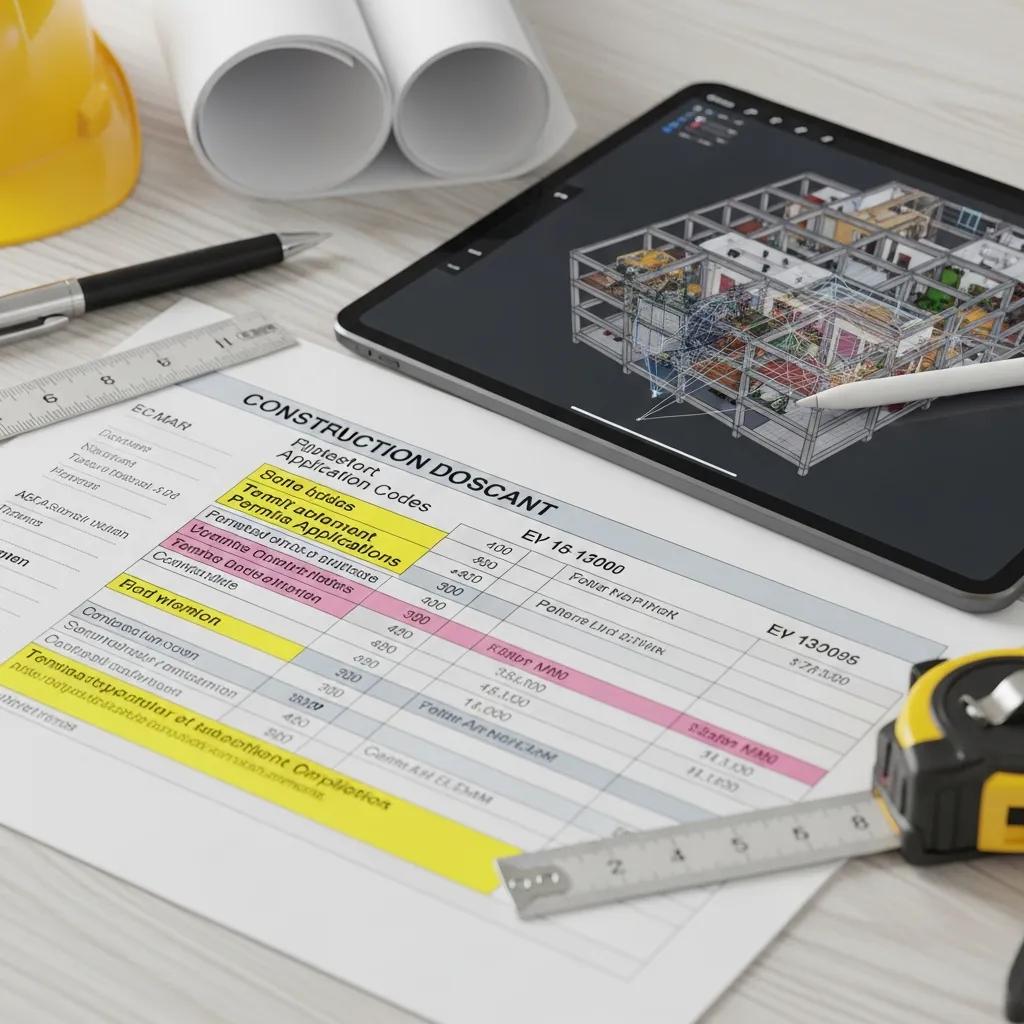
Regulatory and documentation errors typically include missing code citations on drawings, absent material specifications, and lack of essential form appendices — each of which halts automated checks or forces manual reviewer inquiries. Reviewers expect clear metadata (e.g., fire ratings, material standards, egress capacities) directly embedded or indexed so they can validate compliance without extra requests. A short pre-submission validation checklist reduces resubmissions: confirm metadata completeness, attach required forms and appendices, and cross-reference code sections on key sheets. Implementing this checklist before filing reduces common omissions and decreases reviewer queries that otherwise extend permit timelines.
Addressing these document-level challenges enables better coordination workflows; next we examine how poor design coordination compounds permit delays.
How Do Coordination Issues and Inaccurate Plans Impact Permit Timelines?
Coordination failures—such as unresolved MEP/structural clashes or inconsistent elevations—create reviewer uncertainty and frequently produce conditional approvals or outright rejections, adding days or weeks to project schedules. For example, a requested mechanical chase revision can trigger multiple discipline updates and re-drawing cycles that cascade through the submittal. Establishing pre-permit coordination workflows, including interdisciplinary model reviews and documented clash logs, prevents these rework loops. A disciplined coordination process produces consistent plan sets and reduces the number of review-resubmit cycles, improving the chance of first-pass permit approval and limiting schedule exposure.
Reducing coordination-related delays leads naturally to leveraging model-based methods like VDC, which we explore next.
How Can Virtual Design and Construction Accelerate Permit Approvals?
Virtual Design and Construction (VDC) accelerates permit approvals by unifying model-based coordination, clash detection, and sequencing simulations into a single pre-submission workflow that clarifies reviewer intent and reduces rework. By simulating construction sequencing and resolving interdisciplinary conflicts before submittal, VDC lowers the number of reviewer comments and provides visual evidence for compliance checks. This mechanism shortens permit review cycles because reviewers receive consolidated, traceable deliverables instead of fragmented, conflicting documents. Early VDC engagement also supports site logistics and regulatory condition simulations, which reduce conditional approvals tied to phasing or egress concerns.
VDC services provide several direct permit-focused benefits and are best understood by their specific components.
- Clash Detection and Resolution: Automated identification of geometric conflicts reduces the number of design resubmissions.
- 4D Sequencing Simulations: Time-based phasing visuals demonstrate compliant staging and egress plans.
- Consolidated Documentation: Single-source outputs simplify reviewer validation and minimize contradictory drawings.
These components translate to fewer reviewer questions and faster approvals when combined in a disciplined VDC workflow. The table below compares common VDC components and the permit-value they deliver.
| VDC Components | Attribute | Permit Value |
|---|---|---|
| Automated Clash Detection | Identifies conflicts across disciplines | Reduces resubmissions and reviewer queries |
| 4D Sequencing | Time-based construction phasing | Demonstrates code-compliant staging and reduces conditional approvals |
| Consolidated Deliverables | Single-source coordinated outputs | Eases reviewer validation and lowers review cycles |
This comparison shows how each VDC component maps to specific permit-review improvements and why integrating them early reduces overall permit risk.
Conway Coordination and Layout Services (CCLS) offers VDC consulting that applies these exact mechanisms—clash detection, sequencing, and consolidated submittals—to help projects present reviewer-ready packages. As a family-owned firm specializing in VDC, BIM, and high-precision layout, CCLS focuses on delivering coordinated deliverables that simplify regulatory review while maintaining inspection-readiness. For teams evaluating third-party VDC support, a targeted engagement that documents clash resolution counts and sequencing visuals is the most direct path to measurable permit-cycle reductions.
The next subsections explain clash detection mechanics and sequencing benefits in permit contexts.
What Role Does Clash Detection Play in Preventing Permit Rejections?
Clash detection flags geometric and schedule conflicts between disciplines before drawings are exported for permit review, preventing reviewer discoveries that usually trigger resubmissions. The workflow typically runs automated clash reports, assigns responsible parties to resolve issues, and documents resolutions with revision notes and model snapshots for the permit package. Reporting metrics—such as the number of clashes found and resolved prior to submission—give reviewers confidence and demonstrate due diligence. Tracking these metrics in the submittal highlights preemptive quality control and reduces the chance that reviewers will issue conditional comments based on unresolved conflicts.
This proactive clash workflow supports the next permitting lever: model-based sequencing, which clarifies phasing for authorities.
How Does VDC Optimize Construction Sequencing for Regulatory Review?
VDC’s 4D sequencing links model geometry to construction time, enabling teams to produce visuals that show phasing, egress paths, and temporary protections in a way that regulators can readily validate. Sequencing visuals and short animations demonstrate compliance with fire-prevention staging, site access plans, and occupancy phasing without voluminous narrative text. Submitting these time-based exhibits alongside plan sheets reduces reviewer uncertainty and often eliminates conditional approvals that would otherwise require additional follow-up. The result is fewer queries about phasing and a smoother path to permit signoff when authorities can visually verify compliance.
Visual sequencing outcomes naturally lead to data-rich BIM outputs that satisfy code checks, which the next section addresses.
Why Is Building Information Modeling Essential for Construction Compliance?
Building Information Modeling (BIM) is essential for compliance because it embeds metadata and structured information into coordinated geometry, making automated and manual code checks more reliable and faster for permitting authorities. BIM models carry attributes such as material specifications, fire ratings, and equipment schedules that directly answer reviewer questions without ad hoc clarifications. The mechanism—linking rich metadata to model elements—reduces ambiguous details on plan sheets and promotes traceability of changes. As a result, BIM-based submissions lower the incidence of resubmissions and enable clearer permit packages that reviewers can validate efficiently.
The integration of BIM into permit processes is increasingly recognized as a crucial step towards achieving these streamlined outcomes.
Integrating BIM for Streamlined Building Permits
With the recent technological advancement in the Architecture, Engineering, and Construction (AEC) industry, building control authorities in a number of countries are trying to integrate BIM into their building permit processes.
Readiness assessment for BIM-based building permit processes using Fuzzy-COPRAS, K Ullah, 2022
Below is a compact EAV table comparing BIM model outputs versus common compliance attributes and the resulting permit-value.
| BIM Model Type | Compliance Attribute | Value (Permit Impact) |
|---|---|---|
| Architectural BIM | Material specs, room use metadata | Faster validation of code compliance for occupancy and finishes |
| MEP BIM | Equipment schedules, clearances, penetrations | Reduced reviewer questions about service routing and code compliance |
| Structural BIM | Member sizes, connections, tolerance data | Clearer structural compliance evidence and inspection readiness |
This table clarifies how different BIM model types supply the attributes reviewers need and therefore reduce resubmission frequency. Next, we detail how to ensure BIM models include the right attributes.
How Does BIM Ensure Accurate, Data-Rich Permit Submissions?
BIM ensures accuracy by embedding essential metadata—fire ratings, U-values, material types, equipment identifiers—directly into model elements so permit reviewers can extract authoritative information without manual cross-referencing. A practical pre-submittal QA/QC checklist includes validating metadata completeness, running model-based clash and clearance checks, and producing coordinated plan extractions with linked schedules. Presenting export sheets that reference model element IDs and a short metadata index helps reviewers trace any item back to the model. This structured approach minimizes ambiguous details and supports automated or manual compliance verification by regulatory staff.
Delivering these model attributes reduces reviewer ambiguity and prepares projects for final inspection procedures discussed in later sections.
In What Ways Does BIM Reduce Resubmissions and Permit Rework?
BIM reduces resubmissions by resolving interdisciplinary conflicts in model space and by supplying the metadata reviewers use to verify compliance, which cuts down reviewer comments and conditional approvals. Pre-submission reports—such as clash logs, change histories, and metadata completeness summaries—provide transparent evidence of quality control and make reviewer acceptance more likely. Models also allow rapid generation of revised plan sets when changes are necessary, shortening turnarounds and preserving schedule. Documenting model changes and including revision notes in the permit package gives reviewers a clear audit trail that limits follow-up queries and expedites final approvals.
With BIM-driven submittals better aligned to reviewer expectations, on-site accuracy becomes the next crucial factor for inspection success.
How Does Precision Layout Using Robotic Total Station Prevent Permit-Related Issues?

Robotic Total Station layout prevents permit-related issues by translating approved, coordinated plans into highly accurate on-site control that matches model intent, reducing discrepancies that cause inspection failures and hold orders. The mechanism centers on sub-inch placement accuracy for structural anchors, equipment pads, and MEP penetrations, which ensures the built condition aligns with permit drawings and as-built records. Integration of layout data with BIM and as-built 3D scans confirms conformity and supplies verifiable evidence for inspectors. This on-site precision lowers the probability of stop-work orders tied to misaligned elements and supports cleaner final permit closeouts.
The following table compares layout technology attributes and the specific inspection and permit values they deliver.
| Layout Technology | Attribute | Value (Permit/Inspection Impact) |
|---|---|---|
| Robotic Total Station | Sub-inch accuracy, automated stakeout | Higher first-time inspection pass rates and fewer hold orders |
| Trimble integration | Direct model linking and coordinate export | Seamless comparison between model and built conditions |
| 3D scanning verification | Rapid as-built capture | Clear evidence for final permit closeout and discrepancy resolution |
This comparison highlights how precision layout tech maps directly to inspection readiness and permit risk reduction. Below is a short example of on-site precision benefits and a practical CTA.
Conway Coordination and Layout Services applies Trimble Robotic Total Station layout combined with model integration to produce inspection-ready layouts that reduce field discrepancies. Their practical example workflows include layout control point generation, recorded stakeout verification, and a concise as-built deliverable that inspectors can cross-reference with permit drawings. To discuss how precision layout could improve inspection pass rates on your project, contact Nathan Conway at Conway Coordination and Layout Services (CCLS) to schedule a consultation.
The next subsections explain inspection benefits and rework reduction in more detail.
What Are the Benefits of On-Site Accuracy for Inspection Compliance?
On-site accuracy improves first-time inspection pass rates by ensuring critical elements such as anchors, penetrations, and curb lines match approved drawings within allowable tolerances, reducing inspector-initiated corrections. Accurate layout supports progressive inspection sign-offs because inspectors can verify that dimensions, setouts, and clearances comply with the model and submitted plans. Recommended pre-inspection steps include generating a verification report, producing annotated as-built snapshots, and presenting a short control-point summary for reviewers. These artifacts create a transparent trail that inspectors value and that expedites final permit closeout.
Ensuring precise layout directly reduces costly rework, which is the focus of the next subsection.
How Does Precision Layout Reduce Costly Rework and Permit Delays?
Precision layout reduces rework by catching potential misplacements before concrete pours, equipment installation, or rough-ins proceed, thereby avoiding demolition, re-fabrication, and schedule disruptions that trigger permit holds. Cost/time comparisons typically show that preventing a single mislocated structural element saves multiple labor and schedule days versus correcting it after installation. Integrating layout control into QA workflows—linking stakeout records to BIM and scheduling periodic verification scans—creates ongoing alignment between design and field execution. This proactive approach minimizes permit delays caused by field-built divergences and reduces the likelihood of costly change orders tied to noncompliant installations.
Having precise field data also improves stakeholder communication and supports clearer permit documentation, which we cover next.
What Strategies Enhance Communication and Planning for a Smoother Permitting Process?
Enhancing communication and planning requires early engagement with permitting authorities, centralized digital documentation, and clear, auditable response channels so reviewer questions are answered quickly and in context. Early pre-application meetings align expectations and reduce surprises during formal review, while cloud-based version control and model viewers support traceable changes and fast reviewer access. Clear internal workflows assigning responsibility for reviewer comments, documented response templates, and an organized permit package checklist streamline the interaction with authorities. These strategies collectively reduce permit friction and compress approval timelines when consistently applied across projects.
The broader trend towards digital transformation in building permits further supports these strategies, emphasizing the shift towards automated and efficient workflows.
Digitalizing & Automating Building Permit Workflows
of digitizing and automating building permits. We studied current permit workflows and the , while most municipalities also have pre-submission and post-construction phases (Figure 2).
Digital Transformation of Building Permits: Current Status, Maturity, and Future Prospects., D Siegele, 2075
Below is an actionable checklist for teams preparing a permit submittal and planning reviewer engagement.
- Schedule a pre-application meeting: Confirm scopes, code interpretations, and submission requirements with authorities.
- Use centralized digital storage: Maintain a single source of truth with version control and access logs.
- Provide model viewers or extract views: Share data-rich model snapshots for reviewer validation.
- Assign comment-responsible parties: Track reviewer queries and responses with clear ownership.
- Prepare a permit appendix: Include clash logs, sequencing visuals, metadata index, and control-point evidence.
These steps form a defensible submittal strategy that minimizes back-and-forth and demonstrates proactive compliance. Next, we explain why early engagement matters and how to operationalize digital documentation.
Why Is Early Engagement with Permitting Authorities Crucial?
Early engagement clarifies code interpretation, submission expectations, and potential conditions, and it allows teams to adjust deliverables before formal review begins, thereby avoiding common surprises. Running a structured pre-submittal meeting with agenda items—scope overview, key code questions, phasing demonstrations, and required appendices—creates documented outcomes that can be referenced during the formal review. Capture agreements and clarifications in meeting minutes and add them to the permit package to limit later disputes about intent. This proactive approach shortens review cycles because authorities have already validated assumptions that often become conditional comments.
Documenting these early agreements ties directly to the value of digital documentation, discussed next.
How Does Leveraging Digital Documentation Improve Permit Management?
Digital documentation improves permit management by providing version control, auditable change logs, and shared model viewers so reviewers and project teams work from the same authoritative data set. Features to use include access-controlled model viewers, comment resolution workflows, and automatic notifications when key documents change; these reduce response times and avoid lost or outdated attachments. Including links (accessible to reviewers) to specific model views or exporting annotated snapshots in the permit package simplifies reviewer validation. Centralized digital practices also create an audit trail that allows teams to demonstrate due diligence when addressing reviewer comments.
With improved communication and robust documentation in place, teams can realize measurable permit efficiencies; the final section shows real-world examples where these methods were applied.
What Are Real-World Examples of Successful Permit Streamlining with CCLS?
Real-world examples demonstrate how coordinated VDC, BIM, and precision layout reduce permit cycle times and resubmissions by producing reviewer-ready deliverables that inspectors can verify quickly. The snippets below highlight typical project problems, CCLS interventions, and quantifiable outcomes in non-confidential, illustrative terms.
- Multidiscipline Commercial Fit-Out: Client faced multiple MEP-architectural clashes that delayed submittal. CCLS provided clash detection, coordinated model fixes, and a consolidated submittal package; the review cycle shortened by multiple weeks and reviewer comments were reduced significantly.
- Phased Hospital Renovation: The project required complex phasing and egress demonstrations. CCLS used 4D sequencing visuals and metadata-indexed plan extracts that clarified staging; conditional approvals were minimized and inspector follow-ups decreased.
- Industrial Equipment Installation: Field misalignments threatened inspection failure. Precision layout with Robotic Total Station and as-built verification allowed the team to present stamped layout control evidence, leading to a smoother closeout process.
These examples illustrate common problems and the specific mix of VDC, BIM, and robotic layout interventions that drive permit efficiencies. If you’d like a project-specific estimate of potential permit-cycle reductions or a discussion about applying these methods on your site, contact Nathan Conway at Conway Coordination and Layout Services (CCLS) to request a consultation.
How Have CCLS’s VDC and BIM Services Accelerated Permit Approvals?
CCLS’s VDC and BIM interventions typically focus on delivering clash logs, sequencing visuals, and metadata-indexed deliverables that reviewers can validate without extensive clarification requests. In practice, these deliverables reduce reviewer comments and shorten review-resubmit cycles, particularly when teams document the number of clashes resolved prior to submission and supply concise phasing exhibits. By emphasizing coordinated outputs and clear audit trails, CCLS helps project teams present packages that map directly to regulatory review checkpoints and reduce back-and-forth with authorities.
These targeted deliverables make permit reviewers’ jobs easier and increase the likelihood of first-pass approvals, reinforcing the value of model-driven coordination.
What Quantifiable Benefits Demonstrate CCLS’s Impact on Permit Efficiency?
Across projects, CCLS’s combined services commonly produce measurable outcomes such as reduced resubmissions, shortened review cycles, and fewer inspection-day discrepancies, though specific metrics vary by scope. Typical ranges observed in analogous engagements include meaningful reductions in review cycles and lower incidence of hold orders due to field-built variance. For precise, project-specific ROI estimates, project teams should engage CCLS to evaluate their current permit workflows, which enables a tailored estimate of time and cost avoidance based on deliverable scope and jurisdictional complexity.
These concise case snippets show how coordinated pre-submission efforts and technology-driven workflows convert to real permit efficiencies and lower overall project risk.