
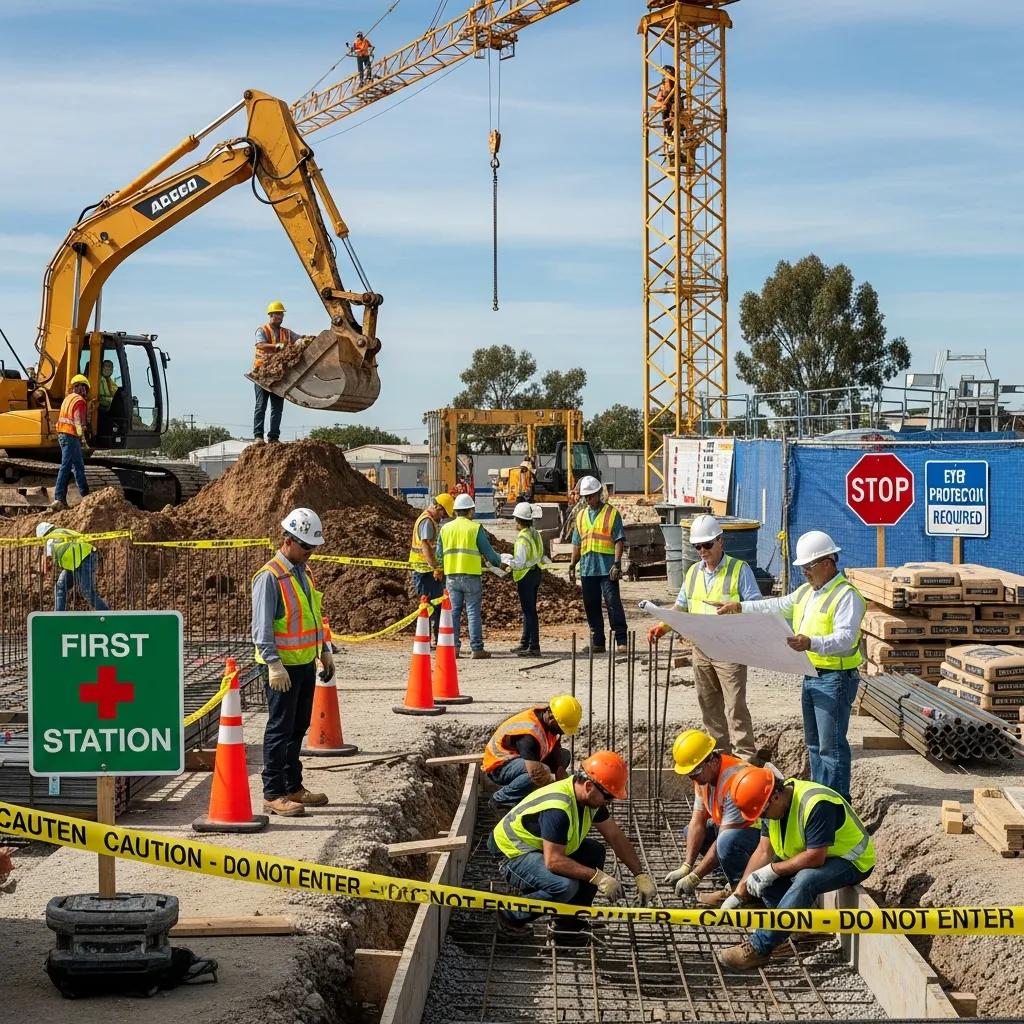
Creating Comprehensive Site Safety Protocols for Construction: Effective Planning and Risk Mitigation
A construction site safety protocol is a coordinated set of procedures, controls, and documentation designed to prevent incidents, ensure regulatory compliance, and protect workers, equipment, and schedules. By combining site-specific risk assessment, clear hazard communication, emergency response planning, and monitoring, project teams reduce exposures and support proactive construction safety management. This guide explains how to build a construction safety plan that leverages digital construction safety solutions—BIM, VDC, 3D scanning, and precision layout—to identify hazards before work begins and to validate safety-critical components in the field. Readers will learn essential plan components, how VDC enhances proactive prevention, ways BIM supports training and emergency response, the role of robotic total station layout in fall prevention and anchor verification, modern training and simulation best practices, and strategies for embedding a durable safety culture. The article emphasizes practical steps, semantic techniques for risk communication, and examples of technologies that map to each safety-plan element to prepare teams for safer execution.
What Are the Essential Components of a Construction Safety Plan?
A comprehensive construction safety plan defines hazards, assigns controls, and documents roles so that risks are reduced before and during execution. Core components include site-specific risk assessment and job hazard analysis (JHA), hazard communication (HAZCOM) compliant with OSHA and GHS principles, emergency response and egress planning, PPE and equipment control protocols, and monitoring plus continuous improvement processes such as audits and incident reporting.
Each component functions together: risk assessment identifies exposures, HAZCOM ensures workers know hazards and controls, emergency planning maps response actions, PPE controls reduce residual risk, and audits close the loop through corrective action. Below is a concise list of these essential components optimized for quick reference and featured-snippet clarity, followed by a comparison table that maps each component to supporting digital services and technologies.
This list summarizes the components readers should prioritize when drafting a site safety protocol and prepares the reader to examine how site-specific assessments use digital inputs like scans and layout data.
- The essential components of a construction safety plan include the following: Site-Specific Risk Assessment (JHA): Identify hazards by location and task, prioritize by likelihood and severity. Hazard Communication (HAZCOM): Maintain written programs, labels, SDS access, and training for trades and contractors. Emergency Response & Egress Planning: Define evacuation paths, muster points, and incident roles for rapid response. PPE and Equipment Controls: Specify required PPE, inspection routines, and equipment locking/tagging procedures. Monitoring, Audits & Incident Reporting: Implement audits, near-miss reporting, and continuous improvement loops.
| Component | Key Attributes | Technology / Service Application |
|---|---|---|
| Risk Assessment & JHA | Hazard identification and prioritization by location/task | 3D scanning and point clouds to detect spatial hazards; model-based risk registers |
| Hazard Communication (HAZCOM) | SDS access, labeling, contractor coordination | Digital SDS management integrated with CDE; model-linked labeling for hazardous zones |
| Emergency Response | Egress paths, muster points, staging | BIM-derived egress overlays and emergency staging in model views |
| PPE & Equipment Controls | Requirements, inspection logs, controls | Mobile inspection workflows and digital checklists tied to model locations |
| Monitoring & Audits | Audit cadence, incident tracking, corrective actions | Virtual safety audits via 3D scans; integrated reporting dashboards for continuous improvement |
How Does Site-Specific Risk Assessment Inform Safety Protocols?
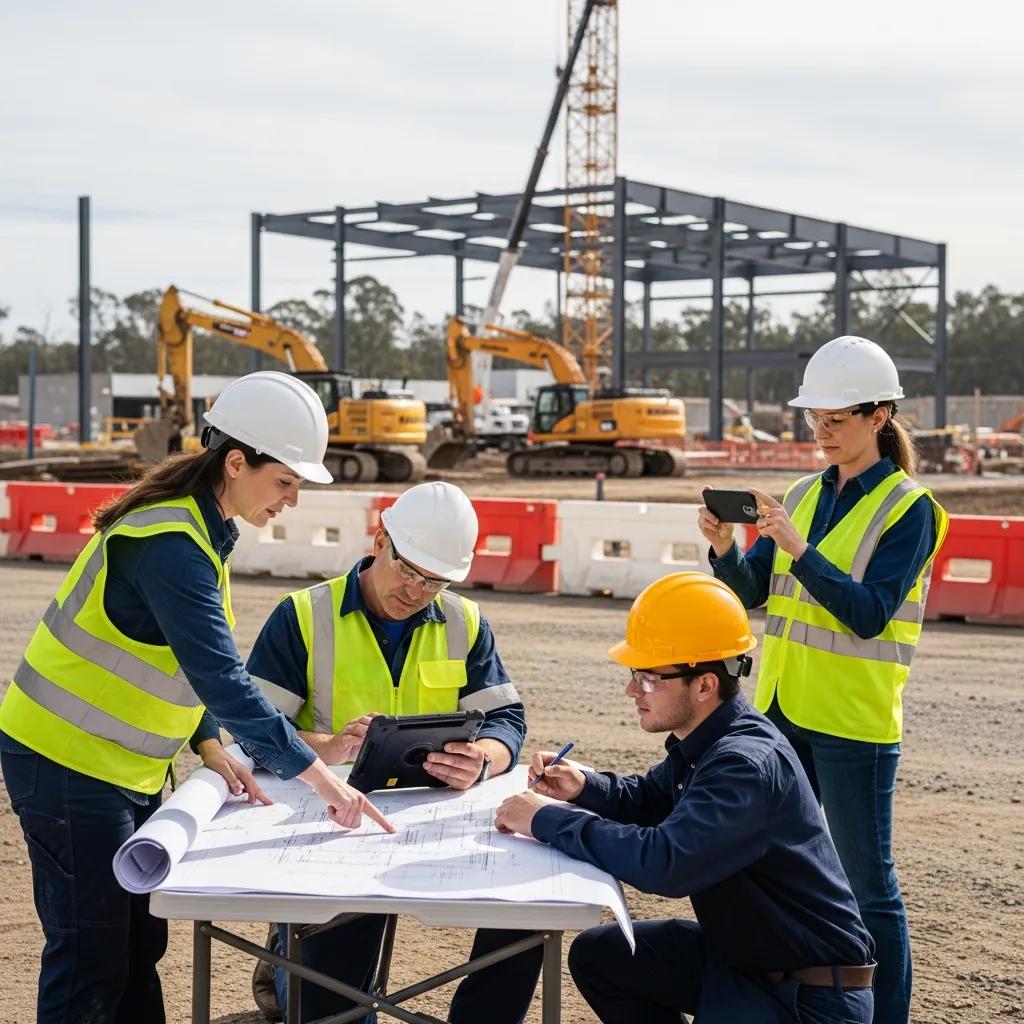
Site-specific risk assessment systematically identifies hazards tied to the unique geometry, sequencing, and equipment on a project and then ranks them to guide controls and sequencing decisions. Assessments begin with walkdown surveys and data capture—site reconnaissance, photos, and increasingly 3D scanning and point-cloud surveys—to generate accurate spatial context for every work area. Once hazards are mapped, teams assign likelihood and consequence scores to prioritize mitigations and to define time-bound controls that are incorporated into the JHA and the schedule. An accurate assessment that includes digital inputs reduces judgment calls in the field and improves the fidelity of emergency egress and temporary works planning, which will be discussed in the HAZCOM and emergency planning subsection.
This understanding of risk scoring and digital inputs naturally transitions to the hazard communication systems needed to keep field teams informed and compliant.
What Are the Key Elements of OSHA-Compliant Hazard Communication Programs?
OSHA-compliant HAZCOM relies on a written program, consistent labeling, accessible Safety Data Sheets (SDS), and documented worker training to ensure that chemical and physical hazards are known and controlled. Programs should specify responsibilities for SDS maintenance, provide digital access for contractors, and adopt GHS-aligned labeling and pictograms to reduce misinterpretation on busy sites. Digital tools streamline SDS distribution and link hazardous material locations to BIM or site mapping so crews can see where specific hazards intersect with their tasks. Training is the final control: documented, trade-specific sessions that reference the site SDS repository and practical labeling applications are essential to make HAZCOM effective.
Having covered HAZCOM, the next section will show how Virtual Design and Construction (VDC) extends these preventive controls through model-based analysis and virtual audits.
How Does Virtual Design and Construction Enhance Construction Site Safety?
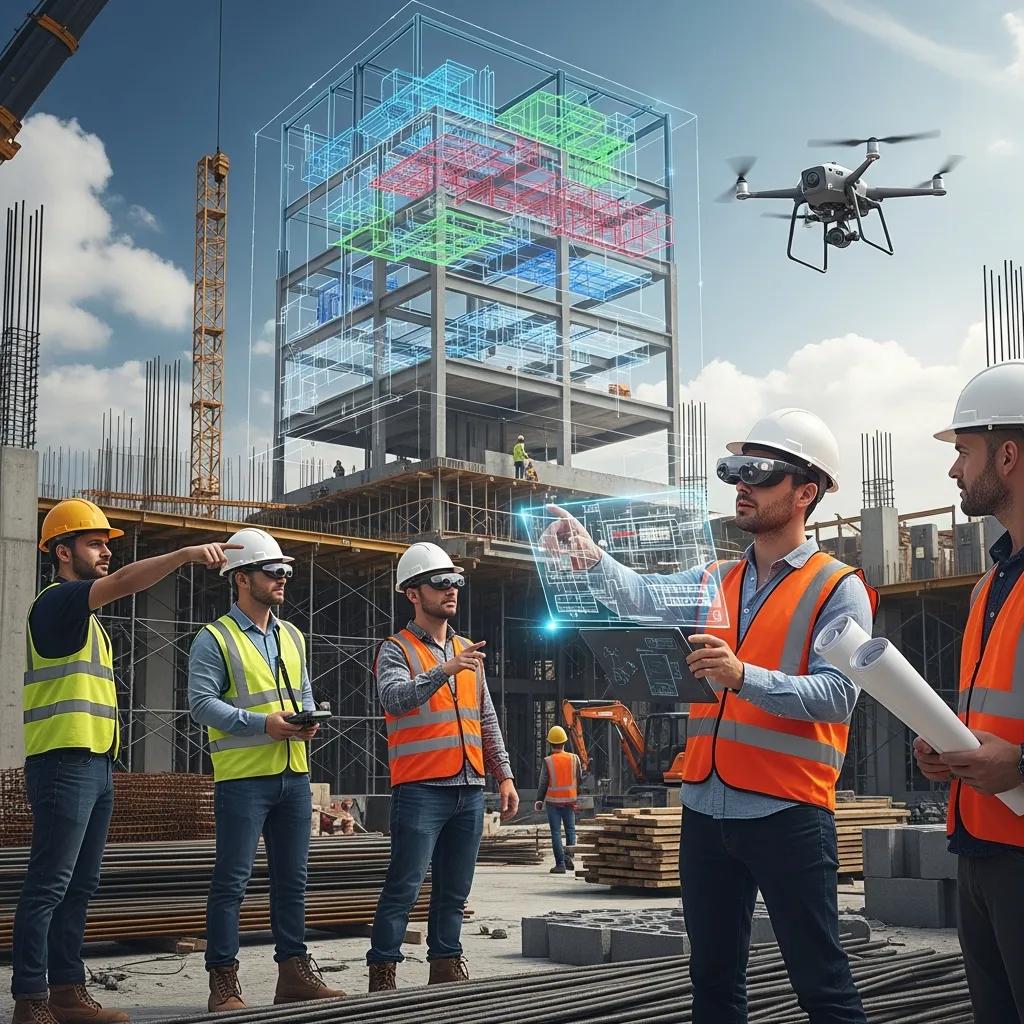
Virtual Design and Construction (VDC) is a model-driven workflow that integrates design, schedule, cost, and safety to identify and mitigate hazards before work starts, improving proactive construction safety management. VDC enables clash detection to find spatial conflicts that could create hazardous field conditions, supports virtual safety audits by exposing risky access or sequencing issues in model views, and uses 4D/5D sequencing to separate high-risk activities in time and space. These capabilities reduce the need for unsafe field rework, support safer logistics planning, and link mitigation actions to the construction schedule and cost baseline. Below is a short list of VDC safety capabilities and a table mapping specific VDC construction services and the risk types they prevent and the project stage where they are most effective.
The synergy between VDC, BIM, and laser scanning is further underscored by recent findings that emphasize their combined power in creating detailed 3D models and ensuring data quality throughout a project’s lifecycle.
VDC, BIM, and Laser Scanning for Construction Safety & Accuracy
An essential component of VDC is Building Information Modeling (BIM), which allows the creation of detailed 3D models that serve as a centralized database for the entire lifecycle of a building. This facilitates interdisciplinary collaboration and ensures data quality across all phases of the project. Additionally, modern methods such as laser scanning have become crucial in assessing and managing existing infrastructure. Laser scanning technology enables the accurate and rapid creation of detailed 3D models of structures, providing critical data for the quality assessment (QA) and structural health monitoring of b
Revolutionizing Construction: The Synergy of VDC/BIM, Laser Scanning and Dusty Robotics, 2024
- VDC improves safety through three primary mechanisms: Clash Detection: Identifies spatial conflicts that could create falls, impalement, or access restrictions. Virtual Safety Audits: Enables remote inspection of site geometry and temporary works before mobilization. 4D/5D Sequencing: Links time and cost to safety planning to prevent concurrent high-risk activities.
| VDC Feature | Risk Types Prevented | Most Effective Project Stage |
|---|---|---|
| Clash Detection | Physical collisions, access obstruction, temporary works conflicts | Design and preconstruction |
| Virtual Safety Audits | Egress blockage, sequencing errors, constructability hazards | Preconstruction and early execution |
| 4D/5D Sequencing | Concurrency risk (heavy lifts vs. trades), staging conflicts | Preconstruction and execution |
How Does VDC Enable Proactive Hazard Identification and Clash Detection?
Model aggregation and systematic clash runs bring multi-trade models into a common data environment (CDE) where automated rules highlight conflicts that represent safety risks, such as mechanical ducting through egress corridors or structural penetrations near fall-protection anchors. Clashes are triaged by risk—classification distinguishes coordination-level discrepancies from safety-critical conditions that require immediate mitigation—and assigned to responsible trades with resolution deadlines. Recordkeeping of clash resolution provides an auditable trail that field teams can reference, reducing uncertainty and last-minute workarounds. This proactive approach reduces in-field interventions and improves the safety posture when crews mobilize.
What Are the Benefits of Virtual Safety Audits and 4D/5D BIM Safety Sequencing?
Virtual safety audits use model views and point-cloud overlays to simulate access, temporary works, and egress, identifying pinch points and unsafe proximities before crews arrive on site. 4D sequencing overlays tasks on the schedule so planners can avoid overlapping high-risk activities—such as confined-space entry during heavy lifts—and can allocate isolated work windows for hazardous tasks. Linking cost (5D) and safety makes trade-offs explicit and funds mitigation measures proactively, such as temporary platforms or additional supervision. A short implementation checklist below helps teams operationalize virtual audits and sequencing.
- Virtual audit and sequencing implementation checklist: Integrate point-cloud scans into the model: Validate as-built geometry before planning. Run safety-focused clash tests: Prioritize clashes flagged as immediate safety risks. Create 4D safety sequences: Schedule isolated windows for high-risk tasks. Document mitigations in the CDE: Assign responsibilities and closure criteria.
In What Ways Does Building Information Modeling Support Safety Management?
Building Information Modeling (BIM) acts as a single source of truth that supports safety planning by embedding spatial, material, and procedural data into model views that safety managers and field teams can use to visualize hazards and plan responses. BIM facilitates creation of egress diagrams, identification of emergency staging areas, and export of model views for worker training and tabletop exercises, enabling precise orientation of crews to site conditions. By centralizing information, BIM reduces miscommunication between trades and lowers incidents caused by misaligned assumptions about access, sequencing, and temporary works. The following table summarizes BIM modeling safety applications and the specific outcomes they produce for emergency response and coordination.
| BIM Application | Safety Outcome | Typical Deliverable |
|---|---|---|
| Egress Mapping & Muster Points | Faster evacuations and clearer routes | Model overlays and annotated evacuation drawings |
| Model-Based Training Modules | Higher retention and scenario fidelity | Interactive model walkthroughs for crews |
| Coordination & Clash Resolution | Fewer field corrections and safer site conditions | Coordinated model and clash-resolution logs |
How Does BIM Facilitate Emergency Response Planning and Worker Training?
BIM enables emergency response planning by mapping egress routes, access points for emergency services, and designated muster locations directly onto model geometry, which can then be exported into clear diagrams for crews and responders. Training modules built from BIM views allow workers to rehearse evacuations and staged responses in a controlled setting, improving situational awareness and reducing response times during incidents. Exportable model data supports tabletop exercises by providing accurate spatial references that drive realistic decision-making and procedural refinement. With trained crews and validated egress plans, project teams reduce the likelihood of chaotic responses that raise injury risk.
How Does BIM Integration Improve Coordination and Reduce On-Site Accidents?
BIM integration reduces accidents by creating a common data environment where all trades work from the same coordinated model, reducing discrepancies that cause unsafe improvisation and rework. Metrics such as reduced clash counts, fewer RFIs related to constructability, and lower rework rates are measurable outcomes of integrated BIM workflows. When sequencing, material deliveries, and temporary works are planned in the model, crews face fewer surprises that can lead to unsafe corrective activities, and safety managers can proactively schedule supervision for high-risk tasks. These coordination improvements link directly to measurable reductions in incident rates and improved compliance across trades.
How Does Precision Layout Technology Improve Fall Prevention and Site Safety?
Precision layout technology minimizes spatial tolerances and misalignments that can create hazardous conditions, particularly for fall protection systems, anchor bolt placement, and temporary access. Automated stakeout using robotic total stations transfers coordinates from the design model to the field with millimeter-level accuracy, reducing cumulative errors that generate unsafe temporary workarounds. Accurate layout reduces rework, limits unsafe corrective activities, and ensures that fall protection anchors, guardrails, and openings are located exactly where their design assumptions place them. The table below compares layout technologies on accuracy metrics and safety outcomes to guide selection of verification workflows.
| Layout Technology | Typical Accuracy | Safety Outcome |
|---|---|---|
| Robotic Total Station Layout | Millimeter to centimeter precision | Accurate anchor placement; fewer field adjustments |
| Manual Layout (tape and transit) | Several centimeters to decimeter variance | Increased risk of misalignment and corrective work |
| Laser Scanning / 3D Scanning | Sub-centimeter as-built verification | Rapid validation of installed components and temporary works |
What Role Does Robotic Total Station Layout Play in Accurate Fall Protection Systems?
Robotic total station layout automates stakeout by reading model coordinates and guiding field crews to exact placement locations for anchors, rails, and guard systems, which reduces tolerance drift and human layout error. Typical workflows involve exporting layout points from BIM, performing a survey control setup, and using the robotic instrument to confirm placement and record coordinates for verification. This precise transfer reduces the need for temporary, improvised fall protection solutions and lowers exposure during late-stage adjustments. Robotic layout data also creates an auditable verification record that links layout points to safety-critical components on the model, which will be useful for structural verification described next.
How Does Accurate Anchor Bolt Verification Contribute to Structural Safety?
Accurate anchor bolt verification combines field measurement—using total stations or as-built laser scanning—with documentation that certifies bolt positions relative to design tolerances, preventing misfits that require forceful corrections or temporary shimming. Verification workflows typically include initial stakeout, post-install scan, tolerance check against design coordinates, and a signed verification report for compliance records. Proper verification prevents structural alignment failures, reduces unscheduled corrective lifts, and eliminates unsafe working-at-height activities associated with rework. Maintaining these verification records improves traceability and reduces ambiguity when structural or safety questions arise during inspection or handover.
What Are the Best Practices for Safety Training and Simulation in Construction?
Modern safety training mixes immersive technologies with hands-on drills and model-based exercises to improve hazard recognition, procedural compliance, and decision-making under pressure. Best practices include integrating VR/AR for immersive hazard recognition scenarios, using digital twins for scenario simulation and live monitoring, and combining model-based training with practical, supervised drills on site to reinforce muscle memory. Training curricula should include measurable learning objectives, short focused sessions to maximize retention, and defined metrics to evaluate effectiveness such as recognition error rates and near-miss reductions. Below is a short list of best practices followed by an implementation example to guide planners.
- Best practices for training and simulation: Use Immersive VR/AR: Simulate high-risk scenarios safely and repeatedly. Leverage Digital Twins: Run live monitoring and scenario stress tests on a virtual model. Combine with Hands-On Drills: Reinforce model learning with supervised physical practice. Measure Effectiveness: Track recognition improvement, error rates, and behavior change.
How Can Virtual Reality and Augmented Reality Enhance Hazard Recognition Training?
VR and AR create repeatable, low-risk environments where workers can experience complex hazards—such as working at height near variable openings or coordinating lifts in congested zones—without exposure. VR offers full-immersion scenario rehearsal that builds situational awareness and response patterns, while AR overlays model information on the real site for contextual training during walkthroughs. Typical session lengths of 20–40 minutes with pre- and post-tests maximize retention and allow trainers to track recognition improvement via performance metrics. By quantifying gains, teams can prioritize additional coaching and adapt content to reduce on-site errors and complacency.
What Is the Role of Digital Twins in Real-Time Safety Monitoring?
Digital twins combine model geometry with live IoT and sensor feeds to provide a near-real-time operational representation of the site that supports incident detection and rapid response. Typical integrations include worker location tracking, environmental sensors for toxic atmospheres, and equipment telemetry that feed dashboards and alerting rules in the twin. When thresholds are breached—such as unauthorized presence in a confined area—the twin can trigger alarms, visualize the incident location, and provide routing for responders. Digital twins also support what-if scenario planning to test mitigations and improve response playbooks, closing the loop between monitoring and preparedness.
Further emphasizing the critical role of digital twins, recent research highlights their capacity for comprehensive and real-time safety monitoring and alerts.
Digital Twin for Construction Safety Risk Management & Monitoring
Applications of digital twin technology’s application in construction safety risk management: real-time monitoring and early warning, safety monitoring and alerts. This provides comprehensive and real-time safety monitoring and alerts.
Applications of digital twin technology in construction safety risk management: a literature review, 2025
Beyond general monitoring, digital twin technology is also being developed to enhance safety specifically in environments involving worker-robot collaboration on construction sites.
Digital Twin Safety Monitoring for Construction Worker-Robot Collaboration
This paper presents a digital twin-enabled safety monitoring system for seamless WRC on construction sites, addressing the need for improved safety monitoring methods in the construction industry.
Digital twin-enabled safety monitoring system for seamless worker-robot collaboration in construction, X Lin, 2025
How Can Construction Firms Develop and Maintain a Strong Safety Culture?
A strong safety culture begins with leadership commitment, visible enforcement of procedures, and systems that reward safe behavior while learning from incidents and near-misses. Practical strategies include setting governance that allocates resources for safety technology and training, implementing regular audits with digital reporting workflows, and maintaining open channels for near-miss reporting and continuous learning. Integrating safety protocols across trades — through shared models, pre-task planning, and contractual safety deliverables — aligns expectations and reduces the gaps that produce unsafe conditions. The checklist and strategies below provide actionable steps to embed safety into everyday operations and lead naturally to the mechanisms for ongoing audits and reporting.
- Core strategies to build safety culture: Leadership Commitment: Visible support and resourcing for safety programs. Regular Audit & Feedback Loops: Scheduled audits with follow-up corrective actions. Cross-Trade Integration: Shared models and pre-task planning to align safety expectations. Transparent Reporting: Near-miss systems and learning-focused investigations.
What Are Effective Strategies for Continuous Safety Audits and Incident Reporting?
Effective audit strategies match cadence to project risk: monthly focused audits for high-risk activities and quarterly comprehensive reviews for stable workstreams, with digital checklists and photo evidence to speed corrective action. Near-miss reporting should be simple and non-punitive, capturing context, contributing factors, and suggested controls, then feeding a data-driven review cycle that identifies systemic issues. Metrics to monitor include near-miss frequency, incident rate, time-to-closure for corrective actions, and audit compliance rates, which jointly indicate program health. These audit and reporting systems prepare the organization to integrate safety protocols across trades, which the following subsection explains.
How Does Integrating Safety Protocols Across Trades Improve Compliance and Communication?
Integrating safety protocols across trades reduces gaps by providing a common data environment where all stakeholders access the same model, safety registers, and sequencing plans, which minimizes misaligned assumptions that lead to unsafe fixes. Practices like pre-task coordination meetings, model-sharing protocols, and contractual safety deliverables create clear expectations and assign accountability for safety-critical tasks. Toolbox talks tied to model views and localized hazard overlays ensure that every trade sees the specific risks for their scope, and shared documentation enables collective ownership of mitigations. By aligning technologies, processes, and contractual terms, firms close the communication loop that often causes preventable incidents.
Conway Coordination and Layout Services (CCLS) is a family-owned and operated lead-generation business that offers specialized digital construction services aligned to the safety practices described above, including Robotic Total Station Layout, VDC Construction Services, VDC Consulting Services, 3D Scanning, 3D Point Cloud Rendering and Model Integration, and BIM Modeling and Coordination. CCLS emphasizes precision and accuracy—using Trimble Robotic Total Station technology and advanced modeling—to support proactive risk mitigation through clash detection, hazard identification, and a single source of truth for coordination. A brief summary list below shows where those services map to the safety-plan components discussed earlier.
How CCLS services align with safety plan components:
- Robotic Total Station Layout: Supports precise anchor and guardrail placement to reduce fall risks.
- VDC Consulting & BIM Modeling: Enables clash detection, 4D sequencing, and virtual audits for proactive hazard mitigation.
- 3D Scanning & Point Clouds: Provides accurate as-built context for risk assessment and verification.
For project teams ready to convert these practices into a site-specific safety protocol, consider requesting a consultation with Conway Coordination and Layout Services to scope verification workflows, model-integration requirements, and layout tolerances that tie to your safety objectives.