
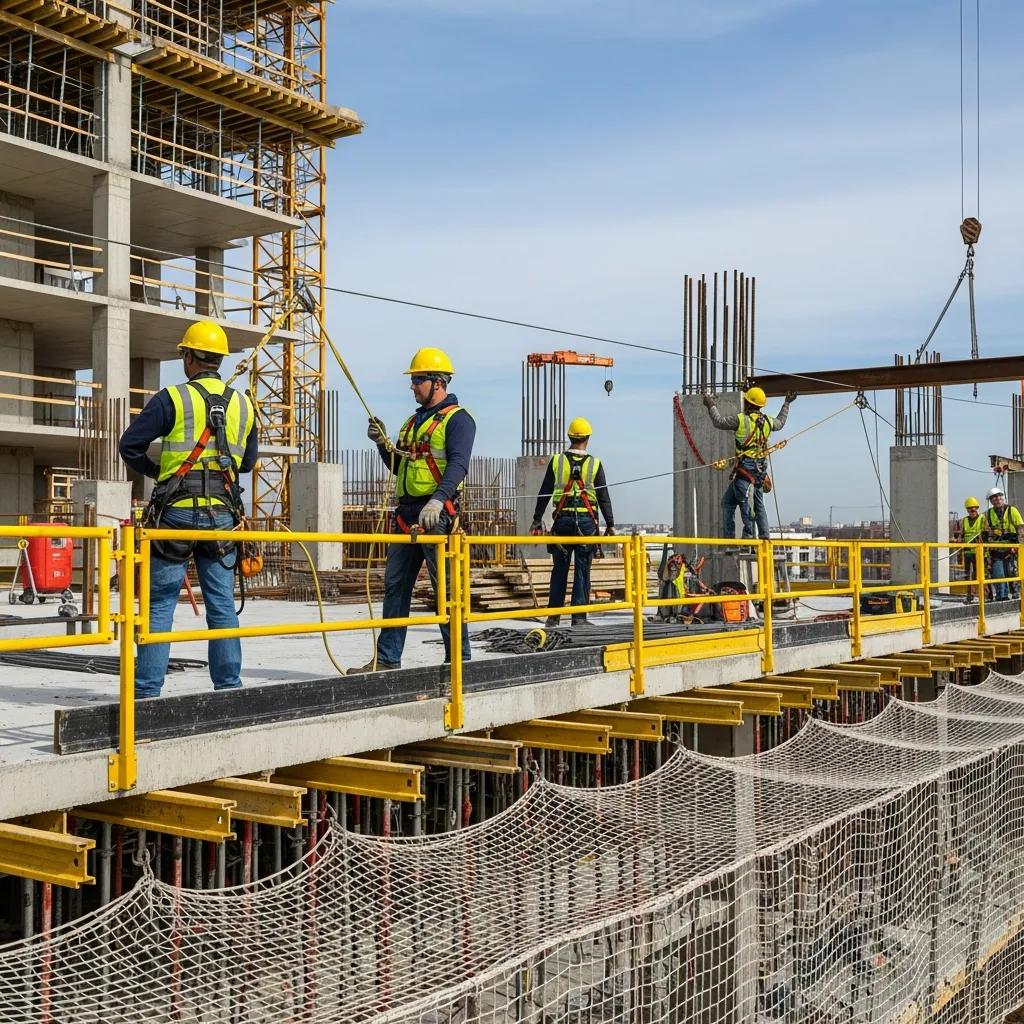
Implementing Advanced Fall Protection Systems in Construction: Precision Planning and Compliance for Safety
Advanced fall protection systems combine engineered hardware, planning workflows, and verification technologies to reduce risk of falls and ensure regulatory compliance on construction sites. Precision planning—rooted in VDC and BIM workflows—aligns fall protection design with structural layouts and site logistics, producing clearer installation instructions and measurable verification artifacts. Projects benefit from this approach through fewer field changes, better inspection readiness, and demonstrable adherence to OSHA fall protection requirements. This article explains the regulatory baseline, provides a step-by-step methodology for developing a comprehensive fall protection plan, and details component-level layout guidance for personal fall arrest systems. It then explores edge protection strategies, the role of advanced technologies such as 3D scanning and Robotic Total Station layout, and the consulting services that help teams translate models into field-ready safety systems. Throughout, readers will find practical lists, comparison tables, and verification workflows to support implementation of fall protection construction solutions on mid-to-large projects.
What Are the OSHA Fall Protection Requirements for Construction Sites?
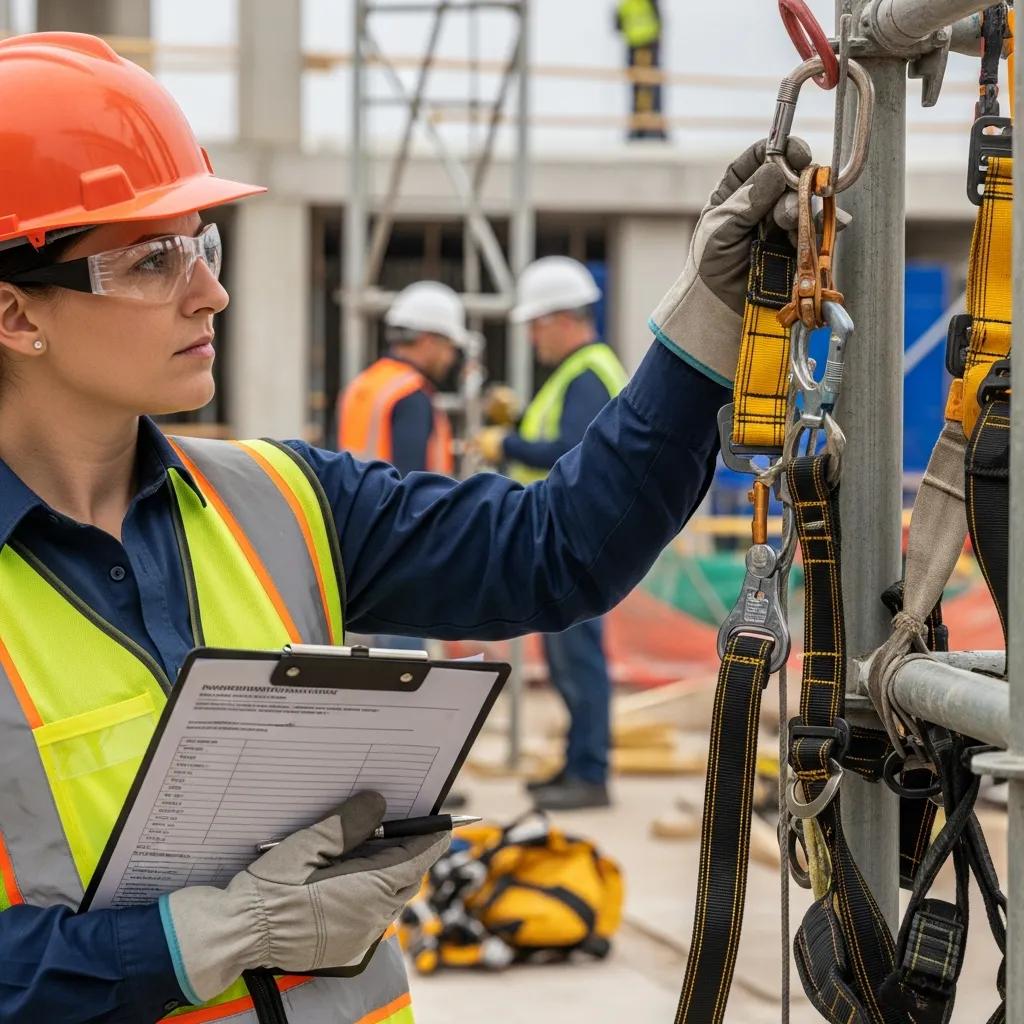
OSHA fall protection requirements set minimum thresholds and performance standards that determine when and how employers must provide fall protection on construction sites. The rules specify fall protection triggers, acceptable systems, and employer responsibilities for planning, training, and documentation, establishing a compliance framework that directly informs system selection and layout tolerances. Understanding these standards early ensures that anchor point specifications, guardrail layouts, and PFAS designs meet required load ratings and inspection criteria. The following bullets summarize the core regulatory requirements that drive plan development and field verification.
- Employers must provide fall protection at elevations where work exposes employees to falls of 6 feet or more above a lower level, as defined in OSHA construction rules.
- Acceptable fall protection includes personal fall arrest systems, guardrails, safety nets, and other systems meeting prescribed performance criteria.
- Employers are responsible for training, maintaining inspection records, and ensuring systems are installed and inspected by competent persons.
These high-level requirements translate into concrete project actions such as specifying anchor-point load capacities, recording inspection logs, and integrating model-based verification into submittals, which is the next area we examine in practical planning terms.
Which OSHA Standards Govern Fall Protection in Construction?
OSHA standards governing construction fall protection provide the specific citations and practical implications project teams must follow. Key references include the primary construction fall protection provisions in 29 CFR 1926 Subpart M and the detailed performance criteria for systems, which together define when systems are required and how they must perform. Practically, these standards require employers to identify competent persons, retain documentation of inspections, and ensure that anchors and components meet rated strengths. Project teams should treat these citations as binding design constraints that inform anchor spacing, orientation, and permissible clearance distances for PFAS systems.
Project teams typically convert regulatory citations into design tolerances and checklist items that become part of the fall protection plan and the BIM model notes. Translating code language into model parameters—such as required anchor strength and minimum guardrail heights—ensures that coordination between design, layout, and installation reduces the risk of noncompliance during inspection.
How Do OSHA Requirements Impact Fall Protection Planning?
OSHA requirements shape fall protection planning by establishing design thresholds and documentation obligations that a fall protection plan must meet. These rules inform every stage of the plan—from hazard assessment and system selection to installation verification and training—by setting measurable criteria for anchor design, inspection intervals, and rescue readiness. For example, anchor points must meet strength ratings and orientation requirements that the layout team must verify in the field and document for auditors. A short checklist below converts these regulatory obligations into immediate planning actions.
- Identify competent persons and responsible parties for inspections and approvals.
- Specify anchor capacities, guardrail heights, and PFAS clearance distances in model deliverables.
- Maintain inspection records, training certifications, and as-built verification artifacts.
Turning these obligations into model-based deliverables and site verification checkpoints reduces ambiguity during installation and supports audit-ready compliance evidence, which we will address next in the context of developing a comprehensive fall protection plan.
How to Develop a Comprehensive Fall Protection Plan for Construction Projects?

A comprehensive fall protection plan translates regulatory requirements and site-specific hazards into a coordinated sequence of design, procurement, layout, installation, and verification actions. The plan begins with a hazard assessment and proceeds through system selection, location-specific layout tolerances, model-based simulations, installation sequencing, inspection protocols, and training deliverables. Each element needs an identified responsible party and a clear verification method—often combining BIM deliverables, as-built scans, and precision layout reports.
Below is a succinct step list designed for quick operational adoption. The following numbered steps present a high-level methodology for producing a complete fall protection plan:
- Conduct a site hazard assessment to map fall exposure and identify critical edges.
- Select appropriate protection systems (guardrails, PFAS, nets) based on task risk.
- Specify anchor designs and load criteria in the project model and design documents.
- Integrate fall protection elements into BIM/VDC for clash detection and sequencing.
- Produce procurement and installation schedules aligned with trade work and logistics.
- Verify installation with layout reports, 3D scans, and competent-person inspections.
- Train personnel on system use, inspection workflows, and rescue procedures.
- Maintain documentation and inspection logs for audit and continuous improvement.
These steps form the backbone of a fall protection plan and map directly to deliverables that can be assigned, reviewed, and validated through model-based coordination. The next table maps plan elements to responsible parties and verification methods, providing a practical EAV reference for project teams.
Different plan elements require clear ownership and verification to ensure traceable compliance and field-ready installation.
| Plan Element | Responsible Party | Deliverable / Verification Method |
|---|---|---|
| Hazard Assessment | Safety Lead / VDC Coordinator | Site hazard map and exposure report validated in BIM model |
| System Design | Design Engineer | Design drawings and anchor specifications with load calculations |
| Layout & Installation | Layout Contractor / Installer | Robotic Total Station layout reports and installation checklists |
| Inspection & QA | Competent Person / Safety Officer | Inspection logs and as-built 3D scan comparison |
| Training & Rescue | Safety Manager | Training records and rescue procedure documentation |
This mapping clarifies the chain of responsibility and recommended verification artifacts, which supports both field execution and regulatory inspection readiness. With these roles defined, teams can integrate precision layout and verification technologies as the next practical step.
(Integration note: Conway Coordination and Layout Services (CCLS) provides VDC Consulting Services and BIM Modeling and Coordination that teams can use to develop, simulate, and validate fall protection plans. CCLS couples model-based coordination with precision layout to reduce risk, streamline installation, and produce the verification artifacts required for inspections. Contact Nathan Conway at Conway Coordination and Layout Services (CCLS) to discuss VDC consulting and BIM modeling capabilities for fall protection planning.)
What Are the Components and Layout Considerations for Personal Fall Arrest Systems?
A personal fall arrest system (PFAS) is a collection of components designed to safely stop a worker’s fall and minimize injury by controlling forces and clearance. Core PFAS elements include an appropriately rated anchor point, a compatible full-body harness, a shock-absorbing connecting device, and often a means of limitation or rescue.
Proper layout ensures anchors are sited to control swing fall, meet clearance requirements, and provide usable attachment for the work tasks at hand. Below is a direct component list followed by a quick-reference table for anchor point selection.
- Anchor Points: Structural anchors rated for the required loads and oriented to minimize swing fall.
- Full-Body Harness: Properly sized harnesses that distribute arrest forces and allow worker mobility.
- Connecting Devices: Shock-absorbing lanyards or self-retracting lifelines that limit deceleration forces.
- Rescue Provisions: Plans and equipment for prompt worker retrieval after an arrest.
Understanding anchor characteristics and layout tolerances is vital; the table below compares common anchor types and recommended attributes for layout decision-making.
| Anchor Type | Required Strength | Typical Location / Specification |
|---|---|---|
| Structural Beam Anchor | 5,000 lbf single-person rated or equivalent system capacity | Installed on steel members with orientation minimizing swing fall |
| Concrete Insert Anchor | 5,000 lbf with approved embedment depth and pattern | Placed near edge and verified with pull-test or engineering statement |
| Engineered Roof Anchor | Design-based load rating per project calculations | Located per roof layout to provide edge coverage and access points |
This table helps project teams choose anchors by matching location, strength, and verification needs. Properly selected anchors reduce field rework and support inspection readiness.
What Are the Core Components of PFAS?
Core PFAS components each perform a defined role: anchors provide attachment, harnesses distribute forces, connecting devices control deceleration, and energy absorbers mitigate peak loads. Anchor design must consider static and dynamic loads with documented capacity and orientation to control swing and clearance. Harness selection should consider worker anthropometrics and suspension trauma mitigation, while connecting devices must be compatible with the anchor and harness ratings. Regular inspection intervals and documentation for each component complete the system and ensure ongoing compliance.
A practical inspection and selection workflow requires documenting component serials, inspection dates, and test results in the project safety log to support traceability during audits and to inform replacement cycles. This leads directly into how precision layout supports accurate anchor placement and reduces installation errors.
How Does Precision Layout Ensure Effective PFAS Installation?
Precision layout ensures that anchor points, guardrails, and lifeline terminations are positioned to within project tolerances, minimizing swing fall exposure and ensuring required clearances for PFAS performance. Technologies such as Robotic Total Station layout and control-point networks allow installers to place anchors exactly where the BIM model intends, reducing on-site interpretation errors. As-built 3D scans then verify anchor locations against the model, creating inspection-ready documentation and reducing RFIs and rework. Case examples show that layout-driven workflows cut field adjustments and shorten inspection cycles, improving schedule certainty.
Using a closed-loop workflow—model → layout → installation → scan verification—provides measurable accuracy metrics and a clear audit trail when demonstrating compliance. This precision-driven approach is especially valuable in complex projects where anchor location tolerances are tight and several trades intersect at edges.
How Do Edge Protection and Guardrail Systems Enhance Construction Site Safety?
Edge protection and guardrail systems provide passive means to prevent falls by creating physical barriers at rooflines, floor edges, and openings, reducing reliance on active personal fall arrest measures. Effective edge protection combines appropriate system selection, correct layout relative to edges and penetrations, and sequencing so trade access is maintained while safety is preserved. Selection factors include expected pedestrian loads, temporary vs. permanent needs, roof slope, and integration with other trades. The next list outlines common system types and primary use-cases to guide selection.
- Temporary Guardrails: Used during framing and floor construction to provide immediate edge protection.
- Modular Guardrail Systems: Prefabricated systems offering rapid installation and adaptability for phased work.
- Permanent Edge Systems: Installed as part of final building envelope to meet long-term facility requirements.
- Combination Systems: Hybrid approaches combining guardrails with PFAS for work areas requiring both access and fall arrest redundancy.
Choosing the right system requires balancing installation speed, durability, and interaction with other construction activities. The subsequent subsection explains typical guardrail types and their pros and cons in common construction contexts.
What Types of Edge Protection Systems Are Used on Construction Sites?
Edge protection systems vary by permanence and modularity—temporary guardrails, modular prefabricated systems, and permanent edge installations each have trade-offs in speed, durability, and load capacity. Temporary systems are fast to install but may require replacement or reinforcement for heavy loads, while permanent systems deliver long-term performance at increased initial cost. Modular systems offer a middle ground with predictable performance and reuse across projects. Each system should be evaluated for integration with opening covers, toeboards, and access points to ensure continuous protection.
Selecting an edge protection solution also requires coordination with sequencing so guardrails do not impede material delivery or trade access; model-based simulations can help map these interactions and reduce field conflicts, which we will cover next.
How Does VDC Facilitate Integration of Edge Protection Systems?
VDC enables early placement of guardrails and edge protection elements in the model, allowing for clash detection, sequence simulation, and logistics planning prior to field installation. Model-based workflows produce installation sequences, material takeoffs, and visual verification snapshots that support safety planning and reduce last-minute field changes. Using VDC deliverables helps teams optimize guardrail locations relative to penetrations, mechanical openings, and staging, ensuring protection is continuous and effective. Deliverables such as clash reports and sequence animations become part of inspection-ready documentation and inform installation checklists.
Model-driven coordination ensures that edge protection systems are installed in the correct order relative to structural and envelope work, reducing rework and enabling safer site access throughout construction phases.
How Do Advanced Technologies Improve Fall Protection System Implementation?
Advanced technologies—VDC, BIM, 3D scanning, and Robotic Total Station layout—improve fall protection by enabling precise design validation, accurate field positioning, and inspection-grade documentation. VDC and BIM identify hazards early through simulation and clash detection, 3D scanning produces as-built point clouds for verification, and Robotic Total Station layout converts model coordinates into precise field marks for anchor installation. Combining these technologies reduces ambiguity between design and field execution, shortens verification cycles, and generates audit-ready deliverables that demonstrate compliance. The table below compares typical technologies, their primary uses, and expected deliverables to guide selection.
| Technology | Primary Use | Benefit / Typical Deliverable |
|---|---|---|
| VDC / BIM | Model-based simulation and coordination | Clash reports, sequence visualizations, coordinated model deliverables |
| 3D Scanning | As-built capture and verification | Point clouds, deviation reports, as-built models for inspection |
| Robotic Total Station | Precision layout and control-point establishment | Layout reports, stake coordinates, millimeter-level positioning |
| Digital Twin Integration | Ongoing lifecycle verification | Synchronized model and field data for maintenance and audits |
Understanding the complementary roles of these technologies allows teams to assemble workflows that deliver measurable accuracy and compliance evidence. The following subsections detail how VDC identifies hazards and how scanning and layout technologies verify installations.
How Does Virtual Design and Construction Enhance Fall Hazard Identification?
Virtual Design and Construction (VDC) enhances fall hazard identification by allowing teams to simulate work sequences, map exposures, and produce hazard heatmaps before field mobilization. By embedding fall protection elements into the BIM model, VDC workflows enable automated clash detection between safety components and building systems, highlight high-risk access points, and generate documentation for planning sessions. Outputs such as animated installation sequences and coordinated shop drawings make safety requirements explicit to trades. These prebuilt verifications reduce surprises in the field, accelerating approvals and improving coordination between safety, layout, and installation teams.
Using VDC to operationalize safety also provides an auditable record of design intent that inspectors and owners can review, improving stakeholder confidence and reducing the likelihood of regulatory findings.
What Is the Role of 3D Scanning and Robotic Total Station in Safety System Verification?
3D scanning captures as-built conditions rapidly and produces point-cloud deliverables that can be compared directly to the BIM model to verify anchor placement, guardrail alignment, and clearance distances. Robotic Total Station layout translates model coordinates into precise field marks that installers use to place anchors to tolerance. Together, these technologies create a verification loop: layout to install, scan to verify, and model update to record as-built conditions. Typical deliverables include deviation reports showing positional accuracy, layout reports documenting control points, and annotated point-cloud overlays for inspectors. These outputs materially reduce inspection failures and provide defensible documentation of compliance.
Integrating these verification steps into the installation workflow gives owners and safety teams confidence that components meet both design intent and regulatory requirements. The table above illustrates the complementary accuracy and deliverables of each technology.
(Integration note: Conway Coordination and Layout Services (CCLS) leverages Robotic Total Station technology alongside BIM Modeling and 3D scanning to verify anchor point placement and system installations. CCLS’s approach emphasizes precision and accuracy to reduce rework and support audit-ready documentation; for project-level discussions, contact Nathan Conway at Conway Coordination and Layout Services.)
What Fall Protection Consulting Services Support Construction Safety and Compliance?
Fall protection consulting services help translate regulatory requirements and model-based plans into executable field activities by offering system design review, coordination with trades, installation oversight, training, and verification. Consultants provide deliverables such as design review memos, coordinated BIM models with safety annotations, installation checklists, and inspection-ready as-built scans. Integrating consulting with VDC and BIM services ensures early hazard detection, fewer field changes, and a documented compliance trail for inspections. Below is a list of typical consulting deliverables project teams should request.
- Design Review Reports: Evaluations of anchor designs, guardrail layouts, and system selection.
- Coordinated Model Packages: BIM deliverables with safety elements modeled and clash detection resolved.
- Installation Oversight: On-site competent-person inspections and verification of layout vs. model.
- Training and Rescue Planning: Worker training sessions and documented rescue procedures.
These services are designed to reduce delays, resolve RFIs before field work, and create documentation that supports regulatory audits. The next subsection explains the consultant’s role across project phases.
How Does Expert Consulting Assist in Fall Protection System Design and Coordination?
Expert consultants assist from preconstruction through commissioning by conducting risk assessments, providing design input for anchors and guardrails, coordinating with trades to avoid conflicts, and overseeing installation verification. Consultants often produce measurable success metrics—reduced RFIs, fewer inspection findings, and improved installation cycle times—by integrating safety checks into the coordination process. Deliverables typically include review memos, revised model elements, inspection logs, and as-built verification documentation. This hands-on advisory role ensures that safety systems are not an afterthought but embedded into project sequencing and quality control.
Embedding consulting activities early in the schedule also enables procurement alignment and ensures that specified components are available when installers require them, reducing schedule risk and supporting safer, more efficient site work.
What Are the Benefits of Integrating Safety Consulting with VDC and BIM Services?
Integrating safety consulting with VDC and BIM services delivers tangible benefits: earlier hazard detection, reduced field changes, improved audit readiness, and greater installation efficiency. Model-based coordination yields documented resolutions for clashes and produces clear installation sequences that installers can follow, while consulting oversight enforces quality through inspection and verification protocols. This integrated approach produces a documented compliance trail—model deliverables, layout reports, and scan verification—that supports regulatory inspections and owner acceptance. Project teams adopting this integrated method typically observe fewer schedule disruptions and clearer accountability across stakeholders.
Conway Coordination and Layout Services (CCLS) specializes in combining VDC Consulting Services, BIM Modeling and Coordination, and precision Robotic Total Station layout to help project teams implement fall protection systems with measurable accuracy and documented verification. For organizations seeking to reduce risk, streamline installation, and produce audit-ready verification artifacts, contacting Nathan Conway at Conway Coordination and Layout Services can connect teams with model-based consulting and layout expertise.